

Get a Free Ebook

Five Inspirational Truths for Authors

Try our Video Classes

Downloadable in-depth learning, with pdf slides

Find out more about My Book Therapy

We want to help you up your writing game. If you are stuck, or just want a boost, please check us out!

Showing posts with label rejection. Show all posts

Sunday, December 11, 2016

Rejection Isn't The End

by Patricia Bradley

I met a writer once who kept every rejection letter she ever received. Over 10,000 letters. I was thinking about her the other day, and not just her, but all the writers out there who keep writing through rejections.

If you are breathing…or writing (they’re the same thing, right?), you’ve experienced rejection at some point in your life. And have not only been rejected, but if you’re a published author, you’ve received a bad review. Or two. So, what do you do when that happens? How do you keep on writing?

“It is not the critic who counts; not the man who points out how the strong man stumbles, or where the doer of deeds could have done them better. The credit belongs to the man who is actually in the arena, whose face is marred by dust and sweat and blood; who strives valiantly; who errs, who comes short again and again, because there is no effort without error and shortcoming; but who does actually strive to do the deeds; who knows great enthusiasms, the great devotions; who spends himself in a worthy cause; who at the best knows in the end the triumph of high achievement, and who at the worst, if he fails, at least fails while daring greatly, so that his place shall never be with those cold and timid souls who neither know victory nor defeat.”  ~President Theodore Roosevelt

I love the quote from Theodore Roosevelt. The person in the arena. You.

Rejection can paralyze a writer, whether it’s from an editor or a reader. How long depends on the writer. So, again, how do you pick yourself up and stare at that blank page after rejection? Like in writing, there’s no right or wrong answer—what works for one writer, doesn’t work for another, but I’d like to make a suggestion or two.

First, allow yourself to feel bad (actually wallow in your pity) for a day…maybe two days if you need to. It’s important to allow yourself to feel disappointment about a rejection. If you try to deny you’re disappointed, it will take longer to get past it.

Once the day (or two) passes, look for the silver lining in the rejection. And there usually is one. If you’ve entered a contest but didn't win, look at what the judges said and evaluate their comments. You probably won’t agree with them…at first, but at least look at the comments objectively. See if there is any validity in them. The same thing with a rejection from an editor or agent. If you receive suggestions that will make your manuscript a fit for them, are you willing to do the rewrites?

Always remember that not everyone will like what you write or how you write. If you understand that from the get-go, it will make rejection much easier. The important thing is to get back in front of the computer and start writing again. Be that person in the arena. Channel that pain into your heroine. Open that vein and bleed all over your paper.

Oh, and that writer who collected all those rejections? Her name was Christie Craig, and she kept writing, and eventually landed an agent who sent her manuscripts out — six by now. One day the agent called and asked if she was sitting down. Christie asked the agent if she’d sold a book, and the agent replied no, and her heart sank.

She hadn’t sold a book, she’d sold four! Read more about Christie Craig here.

So, if when you get a rejection, accept it, try to learn from it, and then get back to what you were created to do—go write!

TWEETABLES


Bio:
Patricia Bradley lives in North Mississippi with her rescue kitty Suzy and loves to write suspense with a twist of romance. Her books include the Logan Point series and two Harlequin Heartwarming romances. Justice Delayed, a Memphis Cold Case Novel, is the first book in her next series and it releases January 31, 2017. When she has time, she likes to throw mud on a wheel and see what happens.

It's been eighteen years since TV crime reporter Andi Hollister's sister was murdered. The confessed killer is behind bars, and the execution date is looming. But when a letter surfaces stating that the condemned killer didn't actually do it, Detective Will Kincaide of the Memphis Cold Case Unit will stop at nothing to help Andi get to the bottom of it. After all, this case is personal: the person who confessed to the crime is Will's cousin. They have less than a week to find the real killer before the wrong person is executed. But much can be accomplished in that week--including uncovering police corruption, running for your life, and falling in love.

With the perfect mixture of intrigue and nail-biting suspense, award-winning author Patricia Bradley invites her readers to crack the case--if they can--alongside the best Memphis has to offer.

Saturday, March 12, 2016

Writing Lessons

By day, Liz Johnson works as a marketing manager, and she makes time to write late at night. Liz is the author of nine novels—including her latest, The Red Door Inn (Prince Edward Island Dreams, book 1)—and a New York Times bestselling novella. She makes her home in Nashville, where she enjoys exploring local music, theater, and making frequent trips to Arizona to dote on her nieces and nephews. She writes stories of true love filled with heart, humor, and happily ever afters. Connect with her at www.LizJohnsonBooks.com or www.Facebook.com/LizJohnsonBooks.

Writing Lessons

I was standing in line for coffee (well, in line with others in line for coffee—I prefer the near milkshake version) at a writers conference several years ago. The woman behind me was also alone and also wearing a nametag identifying her as part of the same conference. Feeling a little more extroverted than usual, I asked, "What do you write?"

I expected a quippy response—the kind of single-line identifier writers spend years perfecting. What I got instead was a tirade on the ills of Christian publishing and the narrow-mindedness of some editors not interested in books about missionaries in Africa.

After five full minutes, she harrumphed. "I just don't understand why God would call me to write this book, when no one seems to be interested."

I thought that probably translated into, "I had a couple painful editor appointments,” but I didn't say as much. Instead I gently—I hope I was gentle, anyway—suggested that perhaps God had called her to write the book so He could teach her something new.

To which she snapped, "I've already learned the lessons I wrote about in my book."

Thank goodness it was then my turn to order. Double that whip cream, please.

I wonder about that exchange every now and then. It was years ago, and I probably wouldn't recognize the woman again if she introduced herself. But I think about what I really meant to say, and if I'm listening to my own advice. You see, I think God uses the very process of writing and editing and pitching books to teach us amazing things. Even on the surface level, I've learned some incredible lessons, like perseverance pays off, flexibility is important, and big computer screens can hide bad hair days.

But there’s more to this whole putting thoughts to paper thing. Here are three lessons God has taught me through the course of writing my books.

1. My worth isn't in sales or how many books have my name on the cover.
Who I am is not how many people recognize me on the street (none, by the way) or what conference I'm asked (or not asked) to speak at. Doing the hard work of writing a book isn't about making a name for myself or being told I'm a wonderful writer (although that's nice to hear every now and then). Because in the darkness (I write best at night) it's just me and my computer and God. That time alone is 95% of my writing life. And in that time, when the enemy whispers lies into my ear (like I’ll never amount to anything or I’m not worthy), I cling to the reminder that my worth is wrapped up in one thing. I am a child of God. And I do what I do because it's the call He's given me. I’m called to use my talents and not bury them in the ground. The process of writing reminds me whose I am and whose voice I heed.

2. God's good gifts don't always come in the form of five-star reviews.
Matthew 7 talks about how God is a good Father, who wants to give His children good gifts. It’s easy to think that those gifts always come wrapped in red ribbons and blazing with stars. But sometimes the sweetest gifts come in a spurt of writing or an unexpected inspiration. My favorite of his gifts are epiphanies that fill in gaping plot holes I couldn’t fill on my own.

The passage I mentioned in Matthew follows the familiar “ask and it shall be given to you” line. I’ve discovered a joy in asking God for help and waiting to see how He’ll show up. Sometimes it’s through a kind word from a reader. Other times it’s in a brainstorming session with a fellow writer. And then there are the times when it’s a meal made by a friend who knows I’m on deadline and just need real food. When my eyes are open to them, I see His gifts everywhere.

3. I don't have to fear rejection.
Writers know the acute pain of dismissal better than most. We wrack up rejection letters with a butterfly net and wear them like a badge of honor. But that doesn’t mean they stop stinging. We pitch to our dream editors and agents, hold our breaths, and let out loud sighs when we hear back. “It’s not right for me.” “Your manuscript isn’t quite ready.” “It doesn’t fit into the market right now.” Or a reviewer plants a one-star review on your work, their words harsh and overly critical.

Industry experts tell us these aren’t personal rejections, but how could they not feel that way when we’ve poured our hearts into these stories? They hurt. Even after the 12th and 25th and 99th. (And they don’t hurt any less after you’ve published a book or six.)  What I’ve come to learn is that a rejection may burn, but it’s not lethal. It may leave a bruise, but it’ll heal. And in the midst of that pain, I continue to turn to one truth. God has promised never to leave me or forsake me. No matter what pain this life brings, His love is everlasting. I don’t have to fear rejection because He’ll never reject me.

Join the conversation. What have you learned through the process of writing, editing, and pitching your work?

The Red Door Inn
Marie Carrington is broke, desperate, and hoping to find sanctuary on Prince Edward Island while decorating a renovated bed-and-breakfast. Seth Sloane moved three thousand miles to help restore his uncle's Victorian B and B--and to forget about the fiancée who broke his heart. He wasn't expecting to have to babysit a woman with a taste for expensive antiques and a bewildering habit of jumping every time he brushes past her.

The only thing Marie and Seth agree on is that getting the Red Door Inn ready to open in just two months will take everything they've got—and they have to find a way to work together. In the process, they may find something infinitely sweeter than they ever imagined on this island of dreams.

Friday, January 29, 2016

Putting it Aside

Born and raised in Louisiana, Robin Caroll is a southerner through and through. Her passion has always been to tell stories to entertain others. Robin's mother, bless her heart, is a genealogist who instilled in Robin the deep love of family and pride of heritage--two aspects Robin weaves into each of her 25 published novels. When she isn't writing, Robin spends time with her husband of twenty-five+ years, her three beautiful daughters and two handsome grandsons--in the South, where else? She serves the writing community by serving as Executive/Conference Director for ACFW. Her books have finaled/placed in such contests as the Carol Award, Holt Medallion, RT Reviewer's Choice Award, Bookseller's Best, and Book of the Year.

I remember the first manuscript I hacked out on a typewriter. (Showing my age, aren’t I?) It was bad, and I mean, bad. That was back in the 90s. Thank goodness I lost that manuscript in one of my moves. Yes, it was THAT BAD. The good news was (and still is) one story does not a writer make.
The next one I hacked out wasn’t AS BAD, but it was still pretty bad. And the next one—well, it was improving, at least. Again, one story does not a writer make.

Then I wrote a story I just loved. Wrote it, rewrote it, polished it until it was “ready.” Submitted it to a publisher. Imagine my surprise when I received a form rejection letter. You know the ones that are addressed to Dear Writer? And another. And another… Back then, I didn’t even realize that “unsolicited manuscript” would get that form rejection letter quicker than quick. That was early in 2000.

Between then and now, there have been many a manuscript on my computer in various stages. Some completed, some not. Some I really love, some…well, not so much anymore. But there is a story on my system that I love. It’s one that comes straight from my heart. It is ready for submission. Again, let me reiterate, I LOVE this story. My beta readers love this story. But for some reason, editors don’t. Or it’s not right for them. Or it’s too similar to something they’ve already contracted. Or . . .

Know what I’m talking about? There comes a time in every writer’s career when they have a story that means so much to them, is so personal to them, that it’s almost obsessive in the way we write, rewrite, and edit that story. When it’s finally ready to go out, we just KNOW it’s going to be snapped right up. But it doesn’t.

Each writer will come to this crossroads sometime in their career. Each writer will have to cross the hurdle, much like overcoming writer’s block. Each writer will have to make that painful decision to either independently publish, or put the story aside and move on. Yep, you heard me—put the story of our heart aside and move on to something else.

Ouch, that hurt. For me, it was several months of pouting. Kicking the couch. (Would never kick my dogs) Pouting again. Stomping around the house until the hubby and kids were cowering in closets. Depressed. Angry. Pouting.

And then I grew as a writer.

I saved the story of my heart onto a jump drive. (Ok, two different ones—I’m obsessive, what can I say?) Then I did the hardest thing: I deleted it off my desktop. My heart pounded, I felt nauseous. But I knew I had to. I didn’t break down. My heart ached only a little before I did the unthinkable—started a new story. I’d learned there’s a time to put away a story and move on to something else. One story does not a writer make.

I still miss that story of my heart sometimes. Every six or seven months, I pull out the drive and read through it. I don’t save it to my computer though. I read it, then put it away. In early 2000, I’d moved on to something else, and doing so got me published.

One story does not a writer make.

One day . . . one day it’ll be that story’s time. It’ll be its turn. And I’ll take it out, probably revise it for the millionth time, and send it out again. Who knows? It might be snapped up in a minute. Or I might publish it independently—the timing might be right for it then.

Until I decide, I’ll keep pressing forward. Keep writing what I can. Keep giving each current story all my attention. I’ll keep doing so because I want to be an author, because I DO have more than one story in my heart.

One story does not a writer make.


As a white water rafting guide, Katie Gallagher must battle the forces of nature on a daily basis. When sabotage becomes apparent on a weekend rafting trip, Katie must determine who she can trust—and who has their own agenda. Hunter Malone has a mission on a business adventure trip on the Gauley River, a mission that didn’t include a spunky guide who could handle the class-five rapids better than he’d ever imagined. But can she handle the truth?


Thursday, October 08, 2015

Are You Frustrated?

by Nicole Petrino-Salter

Frustrated?

Writing is a joy and a privilege and can be a marvelously fulfilling experience, but it can be the opposite of those things just as easily.

Many of us have loved to write from as far back as we can remember. Words have been woven into our lives from the beginning and never completely disappeared. They might have had to be resurrected from a temporary death, but they came alive at some point and managed to create stories, essays, or however we morphed into using them in an organized form.

But then . . . sometimes frustration enters the fray. Words refuse to assert themselves. Life takes over and demands attention. Put-offs, delays, regression, motivation lags, dramatic interference. Innumerable things to waylay writing. Do you wonder if it's worth it? Will you ever make a difference with your efforts?  

If you had to name your frustration(s), what would you say?

As believers, we recognize there is a reason for all things. Purpose lurks behind every mishap and setback. Is that understanding enough for us to regain confidence that writing will bloom again, resume its passion, ignite our desires to create?

What are your frustrations? 


Nicole Petrino-Salter writes love stories with a passion. You can find her here most days: Nicole Petrino-Salter 

Wednesday, September 10, 2014

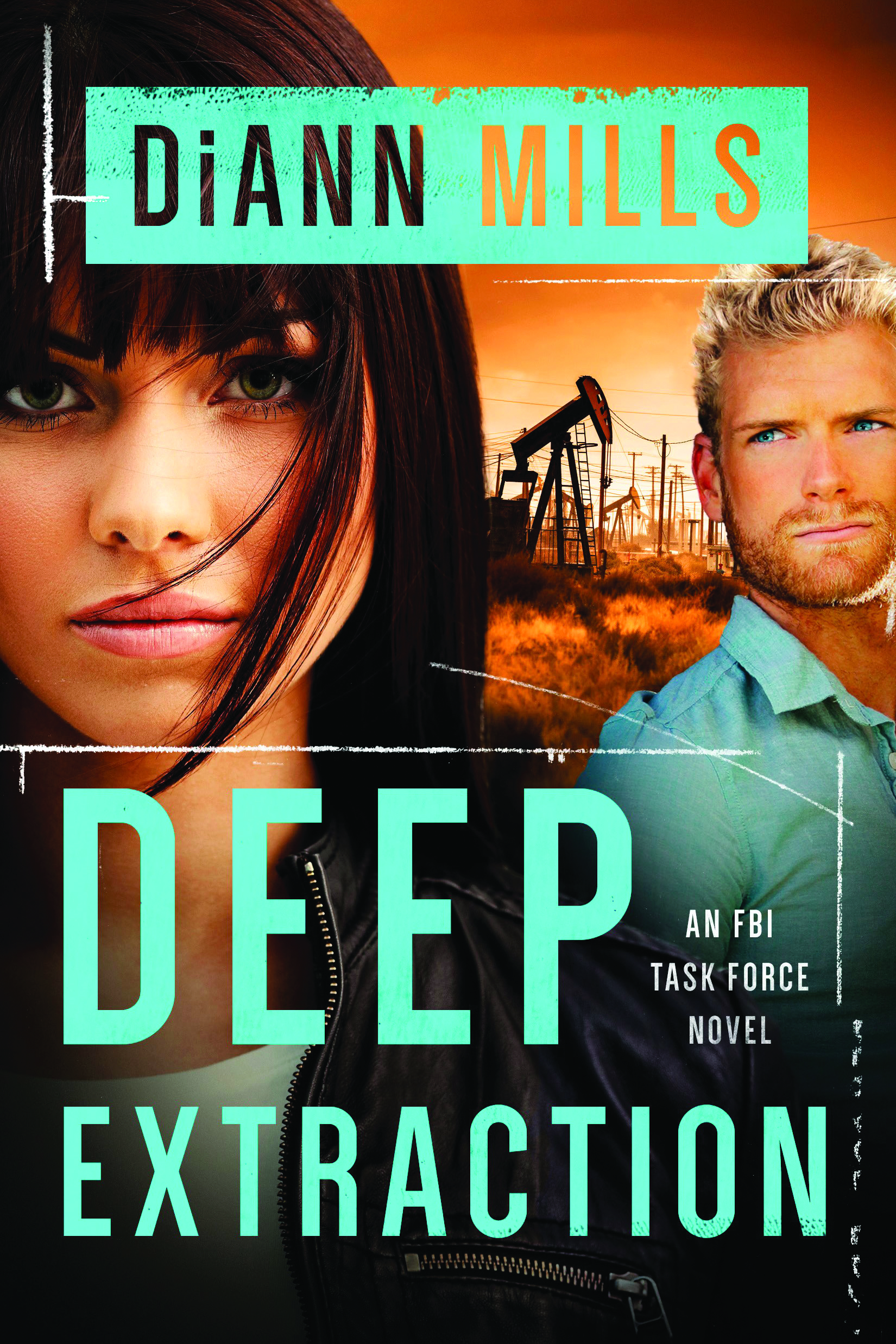
Overcoming the Fear Factor: Finding the Right Agent by DiAnn Mills

By DiAnn Mills

Overcoming the Fear Factor: Finding the Right Agent

Your story is in final form. In your opinion, it’s the best you’ve ever written, and you’re filled with confidence. The suggestions, edits, and marketing plan are in place. Your proposal reads like an NYT writer.

But you don’t have an agent.


An agent? Can't be that scary.
My agent, Janet K. Grant of Books and Such Literary Agency, says this about an agent. “Writers write books. Publishers publish them. But publishers have a big sea of writers to draw from, and someone needs to serve as your swim instructor, telling you who are the sharks and who are the dolphins, and helping you to determine which you want to swim with. That someone is your agent.” I don’t know about you, but swimming with sharks is not my idea of a career builder.

Sometimes agents terrify us. We think they are the one factor that will get us published, when the truth is a quality manuscript is your best advocate. 


 So what does an agent do for a writer?
Stand up! Sit down! Write! Write! Write!

1. Submit your writing project to the proper editor.
2. Follow-up with editors.
3. Negotiate a contract. This is where your agent is worth his/her weight in gold. We writers are creative and usually not comfortable in talking contract terms.
4. Update you with industry trends and changes.
5. Interpret and communicate royalty statements.
6. Be your best cheerleader for the life of your partnership.

7. Advise you in every facet of your writing career.

Your job is to submit a polished manuscript, properly edited, and in the requested format of the agent. Even if you’ve met the agent, make sure you have the correct spelling and address of the person.

And if you’re rejected, consider it redirection. Do your best to find out why the agent declined representation and make changes before submitting again.

Keep perfecting your craft.


Never stop learning.


Never give up on yourself.


Where do you find an agent? Listings are in The Writer’s Market Guide or The Christian Writer’s Market Guide. There you find their submission guidelines and what they are looking for. Stick to them. Sometimes a recommendation from another writer is helpful. But the best way to meet a potential agent is face-to-face. Attending conferences and workshops where agents are present puts you in the spotlight. Polish your pitch, practice, and present it to a perspective agent. It doesn’t end with a single meeting.


Where do I sign up for the T-shirt?
Tips for Finding the Right Agent
1.The right agent is highly recommended by writers and publishers.
2. The right agent is well respected in the industry.
3. The right agent represents your genre.
4. The right agent conducts career counseling and makes recommendations, sometimes tough ones.
5. The right agent reads every word of your manuscript.
6. The right agent is an amazing editor.
7. The right agent must love, not like, your manuscript.
8. The right agent attends major writing conferences and often leads workshops.

9. The right agent submits timely reports on the status of your manuscripts.
10. The right agent is a partner in your writing career, a prayer warrior,  an asset to your life.


Now what’s stopping you? 


DiAnn Mills is a bestselling author who believes her readers should expect an adventure. She currently has more than sixty books published. Her titles have appeared on the CBA and ECPA bestseller lists; won two Christy Awards; and been finalists for the RITA, Daphne Du Maurier, Inspirational Readers’ Choice, and Carol award contests. 
DiAnn is a founding board member of the American Christian Fiction Writers; the 2014 president of the Romance Writers of America’s Faith, Hope, & Love chapter; and a member of Inspirational Writers Alive, Advanced Writers and Speakers Association, and International Thriller Writers.  She speaks to various groups and teaches writing workshops around the country. DiAnn is also a craftsman mentor for the Jerry B. Jenkins
Christian Writers Guild. She and her husband live in sunny Houston, Texas. Visit her website at www.diannmills.com
Facebook - www.facebook.com/DiAnnMills
Twitter - @DiAnnMills
Pinterest - www.pinterest.com/DiAnnMills 
Goodreads - www.goodreads.com/DiAnnMills

Saturday, June 30, 2012

The 5 Stages of Rejection Grief

Rejection.  


All writers go through it. Yet not all writers recognize there is a real grieving process when we receive those rejections. I didn’t realize it myself until one really tough rejection that knocked me so hard it had me reeling through the 5 stages of grief.


It started when my writing mentor told me to scrap my 50,000 word WIP and start over. I was shocked. Sure, I knew my WIP needed help, but to trash six months of writing. She had to be mistaken. I slipped quickly into denial. Maybe a better term for that news was "shock and awe" because I was paralyzed for an entire weekend. I couldn't think, let alone apply any of the great teaching my mentor gave me to my current WIP which was technically dead to me at the moment.

After the anxiety of the weekend wore off, I went through a mixture of anger, bargaining, and depression. I don't remember the anger stage being strong, but the depression was incapacitating at times! I couldn't write or even read. What was the point! My story was dead, and I wasn't about to try and read someone else's story while I was grieving.

Then came the bargaining. Maybe, just maybe I could salvage the WIP. So I tried writing my historical romance in first person. I only got 113 words written before depression set in again, and I realized it was useless. If I turned my WIP into women's fiction as my mentor suggested, it would be a totally different story with a different feel and plot. Which was okay, but something I didn't have the energy to do. After all, I was still grieving.

So I started revisiting an old idea, close to my heart that I'd been afraid to write. First, I reread the seven pages, the only pages I'd written. My heart stirred. I felt new life coming back into my soul. So I read it again, and edited just a few lines and added a few more. Could I do this? I wasn’t sure, but I knew I needed some encouragement so I sent it out to some trustworthy friends. They confirmed I should be working on the story. And I did, but not before I allowed myself to grieve the lost of a WIP.

Rejection is not easy, but sooner or later if you’re a serious writer and put your stuff out there, you will experience rejection. The key to surviving it without taking down those around you is to recognize that a writing rejection requires a grieving process and each person needs to feel it and deal with it in their own time. But also know the only way to get past it is to sit back down and write. 

No matter how long it takes.


Gina Conroy, a.k.a. "the other Gina," is a monthly contributor to Novel Rocket. She's the founder of Writer...Interrupted and is still learning how to balance a career with raising a family. She is represented by Chip MacGregor of MacGregor Literary, and her first novella, Buried Deception, in the Cherry Blossom Capers Collection, released from Barbour Publishing in January 2012 with her second novel Digging Up Death recently contracted with Stonehouse Ink.

Wednesday, January 25, 2012

When Listening to Others' Advice, Don't Forget the Fun


Tricia Goyer is an acclaimed and prolific writer, publishing hundreds of articles in national magazines including Thriving Family and MomSense while authoring more than thirty-one fiction and nonfiction books combined. Among those are 3:16 Teen Edition with Max Lucado and the American Christian Fiction Writers’ Book of the Year Award winners Night Song and Dawn of a Thousand Nights. She has also written books on marriage and parenting and contributed notes to the Women of Faith Study Bible. Tricia hosts a weekly radio program Living Inspired and lives with her husband and children in Arkansas. You can find out more about Tricia at www.triciagoyer.com or www.facebook.com/authortriciagoyer

NR: Tricia will give away 2 books, so leave a comment to be entered in the drawing. Continental U.S. only, please.

When Listening to Others' Advice, Don't Forget the Fun

Often when people find out you want to be a novelist they give you the following advice:

Don't quit your day job.
Don't be disappointed by rejection, because it will happen.
Prepare for a long journey to publication.
Expect hurdles along the way.

Good advice, except that if you focus on all the warnings you're going to lose part of the fun of the process.

And why do you want to follow this dream if you aren't going to have any fun?

I remember going to my second Mt. Hermon Writer's Conference in 1995. I'd submitted a novel I'd JUST started working on and I had a big worry. What IF more than one publisher wanted it? How would I choose!! Oh my!

I laugh now because I was such a newbie. I had nothing publishable to offer, and I didn't realize that...but writing to me was fun. In the last 17 years I still have the same joy. Yes, writing is work but everyday I want to pinch myself. I really get to write books for people from around the world to read??? How cool is that!

So, as for that advice. Let's turn it on it's head.

Don't quit your day job. Of course you can't quit your full-time work (with full-time pay) and expect that you can support yourself with your writing income right off the bat.

But…treat your writing as if you will be doing it as a career for the next 20, 30, 40 years. Focus on what you enjoy doing the most—historical, contemporary, young adult, sci-fi. Don't let others tell you what you should write. Write what a book you'd love to read, and make a 5-year plan of where you want to go. Give yourself performance reviews and bonuses for a job well done. Build relationships with others in the business.

Don't be disappointed by rejection, because it will happen. Yes, rejection will happen but don't feel you have to shrug it off right away. Give yourself time to pout. Rejection hurts because writing matters.

I remember the day after my first novel went to committee and I received a “no.” I fed my children cereal for breakfast, lunch, and dinner and I spent the whole day moping on the couch. I used a whole box of Kleenex on my tears, but you know what? The next day I got up, squared my shoulders and got back to work. That novel never did get published...but the next proposal that went to committee got a “yes.” And you can bet I celebrated then!

Prepare for a long journey to publication. The truth is that it takes an average of ten years for someone to start writing fiction until they have a novel accepted and published. For me it was eight years—pretty close! How did I not get discouraged and give up? Instead of focusing my getting a novel published, I worked on other things. I wrote articles. I did some word-for-hire projects. I even wrote study notes for a Bible. This wasn't the “publishing” I was dreaming of, but I learned some good skills along the way. I also build some great relationships that continue today!

Expect hurdles along the way. There are always bumps in the road. Problems we don't expect. Family situations that keep us away from the computer. Health problems that throw us for a loop. But on every journey there are unexpected surprises. Along the way to having your novel published you'll meet amazing people. You'll discover things about yourself you never knew. You'll grow closer to God as you lean on Him. The hurdles will come, but so will the triumphs and joys. Look forward to these, too.

(And finally, above all, do take at least a few minutes to worry IF more than one publisher wants to buy your work. It could happen...and it's a fun way to brighten your day!)


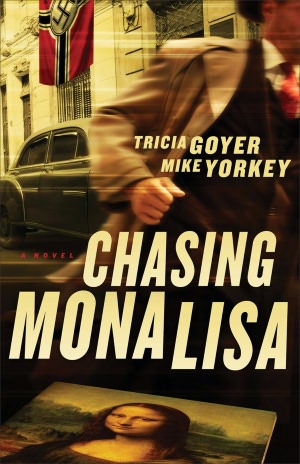
Chasing Mona Lisa

One enigmatic smile. Two passionate protectors. And a relentlessly ticking clock.

August 1944. Paris is on the cusp of liberation. As the soldiers of the Third Reich flee the Allied advance, they ravage the country and steal countless pieces of irreplaceable art. In fact, Reichsmarschall Hermann Göring will stop at nothing to claim the most valuable one of all--the Mona Lisa--as a postwar bargaining chip.

But the woman with the mysterious smile has some very determined protectors. Can Swiss OSS agents Gabi Mueller and Eric Hofstadler rescue Leonardo da Vinci's masterpiece before it falls into German hands?

With nonstop action and intrigue, Chasing Mona Lisa is sure to get your adrenaline pumping as you join the chase to save the most famous painting in the world. From war-ravaged Paris to a posh Swiss chateau, the race is on--and the runners are playing for keeps.