


Get a Free Ebook

Five Inspirational Truths for Authors

Try our Video Classes

Downloadable in-depth learning, with pdf slides

Find out more about My Book Therapy

We want to help you up your writing game. If you are stuck, or just want a boost, please check us out!

Showing posts with label Tricia Goyer. Show all posts

Wednesday, January 09, 2013

Location, Location, Location to Research


Tricia Goyer is an acclaimed and prolific writer, publishing hundreds of articles in national magazines  while authoring more than twenty-five fiction and nonfiction books combined. Among those are 3:16 Teen Edition with Max Lucado and the American Christian Fiction Writers’ Book of the Year Award winners Night Song and Dawn of a Thousand Nights. She has also written books on marriage and parenting and contributed notes to the Women of Faith Study Bible. Tricia lives with her husband and four children in Arkansas.

I've written over thirty novels and for most of them, I've traveled on location for research. It takes time. It takes money, and folks may wonder if it's worth it.

It's possible to accurate novels without traveling on location, but sometimes the location forms the story.
This happened with my co-written novel Love Finds You in Glacier Bay, Alaska. When Ocieanna and I got the idea for Glacier Bay we knew we wanted to mix a historical story with a contemporary one. We had a basic idea, but we were basically researching two books, set in two time periods.

Ocieanna and I traveled to Lonesome Prairie, Montana, and to Seattle, Washington for our previous books, and we knew the benefit of on-site research. We hoped we'd find the same benefit in Glacier Bay.

 If you are looking to travel for research here are some things that might help.

1. Connect before you go. In each of our trips we did some research ahead of time and found knowledgeable people to talk to. The best places to look were historical societies or museums. A phone call goes a long way. Call the local historical society and museum and set an appointment to visit. Let the person know what you're looking for. We've found wonderful people willing to help. They get excited that writers are interested in what they know. They like to share their expertise. (Just remember to take down everyone's name so you can thank them in the acknowledgements.)

2. Talk to locals. One of my favorite things to do is simply talk to the locals. Ask: “What is unique about the area? What are some of you rfavorite stories that you tell others. And who else can I talk to.

3. Don't go with a fixed schedule. Some of the best research and stories have come from unexpected interviews.

4. Have a few set questions, but allow for rabbit trails. Be a good listener.

5. Be observant. This is obvious, but don't just focus on the mountains, the houses, or the museums. Look at the bulletin boards, the grocery store shelves, and ask about the local walking trails.

6. If you've discovered wonderful, colorful locals, write them into the book. Ocieanna and I were able to do this with Glacier Bay. Both historical figures and current residents found their way into our novel. (Just make sure you ask permission!)

7. Don't be so fixed on your storyline that you don't have room to weave all the good stuff in. With each of our books, Ocieanna and I had a basic idea of the storyline, but we had plenty of room to expand and change the plot after our trips.

8. Ask for pre-readers. After your trip send thank you notes to those you interviewed. When you write, also ask if the person would be willing to read your manuscript after you're done. This is  an important step. You can travel, do research and work as hard as you can to get things right, but there are always those little things that a writer misses. When the book is done our goal is to get even the locals to admit, “They got it right.”

What about you? Do you travel to do research? What are the benefit? How has your research impacted your writing?


Love Finds You in Glacier Bay, Alaska

Singer Ginny Marshall is one signature away from the recording contract of her dreams—a deal that would guarantee success for the former foster child, who still struggles to bury the memories of her painful childhood. But Ginny needs advice from the one person who will look out for her best interests—her former fiancĂ©, Brett Miller. She travels to the remote town of Glacier Bay, Alaska, where the town’s colorful characters and stunning scenery provide respite from LA’s pressures.

In Glacier Bay, Ginny discovers a box of old letters and is swept up in the love story between Clay, an early missionary to Alaska Territory, and Ellie, the woman who traveled there to be his children’s governess. When Ginny is reunited with Brett in Glacier Bay, will she discover—as Ellie did—that healing and love are sometimes found in the most unexpected places?

Tuesday, March 20, 2012

How Do You Know if a Story Idea is a Keeper?

Tricia Goyer is the winner of two American Christian Fiction Writers’ Book of the Year Awards (Night Song and Dawn of a Thousand Nights), co-author of 3:16 Teen Edition with Max Lucado, and a contributor to the Women of Faith Study Bible. Also a noted writer of numerous books and articles on marriage and parenting, she lives with her husband and children in Arkansas. Visit Tricia's website at www.triciagoyer.com.


How Do You Know if a Story Idea is a Keeper?

I have to laugh when people ask me how I got the idea for my novel, By the Light of the Silvery Moon. The idea is nearly as old as my son...who will be graduating from high school this year!

It started as a contemporary telling of the Prodigal Son story from the Bible. In preparation for a writer's conference in 1997, I wrote a prologue about a young boy whose carelessness caused his mother's death. That one event then brought division between him and his brother.

The prologue came as a powerful scene, and it captured the attention of editors at Mt. Hermon writer's conference. I clearly remember Steve Laube saying, “You're on to something here.” Yet what good is a prologue without a complete novel to go with it?

After that, I got the idea for From Dust and Ashes and the prodigal son story got put on the shelf. Every now again I'd take out that idea, and turned it over in my mind a few times, but I felt God's whisper, "Not yet."

Fast-forward to 2011. I was approached by an editor about coming up with an idea for the Titanic. April 15, 2012 was the 100th Anniversary—would I like to submit a
novel idea for consideration?

One morning I was laying in bed praying about an "Titanic idea" when the prodigal son story popped into my mind. Was it possible that the seed of the idea I had so many years prior fit on the Titanic? I dug back through my old computer files and found the original prologue. Then, in my mind's eye, the story of a younger son, an older son, a woman who cared for them both--and the loving father--played out in my mind.

That's it!

I copied and pasted that old prologue into a new document and Chapter One started with the story of these new characters and their life-changing journey on the Titanic. The proposal came together quickly, and in a few weeks I learned that Barbour wanted to publish my idea!


When I hold By the Light of the Silvery Moon in my hand, I'm still amazed that I was given the honor of writing this novel. It goes to show that some God-given ideas bloom overnight, while others take years until they see the light of day.


Here are three tips for knowing if you're idea is a keeper.

1) The idea stirs emotion within you. I find all types of interesting ideas in newspaper articles, or in stories I hear, but there have been only a few dozen ideas that have gripped my heart. If your story idea does, pay attention.

2) Others believe in the idea. My husband (dear man) read many of my novel attempts, but out of all of them he kept saying, “When are you going to write that prodigal son idea?” The fact that editors and agents took note of the idea, too, says something.

3) God's fingerprints seemed to be all over it. My novel idea was rooted in Scripture, and I knew the story could be impacting if told in a more modern time period. An image of God is reflected in the loving father who welcomes his wayward son home. If a story idea sticks around in your mind—and will glorify God in it's telling—then it's something to wait upon and pray about! The story may not come to fruition in this decade, but you can be certain it's unsinkable!


By the Light of the Silvery Moon

Remember the Titanic 100 years after its doomed voyage with Tricia Goyer’s fictional portrayal of one woman’s journey. To Amelia Gladstone, this ship means promise of seeing family again. To Quentin Walpole, the Titanic represents a new start in America…if he can get onboard. All seems lost until Amelia offers him a ticket, securing his passage—and bringing him face-to-face with his railroad tycoon father and older brother, Damian. As Amelia works to reconcile father and son, she finds herself the object of both brothers’ affection. Can she choose between two brothers? Or will she lose everything to the icy waters of the Atlantic?


Wednesday, January 25, 2012

When Listening to Others' Advice, Don't Forget the Fun


Tricia Goyer is an acclaimed and prolific writer, publishing hundreds of articles in national magazines including Thriving Family and MomSense while authoring more than thirty-one fiction and nonfiction books combined. Among those are 3:16 Teen Edition with Max Lucado and the American Christian Fiction Writers’ Book of the Year Award winners Night Song and Dawn of a Thousand Nights. She has also written books on marriage and parenting and contributed notes to the Women of Faith Study Bible. Tricia hosts a weekly radio program Living Inspired and lives with her husband and children in Arkansas. You can find out more about Tricia at www.triciagoyer.com or www.facebook.com/authortriciagoyer

NR: Tricia will give away 2 books, so leave a comment to be entered in the drawing. Continental U.S. only, please.

When Listening to Others' Advice, Don't Forget the Fun

Often when people find out you want to be a novelist they give you the following advice:

Don't quit your day job.
Don't be disappointed by rejection, because it will happen.
Prepare for a long journey to publication.
Expect hurdles along the way.

Good advice, except that if you focus on all the warnings you're going to lose part of the fun of the process.

And why do you want to follow this dream if you aren't going to have any fun?

I remember going to my second Mt. Hermon Writer's Conference in 1995. I'd submitted a novel I'd JUST started working on and I had a big worry. What IF more than one publisher wanted it? How would I choose!! Oh my!

I laugh now because I was such a newbie. I had nothing publishable to offer, and I didn't realize that...but writing to me was fun. In the last 17 years I still have the same joy. Yes, writing is work but everyday I want to pinch myself. I really get to write books for people from around the world to read??? How cool is that!

So, as for that advice. Let's turn it on it's head.

Don't quit your day job. Of course you can't quit your full-time work (with full-time pay) and expect that you can support yourself with your writing income right off the bat.

But…treat your writing as if you will be doing it as a career for the next 20, 30, 40 years. Focus on what you enjoy doing the most—historical, contemporary, young adult, sci-fi. Don't let others tell you what you should write. Write what a book you'd love to read, and make a 5-year plan of where you want to go. Give yourself performance reviews and bonuses for a job well done. Build relationships with others in the business.

Don't be disappointed by rejection, because it will happen. Yes, rejection will happen but don't feel you have to shrug it off right away. Give yourself time to pout. Rejection hurts because writing matters.

I remember the day after my first novel went to committee and I received a “no.” I fed my children cereal for breakfast, lunch, and dinner and I spent the whole day moping on the couch. I used a whole box of Kleenex on my tears, but you know what? The next day I got up, squared my shoulders and got back to work. That novel never did get published...but the next proposal that went to committee got a “yes.” And you can bet I celebrated then!

Prepare for a long journey to publication. The truth is that it takes an average of ten years for someone to start writing fiction until they have a novel accepted and published. For me it was eight years—pretty close! How did I not get discouraged and give up? Instead of focusing my getting a novel published, I worked on other things. I wrote articles. I did some word-for-hire projects. I even wrote study notes for a Bible. This wasn't the “publishing” I was dreaming of, but I learned some good skills along the way. I also build some great relationships that continue today!

Expect hurdles along the way. There are always bumps in the road. Problems we don't expect. Family situations that keep us away from the computer. Health problems that throw us for a loop. But on every journey there are unexpected surprises. Along the way to having your novel published you'll meet amazing people. You'll discover things about yourself you never knew. You'll grow closer to God as you lean on Him. The hurdles will come, but so will the triumphs and joys. Look forward to these, too.

(And finally, above all, do take at least a few minutes to worry IF more than one publisher wants to buy your work. It could happen...and it's a fun way to brighten your day!)


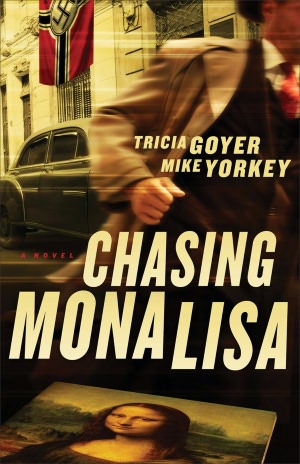
Chasing Mona Lisa

One enigmatic smile. Two passionate protectors. And a relentlessly ticking clock.

August 1944. Paris is on the cusp of liberation. As the soldiers of the Third Reich flee the Allied advance, they ravage the country and steal countless pieces of irreplaceable art. In fact, Reichsmarschall Hermann Göring will stop at nothing to claim the most valuable one of all--the Mona Lisa--as a postwar bargaining chip.

But the woman with the mysterious smile has some very determined protectors. Can Swiss OSS agents Gabi Mueller and Eric Hofstadler rescue Leonardo da Vinci's masterpiece before it falls into German hands?

With nonstop action and intrigue, Chasing Mona Lisa is sure to get your adrenaline pumping as you join the chase to save the most famous painting in the world. From war-ravaged Paris to a posh Swiss chateau, the race is on--and the runners are playing for keeps.

Monday, December 05, 2011

BOOK CLUB TALK WITH TRICIA GOYER


What have been the benefits to you in having relationships with reading groups?

I love reading groups because dedicated readers "speak" the same language as I do. I love hearing about what they read and what they like and dislike about the books they've discussed. Readers who are part of reading groups are my target audience because they understand fiction. They are impacted by themes and characterization and setting and all the things that writers like me love.

Where would you like to see your relationship with reading groups grow? How do you think your goals can be met?

Well, I have an EXCITING way that I'm hoping to grow my relationship with reading groups. I have a new system on my website that allows me to do Video Book Club Chats. This allows me to visit a bookclub LIVE. Book clubs can find out more information here: http://www.triciagoyer.com/videochats.html ... they can even book me for an upcoming event!

Book Signing in York, PA


Book Signing in York, PA

Do you have a set size a reading group has to be before you'll talk to them on the phone or in person? What do you feel most comfortable doing?

I'm comfortable with two people, twenty people or two hundred people! I just love talking about book! That being said, I wish I had unlimited time, but since I don't I appreciate groups being 10+ members. I know that people have other commitments and might not be able to make all the meetings, but for me to tell my family, "I have to visit a book club tonight," I need to justify my ministry reach.

Which type of book club meeting do you prefer? Why?

It's super fun visiting book clubs in person. Then I get to talk to members about all types of things, but being their "virtually" is the next best thing!

Do you learn about your book and yourself from book club meetings? If so what?


Speaking to a group in Shippensburg


I've discovered that readers are VERY smart. I can't offer easy answers or become lazy in my writing. What I've learned about myself is I have similar themes in my books, such as unplanned pregnancy or abandonment issues. When I listen to readers discussing my books I discover they often figure stuff out about me that I didn't see myself. LOL!

Did you learn more about your characters than what you had originally intended? Have you been surprised by readers’ reactions to one of your books? Characters? If so, which ones?

Most of the time I'm not surprised by the readers' reactions. I actually think about what type of reaction I want the reader to have concerning a character before I write them. What does surprise me is how readers pay attention to little clues I drop in, things I think most people won't notice. It's fun! It's like hiding Easter Eggs. They DO get found by smart readers.

Has your book club experience - getting feed back from reading groups - helped you in writing future books? If so, how has it helped you?

Yes. It has helped me know what readers like. When I think of book ideas I often think of specific groups or readers and then ask, "Would they like this book?" I helps me to narrow down my ideas into ones that I can see people talking about at book club! LOL.

What do you think about ebooks and future sales of your book? How will authors do book signings with an ebook reading crowd?

I'm actually excited about ebooks because I think it gets the books into hands of people who might not have picked it up before. I haven't thought about book signings before ebook style BUT after doing LOTS of book signings this year I've discovered even readers who mostly read my books in ebook form will come and meet me--and buy a paperback book and have me sign it--if I'm in town!

Can you Please give us a peek into what you are working on Now and when it will be released?


I have three upcoming releases: Chasing Mona Lisa (Revell) is a WWII high-adreline novel that I wrote with Mike Yorkey. It releases January 2012.

By the Light of the Silvery Moon (Barbour) is a novel about the Titanic. It releases March 2012, just in time for the 100th Anniversary of the sinking of the Titanic.


Beyond Hope's Valley (B and H) is my 3rd novel in my Big Sky Amish Series. It releases April 2012.

I just finished writing The Memory Jar (Zondervan) which is my first Amish novel in the Seven Brides for Seven Bachelors Series! It'll be out Fall 2012.

I'm currently writing two books, Love Finds You in Glacier Bay, Alaska (Summerside). I'm writing this with my friend and co-author Ocieanna Fleiss.

I'm also writing Lead Like Jesus for Parents (Focus on the Family) an non-fiction book I'm writing with Ken Blanchard and Phil Hodges.

I'm working on two more Amish novels; too, so all those things keep me busy!

Nora : ***WOW*** You are one busy lady!! EXCITING for us!! I’m excited to read your new books!

I'm EXCITED about the GIVEAWAY OPPORUNITY - B and H is offering at The Book Club Network www.bookfun.org


Starting DECEMBER 1st.
They are giving away 5 copies of your newest Amish Book Called ALONG WOODED PATHS. Anyone can join in the fun. Just check out The Book Club Network www.bookfun.org

On DECEMBER 7th Tricia will be giving away

(1) complete set of Chronicles of The Spanish Civil War (1) set of her new Amish series which includes two books so far and (1) signed copy of Remembering You and (1) signed copy of 3:16 for Teens. Exciting month ahead. Mark your calendar. Hope to see many of you there!

What do you hope your readers take away from your new book Along Wooded Paths?

I hope my readers walk away wanting to be more open to the stories around them. My greatest joy would be if they'd take the time to invite a veteran to share his or her experiences with them. These stories need to be remembered!
Tricia


Thanks Tricia for sharing about your book club experience and your photos. It was great to catch up with you this summer at the ICRS conference in Atlanta!!

Blessings
MERRY CHRISTMAS EVERYONE
Nora St.Laurent
The Book Club Network
www.bookfun.org

Wednesday, December 02, 2009

Guest Blogger ~ Tricia Goyer


Tricia is the author of 20+ books and has published over 300 articles for national publications such as Focus on the Family, Today’s Christian Woman and HomeLife Magazine. She won Historical Novel of the Year in 2005 and 2006 from American Christian Fiction Writers (ACFW), and was honored with the Writer of the Year award from Mt. Hermon Writer's Conference in 2003. Tricia's book Life Interrupted was a finalist for the Gold Medallion Book Award in 2005.

Tips To Maximize Research

Whenever I talk about my novels I can't help but think about those who helped to make them possible--the men and women I interviewed. In writing my most recent novel, my co-writer Ocieanna Fleiss and I traveled to Lonesome Prairie, Montana and there we met 91-year-old Keith Edwards. Keith has lived in the area his whole life. In fact, his parents were some of the first settlers there, placing them there during the time frame when Love Finds You in Lonesome Prairie was written! Keith told us some great stories, many of which made them into a book. Through the years, interviewing has become one of my favorite parts of writing.

In researching for my six WWII novels, I've interviewed veterans and Holocaust survivors--some of whom had never talked about their experiences, even with their spouses. I conducted some of these first interviews in person at WWII reunions.

I first connected with the veterans after hearing about the experiences of a specific recon unit, who liberated two concentration camps in Austria. I contacted them through letters, and soon received responses from six men from this unit willing to be interviewed. They invited me to their yearly reunion, and I jumped at the chance. I was amazed by how open the men were to sharing their story. I think they were thrilled that someone cared about their experiences.

At the reunion I made appointments. A writer friend went with me, and we filled our schedule. It was my first experience with interviewing, but I use the same procedure today for my novel or article research.


Tricia's office overlooking her own prairie

Tips:

• When it comes to the interviews, I set up my handheld recorder that records MP3s which can be transferred on my computer. After getting the recording started, I turned my full attention to the person. I don't jot notes or read questions. Instead, I maintain eye contact and ask questions.

• I start by asking easy stuff such as their childhood memories, when they joined their military, about basic training, friendships, etc.

• I make sure I have a basic knowledge of their role so I can ask knowledgeable questions. For example, "Did you ever visit in McGully's general store?" or "What type of emotions did you feel when your tank crossed the border into Germany?"

• After the person has covered the basics I ask, "What memories still replay in your mind even 60 years later?" This is the question that brings the most emotion--especially WWII veterans. Many, many men have broken down sobbing. Some apologize and tell me that cannot share their memory. Others do so, but it takes a while for them to warm up.

• Which leads to the most important thing I do...sit and listen. I don't try to fill the silence with my words. Nine times out of ten, the men (or women) open up, and they share things with me that they've never shared before. And many tell me it's a sort of healing for them.

I've been privileged to talk with Holocaust survivors, too. Most of these men and women have told their stories many times--and it's easy for them to open up. My most amazing interview was with a survivor who was in his early teens when he was in a number of concentration camps. He had not spoken to many people about this experience, and when we shared his experiences he literally jumped from his seat and started “acting” out how they marched, how they stood at attention, how the guards beat him, etc. I felt like I was there, and it greatly impacted me.

I’ve continued to interview other people for other situations, and being genuinely interested and caring is key. I offer tissue or hold hands for someone having a hard time. I don’t rush. I also let the person know later how much their story impacted me.

Love Finds You in Lonesome Prairie, Montana

Julia Cavanaugh has never left New York. But in 1889, the young woman rides the orphan train west to deliver the girls in her care to new families. After Julia's final stop in Montana, she plans to kick he dust off her heels and head straight back east.

But upon arriving in the remote town of Lonesome Prairie, she learns to her horror that she is also suppose to be delivered--into the hands of an uncouth miner who carries a bill of purchase for his new "bride."

Julia turns to a respected circuit preacher to protect her from the marriage, but with no return fare, no home, and few friends, her options are bleak. What is God's plan for a lonely woman stranded in the middle of the vast Montana prairie?