Get a Free Ebook

Five Inspirational Truths for Authors

Try our Video Classes

Downloadable in-depth learning, with pdf slides

Find out more about My Book Therapy

We want to help you up your writing game. If you are stuck, or just want a boost, please check us out!

Showing posts with label Writers life. Show all posts

Monday, January 23, 2017

7 Tips for Planning a Writers Brainstorming Retreat

by Beth K. Vogt @bethvogt

Two weeks before Christmas may sound like the craziest time to run away and brainstorm with your best writing buddies – but, hey, if the plan comes together, go for it, right?

And that’s exactly why I found myself sitting in author Rachel Hauck’s living room with author Susie May Warren – my “writing forces to be reckoned with.” We had three days off from Christmas shopping and all the other holidaze To Do’s to brainstorm our next books. Our time was so successful we plan to have an annual December brainstorming retreat.

Monday, October 03, 2016

Writers As Champions

Ronie Kendig is an award-winning, bestselling author of over a dozen novels. She grew up an Army brat, and now she and her husband, an Army veteran, have an adventurous life in Northern Virginia with their children and retired military working dog, VVolt N629. Ronie's degree in Psychology has helped her pen novels of intense, raw characters. She can be found at:
     www.roniekendig.com
     Facebook (www.facebook.com/rapidfirefiction)
     Twitter (@roniekendig)
     Goodreads (www.goodreads.com/RonieK)
     Instagram (@kendigronie)
     Pinterest (http://www.pinterest.com/roniek/)!


* * * * * 

I’ve been mulling the concept of champions lately as I prepare for my keynotes at Oregon Christian Writers’ Fall Conference, and it brings me back to a striking comparison between the writing life and training for tae kwon do that my family and I have been immersed in for the last four years. Soon, our family will test for our second degree black belts. 

I confess a painful truth—I’m not getting any younger. And training is tough. I’ve injured myself a lot in the last six months (my back, bruised the bone of my elbow, jammed my toe breaking boards). But we love it. And we know that the hard work will pay off—we’ll be stronger and in better shape.


Kendig's 1st Degree Black Belt Ceremony
Oddly (or may not), the same is true of writing. Our “writing” training program—learning the craft of writing—can be grueling. There is a lot to learn and many opportunities to make mistakes. It’s easy to become discouraged or daunted—because sometimes, when we learn one thing, we realize just how much we don’t know. At times, writing may even leave us exhausted and depleted, physically and emotionally.

My tae kwon do instructors are world champions. The best. They are sixth and seventh-degree black belts, which amounts to decades of experience. Yet, they are the most humble people I’ve met. I’m struck by how hard this career is, how isolating it can be…yet, how “easy” it is to be a champion to someone. Each night in TKD, we get on the mat, leaving behind our insecurities, the weight of a long day, and the all-too-real life that plagues us. We’re geared up and ready to spar, train, and do our forms. These students and our instructors have become our family. We cheer each other on and challenge each other.

And again, the same is true of the writing community. We have champions around us who are actively championing other writers. And I think that’s what we should all be doing. After all, we are surrounded by like-minded individuals, writing and working toward similar goals—publication, representation.

Over the last 10 years, as I’ve honed my writing craft and fought to develop my career, I have battled discouragement. It’s always there, bouncing on its toes as I edge closer to the “ring” of life. Daring me. Taunting me. Ridiculing me. Discouraging me. It’s a ready foe, anxious to nail a sidekick into our guts and bring us to our knees.

Let’s face it, writing isn’t easy. Often, it’s just plain hard. It demands a lot of us as artists. St. Francis of Assisi said, “He who works with his hands is a laborer. He who works with his hands and head is a craftsman. He who works with his hands, his head, and his heart is an artist.”

Being an artist requires us to create, to draw from a deep well of emotional content, and pour onto the page. Sometimes, when we do, it depletes our emotional and mental reserves. We have to refuel. But how? Where?

It’s important to surround yourself with supportive writing friends who will lift you up during the rough patches instead of belittling or comparing as often happens in our competitive industry. We should be champions for each other. Come alongside someone who is struggling and be their champion.

 We must get on the mat, be willing to train with each other, and cheer one another on. See someone flagging in their courage? Be encouragement to them. See a friend struggling through life? Find a way to champion their cause. Is someone working hard yet battling discouragement? Be their champion.


* * * * * 

The Warrior's Seal (Tox Files #0.5) is a FREE novella prequel! 


A Special Forces team is thrust into a war with the past to save the president after an artifact unleashes a deadly toxin. 

Special Forces operative Cole "Tox" Russell and his team are tasked in a search-and-rescue--the U.S. president has been kidnapped during a goodwill tour. The mission nosedives when an ancient biblical artifact and a deadly toxin wipe out villages. Tox must stop the terrorists and the toxin to save the president.


Wednesday, September 21, 2016

Make Your Writing Better By Resting

From July 2015 to July 2016, I wrote three books for a total of 250,000 words.

For some super writers, that's nothing. But for me, it was quite a feat.

While I've learned to write faster using the Story Equation, three books was still a bit much.

It started last summer when my editor proposed two books due by December 1st.

I was hesitant. I wasn't sure I had the emotional energy to write two books! In the fall of 2015 I was just over a difficult year physically in 2014. What if I ran into problems again?

Connecting emotionally to the characters is important to me and that's hard to do when I have to simply "produce." Hard to do when a tough year hang over your head.

Yet the Lord nudge me, "Do it. Diamonds come from pressure."

I did it. It was fun. But no time to rest. On to the next deadline to make this trio in a year complete.

Once I turn in The Writing Desk rewrites, I will have nothing pressing until January. I can take my time to read, dream, plan the next book.

And just be. Drive to the beach. Spend time just sitting at His feet.

Rest. It's so key to a writer's life.

In the Old Testament, God tells the people of Israel to "fast work." We have to labor to enter into rest because it's our default to work. To want to stay busy. To feel like the more we work the more we'll get done.

I've heard testimonies of successful businessmen who worked 12 - 15 hours a day and still didn't accomplish all they wanted.

But when they started "resting" before the Lord at the beginning of their day, they accomplished all their work and more in a regular 8 hour day.

I ended up on a two week vacation this summer in the middle of the deadline. I had a few restless nights wondering if I'd meet my July deadline.

How can one rest when there's work to be done?

I finished. Two days early. On the heels of my father-in-laws passing.

God can multiply our time if we take time to rest and just be!

This fall I can take the top down on the car and drive along the beach if I want. Let the wind blow through my hair and my thoughts.

Take time to rest. Don't go from one thing to the next.

Work hard on deadline. Rest in between.

You'll be better for it.

*** 
New York Times, USA Today and Wall Street Journal bestselling author Rachel Hauck lives in sunny central Florida.

A graduate of Ohio State University with a degree in Journalism, she worked in the corporate software world before planting her backside in uncomfortable chair to write full time eight years ago.

Her book The Wedding Dress hit Amazon's bestsellers list the first half of 2016.

Rachel serves on the Executive Board for American Christian Fiction Writers. She is a mentor, conference speaker and worship leader.

Rachel writes from her two-story tower in an exceedingly more comfy chair. She is a huge Buckeyes football fan.

Here latest novel is The Wedding Shop"Spellbinding." Starred Booklist Review


Visit her web site: www.rachelhauck.com.

Monday, August 01, 2016

4 Platform Building Lessons from Ephesians - Guest Post by Joan Campbell

Joan Campbell lives in Johannesburg with her husband and daughters. She is inspired by South Africa’s vibrant mix of culture, language, music and folklore. Her country’s history also impacts her writing, with the themes of discrimination and reconciliation woven through her fantasy novels. 

 *** 

I’ll just come right out and admit it. The constant advice to ‘build a platform’ used to irritate me. A lot. I followed it not because I wanted to, but only in the hopes of impressing publishers. 

Once I signed a publishing contract my attitude shifted. With a greater incentive to build an audience interested in my books, I began to pay attention to how other authors tackled this. I saw plenty of creativity, audience engagement, powerful messages and savvy use of social media. 

Inspirational, right? 

 Well…no. Instead, I felt more discouraged and uncertain on how to improve my half-hearted efforts.

That’s when I began to pray about it. I hadn’t ever thought of seeking God’s guidance, mainly because I didn’t think of him as a modern ‘platform guru’. Yet almost immediately I received the direction I sought through a passage from Ephesians 4. These four keys to platform building are changing my outlook, turning something I’ve always done rather resentfully into a joyful part of serving God. 

 Engaging others is part of our calling 

“Therefore I… beg you to lead a life worthy of your calling for you have been called by God.” (Eph. 4:1) 

As a Christian writer, I have a message and ministry from God. I might prefer to huddle over my computer, working only on my manuscripts, but that’s not all God calls me to. He calls us to love others and speak truth into their lives. Our platforms are a powerful tool to do that, be it in the form of a newsletter, blog, Facebook post or speaking engagement. 

Work as a team to build God’s kingdom 

“Always keep yourselves united in the Holy Spirit, and bind yourselves together with peace. We are all one body, we have the same Spirit, and we have all been called to the same glorious future. There is only one Lord, one faith, one baptism, and there is only one God and Father, who is over us all and in us all and living through us all.” (Eph. 4:3-6) 

In the competitive world of publishing, it’s easy to lose sight of the fact that—as Christian writers—we are called to build God’s Kingdom. To do that we need to unite and pull together by encouraging and supporting each other, promoting each others’ books and doing all we can to get the message of Christ’s love into the world. We are a team. 

 Let our uniqueness and gifts shine through 

“However, he has given each one of us a special gift according to the generosity of Christ. He is the one who gave these gifts to the church: the apostles, the prophets, the evangelists, and the pastors and teachers.” (Eph. 4:7,11) 

 As much as we are a team, we are also wonderfully unique. We have our own voice, own stories and message, own audience and own spiritual gifts. If our gift is teaching, this will be reflected in our posts and blogs. If it is evangelism or encouragement, that will be the thrust of our messages. Our platforms are not an end in itself, they are an extension of the unique ministry God has for each of us.  

Be authentic and vulnerable 

 “So put away all falsehood and tell your neighbour the truth because we belong to each other.” (Eph. 4:25) 

In our scramble for attention, it can be easy to project something other than the truth, but God calls us to be honest and authentic in our engagement with people. That is the vulnerable place where the real connection happens between us and our followers/readers, and where our words have the greatest impact. 

Ephesians 4:29 tells us that our words should be an encouragement to those who hear them. I love this verse in The Message, which says our words should be gifts to the world. What an honour that God has given us words to write and speak and share. We need the courage to do this not only in ways comfortable to us, but also in ways that challenge us. Platform building is not about us garnering readers and acclaim. It is about being true to God’s calling to bring words of truth, hope and salvation to the world. 

 (Verses from The New Living Translation) 

 Connect with Joan on her Website, Facebook, Goodreads and Twitter (she says she's still working on her attitude towards tweets). 

 *** 

 Joan’s Books 

Chains of Gwyndorr is the first book of The Poison Tree Path Chronicles and published by Enclave Publishing. Joan started writing this book after she read The Chronicles of Narnia to her two young daughters and realised the powerful way in which a story can convey redemption. 
Buy it on Amazon

Legends of the Loreteller, the trilogy’s companion book, is a collection of short stories set in Tirragyl, the fantasy world of the The Poison Tree Path Chronicles. 
Available as a FREE DOWNLOAD on Joan’s website 

Encounters: Life Changing Moments with Jesus brings readers face to face with Jesus, through stories from the gospels told in the voice of those Jesus encountered. The book is enhanced with reflections, prayers and art work.

Buy it on Amazon.


* * * * * 
Ronie Kendig is an award-winning, bestselling author who grew up an Army brat. After twenty-five years of marriage, she and her hunky hero husband have a full life with their children, a Maltese Menace, and a retired military working dog in Northern Virginia. 

Find Ronie online:
     Website: www.roniekendig.com
     Facebook (www.facebook.com/rapidfirefiction)
     Twitter (@roniekendig)
     Goodreads (www.goodreads.com/RonieK)
     Instagram (@kendigronie)
     Pinterest (http://www.pinterest.com/roniek/)


Friday, April 15, 2016

Author Answers ~ Catching Up with Cynthia Ruchti


What two or three things would you do differently if you were starting your publishing career today?

Since I was 58 when my debut novel was published, I’d have to say, “Start earlier!” But on the other hand, I can trace back through thirty-three years of ministry in radio—a good portion of my adulthood—and see that God prepared me, informed me, deepened me, worked on maturing me (that process will never end), created empathy in me, and accomplished untold other prep work in me before I ever signed my first contract.

I would apply myself to better and more efficient filing methods if I were starting now. Not only do we have greater access to tools that help us accomplish that goal these days, but I understand all too well what it’s like to have bins of material that need filing, scraps of paper with a brilliant idea buried under other scraps of paper, and what it’s like to waste time re-researching a bit of information I already have somewhere in the office. And this is coming from an author who has a “decent” filing system. I’m working toward becoming more streamlined now, uncluttering the paper jam of my life. That too, I wish I’d started sooner.

What one issue makes you struggle the most as an author? How do you handle it?

By necessity, because of the many facets that accompany publication—marketing, reader communication, research, development, editing, planning, interviews, conferences, speaking—and because, like many authors, I have a day job too, finding the sweet spot in time management is always an issue. What is most important for this moment? Some people have a word of the year. This year, I felt led to adopt a three-word phase that has often helped guide me in time management decision-making. My phrase for 2016 is “More of Less?” The question mark is there intentionally. Throughout the day, I ask, “Do I need more of this in my life or less of it?” It’s been an exercise that causes me to approach every assignment and every request with greater intentionality. And when I ask the question, I’m asking both myself and God…and listening for His answer.

What one issue ignites your passion? Does your passion fuel your writing? What would you do with your life if you didn't write?

My writing tagline, but also for my life, in its extended version (my tagline, although let’s say my extended life, too!) is “I can’t unravel. I’m hemmed in Hope.” Landing on that tagline was like coming home to harbor. It seems to fit what I believe, what I practice, what I write, and what I long to pour into others. The stories I’m compelled to write are not all happy-happy-joy-joy stories. They’re careful, intimate, sometimes raw peeks into the very real struggles humans face, and sometimes the ones we don’t want to admit—like the character who isn’t sure she wants to be around her husband that much in retirement (Song of Silence from Abingdon Press). But hope isn’t just the last paragraph of the final chapter. It is woven throughout the story, even in the tough parts, because that’s what God does. He hems us in hope so we can bear life’s ravages—emotional, financial, health-wise, spiritual—without unraveling.

If I didn’t write, I would find some outlet where I could continue to encourage people with the irresistible wonder that God has created hope for every situation we can face.

And I’d consider editing or coaching other communicators. Or…take on more speaking opportunities for women’s events.

Do you still experience self-doubts regarding your work, or struggle in a particular area such as writers block or angst driven head-banging against walls? Please share some helpful overcoming hints that you’ve discovered.

I’m just now getting serious about the benefits of setting a timer to create boundaries for writing and intentional breaks for moving and accomplishing the non-writing facets of this business. I’m finding my rhythm in about twenty-five or thirty-minute block of focused writing interspersed with ten-minute blocks (the recommendation is five, but ten works better for me) in which I keep myself from writing (unless in the last throes of a deadline) and force myself to walk around, unload the dishwasher, exercise, check email, put a stamp on an envelope, tidy the family room… Anything that is not actual writing. I implemented the plan—my home-tweaked version of the popular Pomodoro Technique—in the last two weeks of a very tight deadline. My productivity increased, and I felt as if I were still engaged in home life, rather than completely ignoring it. The body needs to move, but if I sat at my computer until the work was done, I never would move. The work is never “done.” And that is a natural frustration to my personality type. I’ve made it a regular practice now. It’s bringing a sense of energy to my writing, greater efficiency (although I had to DO it before I was convinced it could), keeps me from endless minutes or more staring at a blank screen because I’m eager to get back to the manuscript, manages distractions in a positive way, and also manages my guilt for what I in the past wasn’t accomplishing when in writer mode.

What is your favorite source for finding story ideas?

Life. More specifically, listening to life.

The kind of stories I’m compelled to write are inspired by listening to people’s heartaches, the story of their struggles, and watching for where that intersects with God’s story.

I find ideas—whether for fiction, nonfiction, or devotions—by staying alert and looking for the story in any small incident or observation.

One of my first fiction instructors had us create a paragraph in fifteen minutes centered on something in that room. “What item?” He said, “Pick one. It doesn’t matter. There’s a story everywhere you look.” I’ve taken that to heart and found it not only true but empathy-building.

What piece of writing have you done that you’re particularly proud of and why? (Doesn't have to be one of your books or even published.)
I don’t look the type, don’t fit the profile, but I was challenged to write a Spoken Word piece for a specific sermon our pastor intended to preach the following Sunday. He wanted a Spoken Word on the Old Testament Joseph and the story of his going from a literal pit, thrown there by his brothers, to a place of prominence where the salvation of his nation depended on his forgiving his brothers. I had a heavy schedule at the time and told him, “I’ll try. But if it doesn’t come quickly, I’ll have to say no.” Within an hour, I emailed the piece to him, and reread it as if seeing it for the first time. An “in the zone” experience.

Since then I’ve done two other Spoken Word pieces—one for Christmas and one for Easter. I can’t say I’m “proud” of them, but that I am blessed to have been given the challenge, and stirred by how God poured His thoughts into me when I approached as an empty vessel ready to be filled.

It also reminded me of the power of poetry, and its importance in communicating deep truths. Sometimes when I’m in a rut in my writing, I’ll stop and read poetry. It restores my infatuation with the beauty and musicality of writing, the love of language, and the power of story.

What is the first thing you do when you begin a new book?

I’m one of those writers who needs a title to inspire me as I write. It’s so much more difficult for me to create chapters, plots, characters, if I don’t have a title in mind, even if it isn’t the final title the publisher and I agree on.

What gives you the greatest writer buzz, makes the trip worth the hassles (besides coffee or other substances, or course)?

My heart swells with joy when I read a note from a reader or a reviewer that shows they “got” what I attempted to communicate through story. But more thrilling than that is a reader whose life was enriched, comforted, encouraged, or newly hemmed in hope because of their connection with something I’ve written. It means I got out of the way so God could say what He wanted to say.

~~~~~~~~~~~~~~~~~~~~~~~~

Cynthia Ruchti tells stories hemmed in hope through her novels, novellas, nonfiction books, articles, and devotionals, drawing from 33 years of on-air radio ministry. Ruchti has 17 books in print, and her books have received numerous awards and nominations.

One of Ruchti’s greatest joys is helping other writers grow in their craft. To that end, she has served as worship and devotions staff and faculty for the Write-to-Publish conference and teaches at other writers’ conferences across the country and internationally as opportunities arise. She also serves as the professional relations liaison for American Christian Fiction Writers.

To keep up with Cynthia Ruchti, visit www.cynthiaruchti.com. You can also follow her on Facebook (Cynthia Ruchti), Twitter (@cynthiaruchti), and Pinterest (cynthiaruchti).

Thursday, November 19, 2015

10 Ways to Jump-start Your Writing

10. If the seat in which you park your behind is a good one, you'll park it more often. A while ago, someone told me about her office chair. It has an exercise ball in it. It's actually part of the chair. If you use an exercise ball to sit on but are balance-challenged, this is for you. Then, you can be to be a balanced writer.

9. Have your muse readily available...capture it in a jar. If James Scott Bell can keep "the boys in the basement," I can keep my muse is a jar. In fact, my critique partner Jessica Dotta made it for me. It's amusing to look at (yes, the pun was intended) and will remind me to start creating.

8. Keep chocolate handy. Okay, it's not that new of an idea, but my new take on it works. Allow yourself one M&M for every forty words written. That way you get twenty-five M&Ms for every 1000 words. It's not enough to get fat, unless you're like Karen Kingsbury, who writes 10,000 words a day.

7. Start the week off right with a clean desk. I try to pretend I'm neat. I like to be neat. I write better with a clean desk. But at night, while I'm asleep, the dust bunnies come out to play. They leave an awful mess, stacks of books, notes and scraps of paper, empty M&Ms bags. There's nothing I can do. They're an endangered species.

6. Stacks of colorful sticky notes help keep you organized. I attended my local ACFW chapter meeting (go ACFW North Georgia!), where an author told us about her method of editing. It involved different colors, sizes, and shapes of sticky notes. It worked for her, so I figured it would for me, too. The next day, I hurried to the store and $90 later came home with a bag full of every color and size imaginable. The next day I tried it. I discovered this method of editing doesn't work for me, but I'm good for sticky notes for the next five years.

5. Hang inspirational pictures & sayings around your desk for those times when you are not creative. Am I the only one who stares blankly at a screen for eons? I thought my brain had turned to grits. So I hung pictures of my characters, quotations in a pretty frame, anything to fire those synapses in my head.

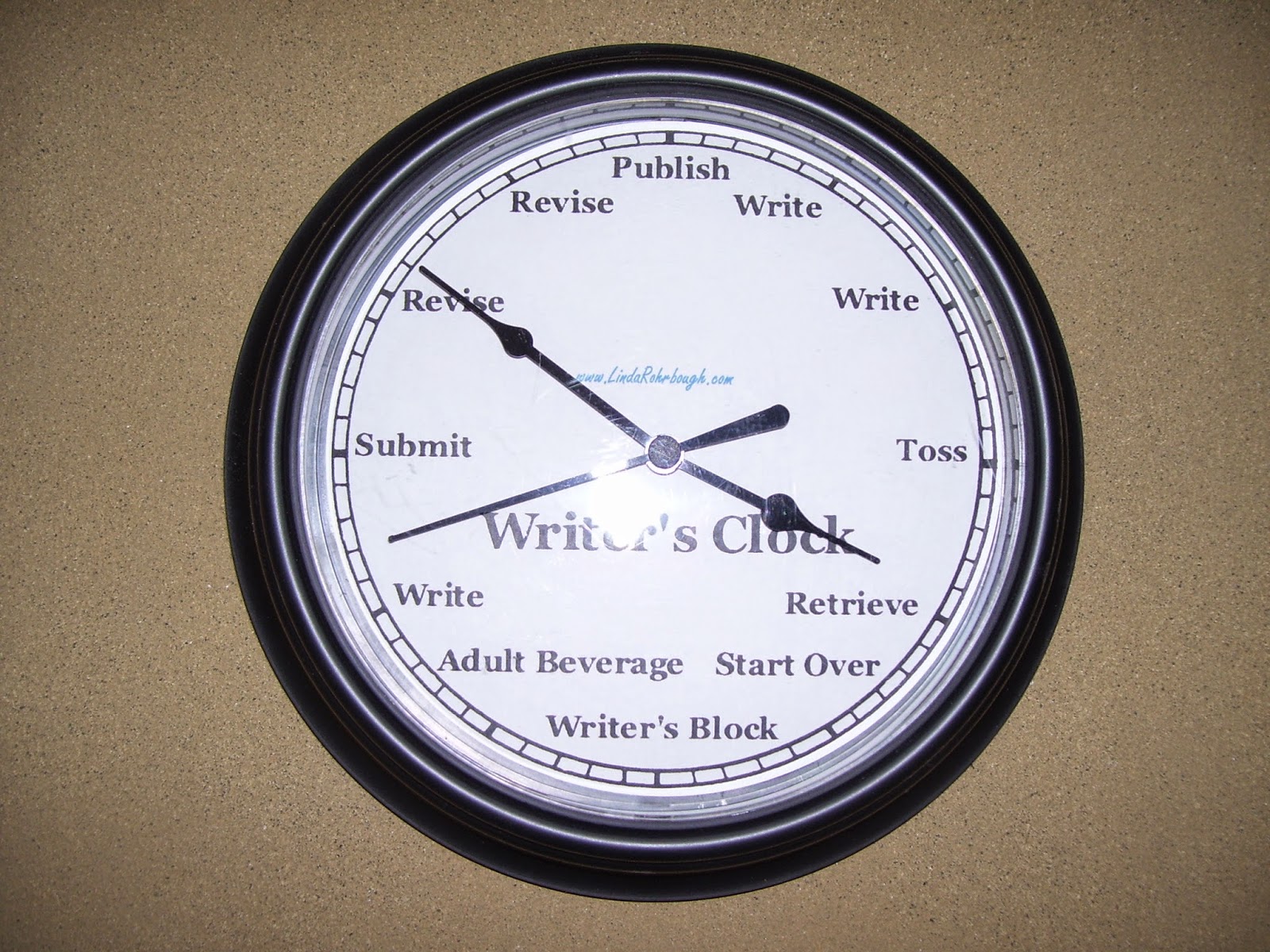
4. Writers' accoutrements. I have a clock, made by one of my writer friends, Linda Rorbaugh. It makes me smile and reminds me that tossing and retrieving are all part of the process of writing. But at nine o'clock there's the submit part that leads to publishing. However, last year, I made it to 12 o'clock. That's PUBLISH!

3. A getaway, no matter how small, is good for writers. It tricks you into thinking you're like Steinbeck or Hemingway. Okay, maybe not, but Starbucks does not have a telephone that rings for you. Nor does it have washing machines or vacuum cleaners that know your name. So, do yourself a favor and break the dull routine you've gotten into.
2. Hang a laminated "Do not disturb ~ writer working" doorknob sign for the office door. Oh, and be sure you shut the door and hang it on the outside. I got a really nice one from My Book Therapy. Of course, it didn't come with a guarantee that the hubs wouldn't open the door and ask if I'm busy. And our mastiffs, Shadrach and Oliver, can't read, so they woof outside until I can't ignore them a minute longer. They have a doggy door a linebacker could fit through, but no, they want personal service. Maybe I should write a manual for authors: How to Train Husbands, Children, and Dogs. Hmm, I could make a fortune...if it worked. Somehow I have my doubts, though. Which leads to... 

1. Turn a blind eye to dust and clutter. Remember #7? Dust bunnies are an endangered species, so do your part. Give them undisturbed breeding grounds (they breed best amidst clutter). That frees you up to write. It all makes sense if you look at it the right way. 


Chapel Springs Survival, coming Dec 3, 2015

A mail-order bride, a town overrun with tourists, and illegal art ~ can Claire and Chapel Springs survive?

Life is good for Claire Bennett. That is until the mayor's brother blabs that her nineteen-year-old son, Wes, has secretly married a Brazilian mail order bride. When she tries to welcome her new daughter-in-law, Claire is ridiculed, rebuffed, and rejected. Loving this girl is like hugging a prickly cactus. 

Lydia Smith is happily living alone and running her spa—then the widow on the hill becomes a blushing bride. Along with her new husband, she has a dream to expand the spa by adding guest rooms. Things are going according to plan until her groom's adult son moves in—on everything. Will her dream survive her stepson?

From the first sighting of a country music star in the art gallery, The Painted Loon, to the visit of a Hollywood diva, Chapel Springs is inundated with stargazers, causing lifelong residents to flee the area. When her best friends put their house on the market, Claire is forced to do something or lose the closest thing to a sister she’s got. 

With her son's future at stake and the town looking to her to solve their problems, Claire isn't sure she can survive this whirlwind of trouble.

While a floppy straw hat is her favorite, novelist Ane Mulligan has worn several including pro-family lobbyist, drama director, playwright, humor columnist, and novelist. She firmly believes coffee and chocolate are two of the four major food groups. Ane writes her Southern-fried fiction in Sugar Hill, GA, where she resides with her artist husband, her chef son, and two dogs of Biblical proportion. You can find Ane on her Southern-fried Fiction website, Google+, Facebook, Goodreads, Twitter, and Pinterest.