


Get a Free Ebook

Five Inspirational Truths for Authors

Try our Video Classes

Downloadable in-depth learning, with pdf slides

Find out more about My Book Therapy

We want to help you up your writing game. If you are stuck, or just want a boost, please check us out!

Showing posts with label Susan May Warren. Show all posts

Sunday, September 10, 2017

Act 2 Plotting in 5 Easy Questions

by Susan May Warren, @SusanMayWarren 


I always get the Chapter Seven Blues. I know it’s inevitable, but I seem to forget that it happens, and often I’ll find myself down in the kitchen, moping (and looking for chocolate) and my husband will say… “You’re at Chapter 7, aren’t you?”

I’ll turn, stare at him, and nod. “How did you know that?”

“Because the excitement of the story has gotten you through chapter 3, and Act 1, and the momentum carried you into chapters 4-6, but now the steam has died in the middle of Act 2, and you’re down here hunting for inspiration.” (This is usually accompanied by him taking the bag of chocolate chips out of my hand.)

Thursday, August 10, 2017

Using Coloring Emotions to Create Unique Scenes

by Susan May Warren, @SusanMayWarren

An aspiring author once asked me about describing a character’s emotional responses in a scene (show don’t tell!) and still be original every time. So let’s talk about it. What is a good way for describing emotional responses with originality?

I love this question because it’s all about going deeper with your characterization, and really drawing the reader into the story in a way that connects. I believe there are four levels to portraying emotion.

Saturday, August 05, 2017

5 Essentials of a First Chapter

by Susan May Warren, @SusanMayWarren

There are a lot of checklists for building a first chapter, and sometimes they can get overwhelming. Over at My Book Therapy we have an advanced checklist we use to help people build their first scene (it’s the same checklist I use when building my first chapters!). However, I admit, it can get overwhelming.

So, let’s start with just 5 things. (I made a nifty acronym to help you remember, just because that’s how my brain works. You don’t have to use it.)

You’re starting your story at the edge of a C.L.I.F.F.:

Thursday, July 13, 2017

How to Write a Suspense

by Susan May Warren, @SusanMayWarren
Summer is in full swing. Which means one thing: We’re one season closer to football. We love football, and the wait is killing us. But one of the things I love about football is that it’s a great metaphor for nearly everything.

Like writing a suspense novel. A football game has all the elements of a great suspense novel: the players we love, an objective, a playbook on how to win the day, villains, truth tellers (called coaches) on the sidelines and deadline for “game over.”

I could blogged all year about suspense, but I can’t cover all that territory today, so we’re going to touch on the one big element every suspense should have: The Big Event.

Saturday, July 01, 2017

Getting Your Story Summary onto The Page

by Susan May Warren, @SusanMayWarren

I know that people panic about writing a synopsis. The fact is, there are many different synopsis styles and deliveries. There is no one right way – but there are few principles.

Let’s start with Delivery:


You can write the synopsis a couple different ways.

Friday, June 23, 2017

Finding Your Romantic Story Arc

by Susan May Warren, @SusanMayWarren

If you are writing a romance, it can sometimes be difficult to know exactly how to build all the pieces so that you have the right amount of tension in your story. How soon do you make them fall in love? When do you start breaking them up? How do they get back together?

This problem is solved by understanding the two main story arcs of romance: The Why/Why Not, or the Why Not/Why. (These arc models apply to both a straight up romance, or just a romance thread.)

Sunday, June 11, 2017

Black Moment Construction

by Susan May Warren, @SusanMayWarren

The Black Moment in your novel is the most important part of your novel.

I just had to say that because I see so many manuscripts that pull their punches on the Black Moment. Authors have fallen in love with their characters and they just don’t want to hurt them. But creating a powerful Black Moment is what both the character and the reader need to convince them they must change.

Thursday, June 08, 2017

Make Your Heroine & Hero Unique

by Susan May Warren, @SusanMayWarren

How do you make your hero or heroine unique? Have you ever written a hero or heroine and thought…oh, they seem just like the last character I created? It’s easy to do – you can only pick so many creative combinations for your character…UNLESS…

Thursday, May 11, 2017

Wordpainting for Emotional Effect

by Susan May Warren

Two weeks ago we took a look at 4 Tips to writing ACTIVE description.

This week, let’s take a look at incorporating those 4 Tips and Wordsmithing your description.

Once you have all the elements of FOCUS, or your metaphorical word pool, you want to start putting it together.

Friday, April 28, 2017

4 Tips to writing ACTIVE description

by Susan May Warren


FOCUS

In my past couple posts, I have used this acronym to in to enhance our static description (Here for Part 1) and (Here for Part 2)

Today, we’re going to use this acronym, and apply it as we move our character throughout the scene, experiencing the storyworld as we interact with the actions of the scene

What is ACTIVE Description?

Thursday, April 13, 2017

Using Symbolism in Your Description!

by Susan May Warren

A Quick and Easy Tool for Writing Description (part 2)

This month we’ve been talking about Extreme Scene Makeover and diving into description. I introduced the acronym FOCUS, a tool I use to help me write description. We covered F-O-CU on a post two weeks ago (here).

First step in writing great description is to put it through the POV of your character. It’s all about how they feel about being there. We layer in their attitude while they describe the scene.

Thursday, March 30, 2017

When Writing Description, You Must F.O.C.U.S.

by Susan May Warren

Three weeks ago, I introduced the acronym FOCUS, a tool I use to help me write description. (Click here to read that blog)

First step in writing great description is to put it through the POV of your character. It’s all about how they feel about being there. We layer in their attitude while they describe the scene. 
Once you add in perspective, then you need to dig deep into the description. I use the word FOCUS to help me break it down.

Thursday, March 09, 2017

How to Write Static Description

by Susan May Warren


Writing Description...

Is it telling? Showing? Actually both—you must tell us what the character is seeing. BUT, you also need to do it in a way that helps us FEEL the character’s emotions, and that means SHOWING.

In other words, because we’re always trying to SHOW the character’s emotions, the way they feel about being in a place, or seeing someone is portrayed through their perspective as they describe what they see.

Sunday, February 26, 2017

A Storycrafting Checklist

by Susan May Warren

Do you have all the pieces of a brilliant novel? Before we dive into our storycrafting checklist, let’s talk about the debate between character driven and plot driven novels.

Character Driven versus Plot Driven Novel

Think of the last story you read, the last great movie you watched. Even your favorite television series. Were you more interested in the plot or the person? I would bet that the element that drew you into the story were the characters.

Let’s think about this. Plot is interesting, but not unless it is about someone we care about.

Sunday, February 12, 2017

Love Me Tender

by Susan May Waren @SusanMayWarren
With Valentine's Day just two days away, romance is in the air.

“Christian Romance, is there such a thing?”

Wow, I sure hope so! But you have no idea how often I’ve heard those words from nice, church-going folks who I know are married and once fell in love.

Today we’re going to take a look, real quickly, at Sexual Tension in a romance.

No, no, no, our Christian books don’t have sex in them. But it doesn’t mean our characters are made of cardboard! You don’t have to say the s-word to create sexual tension. The author can focus it on eyes and lips and thinking about kissing or holding someone…because this is a natural response to the deepening affection characters have for one another. This is a very normal part of their relationship – it’s how far they pursue this normal part that makes a difference (as in every relationship).

Thursday, February 09, 2017

Building Your Characters from the Inside - Part 4: Epiphany

by Susan May Warren

By now, you should have figured out how to make your character suffer, and what his Black Moment is going to look like (and if not, that’s okay – just go and reads parts 1-3 at these links: Part 1:Values, Part 2:Conflict, and Part 3:Black Moment). Today, we’re going to talk EPIPHANY.

What is Epiphany? It’s the moment, right at the darkest in the plot when the character wakes up to the truth that has been dogging him the entire book and goes, AHA! (Accompanied by a little hand-to-head thump).


It’s the moment when they figure it out, or perhaps the moment when they reach DEEP INSIDE to gather up the strength – physical or emotional that they didn’t know they had, to complete the task.

How do we find that? 


Friday, January 27, 2017

Building Your Characters from the Inside - Part 3: Black Moment

by Susan May Warren

Welcome back! I hope you and your character and still talking to each other, now that you know his deepest fears, greatest dreams, and know how to hurt him! (If you missed part one you can find them at these links: Part 1 and Part 2)

You will want to be caught up, because today, we’re going to talk about how to put all that knowledge together to create THE BLACK MOMENT.

What is The Black Moment?

Monday, January 23, 2017

7 Tips for Planning a Writers Brainstorming Retreat

by Beth K. Vogt @bethvogt

Two weeks before Christmas may sound like the craziest time to run away and brainstorm with your best writing buddies – but, hey, if the plan comes together, go for it, right?

And that’s exactly why I found myself sitting in author Rachel Hauck’s living room with author Susie May Warren – my “writing forces to be reckoned with.” We had three days off from Christmas shopping and all the other holidaze To Do’s to brainstorm our next books. Our time was so successful we plan to have an annual December brainstorming retreat.

Sunday, January 22, 2017

Building Your Characters from the Inside - Part 2: Conflict

by Susan May Warren

On the 12th, we talked about sitting down with your character and getting to the bottom of who he thinks he is to discover their values, dreams and fears. (If you missed it you can find it here.)

WHY do we need to know what they value? Because we want to make them SUFFER.

But why do we want suffering? Isn’t that cruel?

Hey – that’s the price of a good story! Lots of angst and suffering. Suffering makes the character uncomfortable, and causes…CONFLICT!

Thursday, January 12, 2017

Building Your Characters from the Inside - Part 1: Values

by Susan May Warren

It is a New Year and you want to take your writing further this year than ever before. But where do you start?

There you are, you’ve got a blank computer screen, and the smallest tickle of an idea, something you’ve read, or seen, some question you think might be interesting tackled in a book. But where do you go from there? How do you turn a blip of an idea into a full novel, one that will resonate with readers?

Or maybe you have a novel complete but it keeps getting rejected and doesn’t seem to be resonating with others.

Christian books should reach beyond our hearts to touch our souls. Regardless of the genre — suspense, romance, historical, or chick lit — stories can touch our lives, even change us. And, while plot lines are important…it is characters that drive stories. When we think of the Hunt for Red October, we think of Jack Ryan. When we think of the Fugitive, we think of Dr. Richard Kimball. Characters drive the plot. So, how do we create characters that live and breathe and drive a story into our hearts? Here are Four Hints: (Check back January 22 for Hint#2, January 27th for hint Hint #3, and Feburary 9th for Hint #4!)

Hint #1: Throw away the list!


When I began writing, I did what seemed logical – I filled out character lists. Answered hundreds of questions. But my characters still felt flat, and more than that, their actions, dialogue and conflict didn’t seem to connect. At the time, I was home schooling, and as I looked at developing my children’s self-esteem, it hit me. People reveal themselves from the inside out, based on how they see themselves, or want others to see them. And discovering how a character defines himself is the key to making them come alive. Start by asking your character who they are.

Who am I?
I  have an identity – as a wife, a mother, an author, and by those three words, I’ve given you a glimpse into who I am, based on your understanding of what those words mean to you. Everyone has an identity, a way they describe themselves. Knowing how our character defines him or herself will help us understand his/her motivations and values. And knowing those will help us figure out what their greatest fear and dreams are, and help us craft internal and external conflict.

Let’s take the characters I mentioned above:

Jack Ryan – a CIA analyst, rising in the ranks who hasn’t had much field action. He’s a family man who wants to keep the world safe. His greatest fear in this movie is misinterpreting the actions of a Russian sub that has gone AWOL and accidentally igniting WW3. His greatest dream is to be right…and gain access to this sub. His motivation is his family…keeping them safe.

Dr. Richard Kimball in the Fugitive. He’s a doctor who has been wrongly accused of murdering his wife. His greatest fear is never having her murder solved. His greatest dream for the purpose of this movie, is apprehending her killers. His motivation is his love for his wife, and his freedom.

Knowing a person’s identity makes their actions believable. So, how do we discover our characters?

First, create a character. Then, ask how he defines himself. For example, I created a character, Joe, for my book Happily Ever After. Joe called himself a drifter. Why? Because he hadn’t had a home in years. Why? Because he left home as a teen. Why? Because it hurt too much to stay there. Why? Because his father left them after his little brother was born with Down Syndrome. Why? Because he’d been close to his father and his heart was broken.

See the pattern? Start with an identity and start asking WHY. The key is to keep asking until you get to the underlying motivations behind your character’s identity. Once you’re there, it’s not too hard to discover the three things that will give your character resonance:

  1. Your character’s values
  2. Your character’s greatest fears
  3. Your character’s greatest dream
Q: But why are Values important?

A: Because Values drive actions.

We do things because we believe in them. For example, if my character has a broken past, maybe he values trust and family. And maybe he’ll do anything to protect the ones he loves – i.e., his brother and mother. But maybe he also values his privacy? One way to create internal conflict in a story is to pit a character’s values against each other. What if this character has to sacrifice his privacy to earn someone’s trust? Or sacrifice his family to keep his privacy?

A person’s values also lead to mannerisms and ancillary information. For example, my character might carry a picture of his family in his glove compartment. Actions and behaviors that are value-driven carry meaning and deepen your character.

Now, it’s time to make your character suffer!

While you were asking your character the whys you should have also asked him about his greatest fear, and greatest dream. Because, your goal is to make him suffer. For example, if my hero loves family, maybe his greatest fear would be to lose the family he has left. And maybe his greatest dream is having a family of his own?
What about the extras?

Oh, you mean the kind of car he drives? The clothes he wears? Your character’s identity, motivations and values will also reveal the “list” questions. My character might drive an old pickup…maybe unconsciously the same kind his dad did. Or maybe he’d drive something completely opposite. Maybe his hobby is fishing…reminiscent of the old trips with his father. Once you know your character’s identity, he’ll fill in the gaps. Your job is to listen.

So, brew a cup of coffee…sit down with your character, and have a little chat! (See, you can be a Therapist too!)

See you January 22nd when we talk about CONFLICT!

And don’t forget this year, at Novel.Academy, we’re diving deep into the editing process with a series called Extreme Book Makeover! We’ll be looking at everything from the structure and characterization, to scenes, scene tension, storyworld, dialogue, emotions, wordsmithing and even polishing your novel. Get that course, and over 100 more when you join Novel.Academy. Check out our free lessons and see for yourself!

Your Story Matters. Go, Write Something Brilliant!

Susie May


TWEETABLES


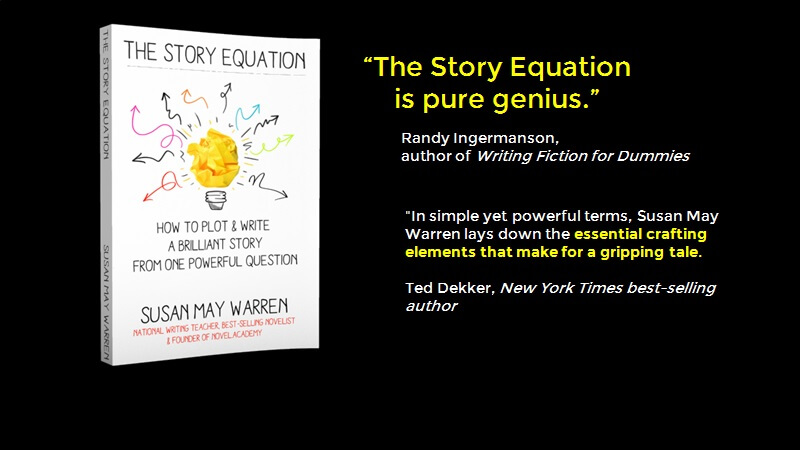
Susan May Warren is owner of Novel Rocket and the founder of Novel.Academy. A Christy and RITA award-winning author of over fifty novels with Tyndale,BarbourSteeple HillSummerside Press and Revell publishers, she's an eight-time Christy award finalist, a three-time RITA Finalist, and a multi-winner of theInspirational Readers Choice award and the ACFW Carol. A popular writing teacher at conferences around the nation, she's also the author of the popular writing method, The Story Equation. A full listing of her titles, reviews and awards can be found at: www.susanmaywarren.com. Contact her at:susan@mybooktherapy.com.