Get a Free Ebook

Five Inspirational Truths for Authors

Try our Video Classes

Downloadable in-depth learning, with pdf slides

Find out more about My Book Therapy

We want to help you up your writing game. If you are stuck, or just want a boost, please check us out!

Showing posts with label fiction research. Show all posts

Friday, December 16, 2016

5 Ways to Spark Connections with Your Story

by Michèle Phoenix

1. Find a significant point of connection

As an English teacher, I was constantly telling my students to “write what you know.” By that, I didn’t mean that each one of their short stories, poems and screenplays needed to be autobiographical. What I was suggesting is something I’ve found to be true: if there’s a place, a character or an element of the plot line that links me to the story—so much so that I can write it out of intimate knowledge and personal identification—it will infuse the rest of the book with a sense of authority.

That’s exactly what I did in Of Stillness and Storm. My parents were missionaries to France for forty years, and I lived surrounded by devoted Christians whose hearts were in the right place, but whose priorities were sometimes obscured by their zeal to reach the unbelieving. Lauren and Sam—with their laudable strengths and deplorable flaws—are composites of the family friends who populated my childhood.

Did I have to do research into locations, lifestyles and medical details? Of course, I did. But ministry flows through my veins, and anchoring the book to that real-life knowledge helped me to write confidently and ultimately galvanized the creative process.


2. Look for “the spark” in unexpected places

To be honest, I’d wanted to write a story set on the mission field for some time, but lacked that illusive but crucial spark that becomes the impetus to sit down and start typing. I had bits and pieces floating around my mind—hints of personalities and shades of conflict—but it wasn’t until 2012, when I traveled to Kathmandu for the first time, the novel began to crystallize. I was struck by the beauty and brokenness of Nepal, and I saw in its desolate landscape and difficult living conditions a metaphor for the toll an honorable but reckless ministry can take on good people.

A story centered on a missionary couple’s personal journey from their first encounter to their moment of reckoning emerged from the geographical symbol I’d found while traveling for other reasons.


3. Let your characters teach you who they are

I’ve never been someone who carefully crafts characters before the writing begins, so for me much of the initial process is just waiting for them to reveal themselves. When Lauren first spirited her way into my mind, she carried with her the weight of a past I couldn’t wait to explore. Learning who she was and why she was became a powerful incentive to keep digging deeper.

Loving one’s characters, flawed and fallible as they may be, is also imperative. It empowers the writer to be courageous in exposing their struggles. Because I felt so devoted to Lauren, the evolution of her marriage to Sam was a story I strove to treat with unflinching honesty. The degradation of her bonds with a son she loved so fiercely was an aching exercise in resisting the urge to settle for happy endings. Aidan’s reappearance in her life was a complete surprise, even to me. But once he emerged with those four simple words—is it really you—he became someone I wanted to write boldly, a galvanizing presence in Lauren’s grappling with purpose and identity.


4. Step away, but don’t give up

Of the books I’ve had published so far (there’s one more coming in September 2017!), this is the one that was the hardest to write. Though the first drafts of other novels took me just three or four weeks to pour out, this one took me months. And here I’d thought familiarity with the context would simplify the process! There were times when I wanted to scratch it all and find another story to tell, but there was an intensity to Lauren’s “occupation” of my creative spaces that I couldn’t quell. So I powered through.

Once I found the courage to share what I’d written with select friends and critics, early feedback wasn’t all encouraging—though it was exactly right. When my college writing professor, who had volunteered to read an early draft, sent a rather bluntly-worded email to me, I realized my best intentions and efforts were not paying off. “I’m past chapter eight,” she wrote. “What will keep me reading? Is it coming soon?”

Oh, the temptation to throw in the towel—or throw out the Macbook! I set the manuscript aside for several weeks, perhaps hoping that leaving it unattended would cause a sort of literary fermentation to happen that would miraculously elevate the novel from boring to readable. Still, it tugged at my consciousness, the unfinished story crescendoing from a dull hum to an attention-grabbing screech. So when my period of pouting was over, I set to work deconstructing and reconstructing what I already had, shifting some scenes and deleting others, and generally distilling the book to its most basic, focused form.

Of Stillness and Storm was born.


5. Live around your writing

Writing is something I do. It is not the measure of my worth. Over the years, I’ve taught a handful of students who boldly declared, as Aidan does in the novel, that they—are—their—art. They were willing to rest their self-assessment and sense of value on an occupation that offers absolutely no guaranteed outcomes. How dangerous to base one’s identity on something as subjective and unpredictable as writing.

Though I’ve always loved the written word and fancied myself an author, I was fortunate enough to discover in my early adulthood that I have other strengths too—skills that have brought me a sense of purpose and productivity beyond the Russian Roulette of traditional publishing. Would my life still have meaning if Tyndale and Thomas Nelson had passed on my books? Absolutely—because there are other areas in it that motivate and fulfill me too.

Writing is important. It can be life-shaping and world-altering. So can kindness, investment in others and finding novel ways of using all one’s strengths for the betterment of self and others.

TWEETABLES

5 Ways to Spark Connections with Your Story by Michèle Phoenix (Click to Tweet)

Step away, but don’t give up~ 
Michèle Phoenix (Click to Tweet)


Bio:

Born in France to a Canadian father and an American mother, Michèle Phoenix is a consultant, writer and speaker with a heart for Third Culture Kids. She taught for 20 years at Black Forest Academy (Germany) before launching her own advocacy venture under Global Outreach Mission. Michèle travels globally to consult and teach on topics related to this unique people group. She loves good conversations, mischievous students, Marvel movies and paths to healing. Learn more at michelephoenix.com Twitter: @frenchphoenix

Book Blurb:

“I felt torn between two worlds. Each with its own mystery. One more captivating than the other, but the other more real and breathing.”

It took Lauren and her husband ten years to achieve their dream—reaching primitive tribes in remote regions of Nepal. But while Sam treks into the Himalayas for weeks at a time, finding passion and purpose in his work among the needy, Lauren and Ryan stay behind, their daily reality more taxing than inspiring. For them, what started as a calling begins to feel like the family’s undoing. 

At the peak of her isolation and disillusion, a friend from Lauren’s past enters her life again. But as her communication with Aidan intensifies, so does the tension of coping with the present while reengaging with the past. It’s thirteen-year-old Ryan who most keenly bears the brunt of her distraction.

Intimate and bold, Of Stillness and Storm weaves profound dilemmas into a tale of troubled love and honorable intentions gone awry.


Thursday, November 03, 2016

Helping Art to Imitate Life


by Dan Walsh

There’s a piece of writing advice beginners are sometimes told: “Write what you know.” I get why. Fiction writing is all about making stuff up. If you write about things you know well, it’s much easier to sound credible and authentic as your story unfolds (as you make stuff up).

I heard this advice back in the days when I was crafting my first novel. I knew a whole lot about WW2, had been studying this era as a hobby for many years. So I set my first 2 novels (The Unfinished Gift and The Homecoming) on the homefront during WW2. Worked out great.

But in time, 2 things began to surface that revealed some flaws in this “write what you know” idea. If you plan to keep writing books, you eventually run out of things you know. Or you find, you don’t want to keep writing about the same thing over and over again (the thing you know).

Something I’ve learned to help offset this problem is to start paying attention to the things going on in my life that might actually—with some help—become decent material for my books. I added “with some help” because, let’s face it, my life, as is, would bore the average reader to tears. That is, taken as a whole. But if I spend some time breaking it down a bit, I realize my life does have some non-boring, interesting parts. Occasionally, even some exciting, adventurous parts. Admittedly, they are few and far between. But they do exist. And they are mine. I can use them in my books and don’t even need to get anyone’s permission.


Here’s an example. My wife is an amazing dog trainer (she’s professionally certified and has trained over 1,000 dogs). For 4 years, she was the Animal Behavior Manager at our local Humane Society and now trains dogs in a private practice. Every day she would come home with these fascinating stories. It dawned on me, I could do a series that featured a rescue shelter dog as a main character, as well as a dog trainer similar to her (only younger and single, so I could add a romantic thread). I’ve borrowed bits and pieces from some of her best stories to create at least 3 very good novel ideas (maybe more).

Just like that, and the Forever Home series was born. Rescuing Finley (Book 1) came out last November and is doing extremely well (276 Amazon reviews, Avg 4.8 Stars). I just released Book 2, Finding Riley, on October 1st. And here’s another fun way I helped Art to imitate Life…the dog on the cover of Book 2 (who’s playing Riley) is actually Charlie, a mixed spaniel dog we brought home from the shelter 2 years ago. I was able to use all kinds of things drawn from real-life experiences with Charlie in my new novel.

I just weave all this real-life stuff in with the made up stuff (which is often way more exciting) and it seems to be working out great (17 novels later).

Here’s my final example. We live in Daytona Beach. Two weeks ago, Hurricane Matthew came barreling through the Caribbean straight for us. It had been 12 years since we’d experienced a hurricane. Back in 2004, we went through 3 of them (and we didn’t evacuate; we stayed home). But the folks on the Weather Channel, and our local weather experts, were all saying this storm might hit us head-on as a strong Category 4. They were warning about massive tidal surges, roofs tearing off of houses, trees coming down all over.


Suddenly, we were told we had to evacuate…only 2 hours before the weather outside would start getting really bad. We rushed around the house, gathering insurance papers and things that mattered most into bags and suitcases, packed up the dogs, and joined a caravan of family members out on the highway (along with hundreds of thousands of others).

We drove nine hours straight toward Atlanta, wondering if we’d even have a home to come back to. The next few days provided quite an adventure.

At one point, my wife looked over at me, smiled and said, “I think Jack and Rachel will have to go through a hurricane.” I said, “Oh yeah. They definitely will.”

Who are Jack and Rachel? They are the main characters in my other novel series, The Jack Turner Suspense series. Jack and Rachel don’t know it yet, but their future now includes a number of crazy hurricane experiences that will remarkably resemble our own.

How about you? Share some of the moments when your Art has Imitated your Life in your writing.

TWEETABLES


*     *    *

Dan Walsh is the bestselling author of 17 novels, including The Unfinished Gift, The Reunion and When Night Comes. He has won 3 Carol Awards (finalist 6 times) and 3 Selah Awards. Three of his books were finalists for Inspirational Book of the Year (RT Book Reviews). Dan is a member of ACFW and Word Weavers. He lives with his wife, Cindi, in the Daytona Beach area where they love to take walks and spend time with their grandkids. Click here to connect with Dan or check out his books.

Friday, August 09, 2013

Solving Mysteries Through Research ~ by Sally J. Ling


Sally J. Ling, Florida’s History Detective, is an author, speaker, and historian. She writes historical fiction and nonfiction and specializes in little known stories of Florida history.
As a special correspondent, Sally wrote for the Sun Sentinel newspaper for four years and was a contributing journalist for Boca Raton, Gold Coast, Delray Beach, Boca Life, Jupiterand Palm Beacher magazines.
Based upon excerpts from her book Run the Rum In, Sally appeared in two TV documentaries-- “Gangsters” - the National Geographic Channel, and “Prohibition and the South Florida Connection” - WLRN, Miami. She served as associate producer on the latter production.
She has been a guest on South Florida PBS TV and radio stations, guest presenter at the Lifelong Learning Society at Florida Atlantic University and Future Authors of America, and guest speaker at numerous historical societies, libraries, organizations, and schools. 
Sally lives with her husband, Chuck, and her cat, Kitty, and splits her time between Deerfield Beach, Florida, and Wolf Laurel, North Carolina.

Research is Like a Mystery Waiting to be Solved

Sally J. Ling


As a child, I loved putting jigsaw puzzles together. My two sisters and I would spend hours hunched over the card table, fitting the borders together first then finding just the right pieces to make the 1,000-piece puzzle resemble the picture on the box. The hunt for each piece was exciting, like trying to solve some mystery. Perhaps that is why I so like doing research for my books today.

Whether I’m writing historical nonfiction about a fascinating part of Florida history or a novel, I always approach my research as though it’s a mystery waiting to be solved. It keeps me motivated, and I never know where the smallest piece of information will take me. Consider the case of the missing child.

While researching the 1948 Boca Raton, Florida, double homicide of the prominent Italian sculptor and his wife, Leno and Louise Lazzari, I noticed in the police deposition that Margie, the woman who found the bodies, stated that when she came to live at her current home in West Palm Beach in 1934 there were five Constiglioni children. The 1930 Census Report I held in my hand, however, listed six children. One child was missing. Though the missing child wasn’t really central to the account of the homicides, the questions who, what, when, where, and why became an itch that needed to be scratched.

Through genealogical records, I discovered that it was Gloria, the fifth Constiglioni child, who was missing. The mystery became more intriguing when the police report from the homicide stated that in 1932 Gloria’s mother Theresa was committed to the state’s mental hospital. My nose said that the two incidents were connected, that something horrific had happened that sent the mother over the edge. But what?

After obtaining the child’s death certificate from the state, part of the mystery was solved. The four-year-old child accidently caught her clothes on fire while playing with matches. She was severely burned in the incident and died in the hospital two days later. Now I had partial proof of what I suspected—there was a horrendous incident. But . . .  was this really what sent poor Theresa to the mental institution? After all, she didn’t enter the hospital until two years after the child’s death; and, even though I had the deposition, police and census reports, and death certificate, I couldn’t just go on my hunch. I still needed concrete proof of a direct connection between the two incidents. That came just days later.

Solid research is the foundation of any good book, whether fiction or nonfiction. It makes the story believable, it gives the author credibility, and in a novel, provides enough truth to allow the mingling of fiction with fact to draw the reader in and make the entire story credible. In my latest biblical novel The Cloak, several readers actually asked me if the story was real. If the reader cannot separate fact from fiction, the author has accomplished his or her goal and received the ultimate compliment.

Gloria’s mystery was solved when, through a combination of research and luck, I found two of her sisters. At ages 88 and 92, they were able to confirm my hunch and provide the rest of the story. Their mother was so distraught by the unfortunate death of Gloria she literally lost her mind. Her admittance card from the Florida State Hospital stated she was “chronically insane.”* There was my proof.

As I mentioned, you never know where your research will lead. It was because of Gloria’s mystery and the fact that Theresa wound up in the Florida State Hospital that my latest nonfiction book, Out of Mind, Out of Sight, was born. It is the first book to give a complete history of the mental facility at Chatahoochee, Florida, after more than 135 years of existence.

So, you see, research really is like a mystery waiting to be solved.


*This is not a standard term used in today’s mental health field.


Wednesday, May 29, 2013

Research ~ the Fun Way


S. Dionne Moore resides in South Central Pennsylvania with her family. She is a weekly contributor to The Borrowed Book blog where she offers tips on the writing life, posts recipes, and teaches on various writing-related subjects. She has a passion for history and obscure fact that can be spun into a story and also enjoys gardening, piano and wants everyone to know that if you get to Sharpsburg, MD, you MUST stop at Burkholder's Bakery and try the best chocolate covered, cream filled donuts on the face of the earth. No exaggeration. You're welcome.


One of the reasons I write historical romance is that I love conducting the research. For my May 2013 release, A Heartbeat Away, I traveled to Sharpsburg, Maryland, the setting for the bloodiest battle of the Civil War, the Battle of Antietam (Sharpsburg, for you southerners).

Sharpsburg is a very small town, unscathed by commercial development, a true gem of history frozen in time by the town's refusal to allow commercialism to mar what they have worked so hard to preserve.

I was taken on a private tour by Bob Murphy of RCM History Tours (RCM Twitter). His prices are very reasonable and he accommodated my desire to walk some of the tour. I stayed at the snug and very clean Mary Hill House.

Now for the pics...

Outside of the church. This is the church Gerta Bumgartner would have attended if not for the battle raging on the top of South Mountain that Sunday.


The inside of the famous Dunker Church


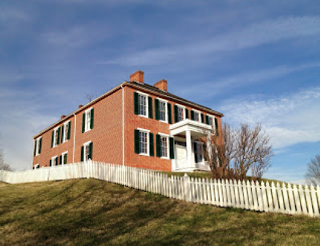
Piper Farm was the model for the house neighboring Gerta’s fictional home. This farm became the headquarters for Confederates Longstreet and Hill during the battle.


Mumma Farm was the only farm burned up during the battle. The springhouse didn't burn and was my inspiration for Gerta’s spring house where the reader first encounters the injured Joe.


Roulette Farm--in my story, the Roulette's are escaping to the caves along the Potomac. 
Caves that are real, I might add.


Bloody Lane, called Hog Trough Lane before the battle

Burnside Bridge from the Confederate side. 
With only 300-400 soldiers holding off over 2K because they held the higher ground.


Antietam National Cemetery

Grove House, Lee's Headquarters in Sharpsburg during Confederate occupation


Do you see the shell stuck in the side of this house? 
Every house in Sharpsburg was used to shelter the wounded. 


McClellan's command was centered at Pry House. Not open for tour at the time of my trip. :(


Uh, this wasn't part of the tour, but was part of the recovery. 
Nutter's Ice-Cream. 4 scoops for $2.95. I was sold!

Have you visited a Civil War battlefield or historic site? If you could visit one historic site anywhere in the world, where would it be? Please join the conversation below in the comment section.


A Heartbeat Away


When a band of runaway slaves brings Union-loyal Elizabeth "Beth" Bumgartner a wounded Confederate soldier named "Joe", it is the catalyst that pushes her to defy her pacifist parents and become a nurse during the Battle of Antietam.

Her mother's mysterious good-bye gift is filled with quilt blocks that bring comfort to Beth during the hard days and lonely nights, but as she sews each block, she realizes there is a hidden message of faith within the pattern that encourages and sustains her.

Reunited with Joe, Beth learns his secret and puts the quilt's message to its greatest test--but can betrayal be forgiven?


Sandra D. Moore is a transplanted city girl and glad of it! She enjoys ferreting out little-known historical details and crafting a story around them. Her new releases include Promise Brides (3-in-1 historical romances set in PA) of which two stories are ACFW Carol Award Finalists. In May 2013, A Heartbeat Away, Book 7 in Abingdon Press’s Quilts of Love series, releases. Murder on the Ol’ Bunions released from Smashwords as an ebook in March 2012 followed by Polly Dent Loses Grip and for the first time ever, Your Goose is Cooked, the third and final book in the LaTisha Barnhart Mystery series. To learn more about Sandra and her cozy mysteries and historical romances, visit her website here, Twitter or Pinterest. 

Wednesday, January 09, 2013

Location, Location, Location to Research


Tricia Goyer is an acclaimed and prolific writer, publishing hundreds of articles in national magazines  while authoring more than twenty-five fiction and nonfiction books combined. Among those are 3:16 Teen Edition with Max Lucado and the American Christian Fiction Writers’ Book of the Year Award winners Night Song and Dawn of a Thousand Nights. She has also written books on marriage and parenting and contributed notes to the Women of Faith Study Bible. Tricia lives with her husband and four children in Arkansas.

I've written over thirty novels and for most of them, I've traveled on location for research. It takes time. It takes money, and folks may wonder if it's worth it.

It's possible to accurate novels without traveling on location, but sometimes the location forms the story.
This happened with my co-written novel Love Finds You in Glacier Bay, Alaska. When Ocieanna and I got the idea for Glacier Bay we knew we wanted to mix a historical story with a contemporary one. We had a basic idea, but we were basically researching two books, set in two time periods.

Ocieanna and I traveled to Lonesome Prairie, Montana, and to Seattle, Washington for our previous books, and we knew the benefit of on-site research. We hoped we'd find the same benefit in Glacier Bay.

 If you are looking to travel for research here are some things that might help.

1. Connect before you go. In each of our trips we did some research ahead of time and found knowledgeable people to talk to. The best places to look were historical societies or museums. A phone call goes a long way. Call the local historical society and museum and set an appointment to visit. Let the person know what you're looking for. We've found wonderful people willing to help. They get excited that writers are interested in what they know. They like to share their expertise. (Just remember to take down everyone's name so you can thank them in the acknowledgements.)

2. Talk to locals. One of my favorite things to do is simply talk to the locals. Ask: “What is unique about the area? What are some of you rfavorite stories that you tell others. And who else can I talk to.

3. Don't go with a fixed schedule. Some of the best research and stories have come from unexpected interviews.

4. Have a few set questions, but allow for rabbit trails. Be a good listener.

5. Be observant. This is obvious, but don't just focus on the mountains, the houses, or the museums. Look at the bulletin boards, the grocery store shelves, and ask about the local walking trails.

6. If you've discovered wonderful, colorful locals, write them into the book. Ocieanna and I were able to do this with Glacier Bay. Both historical figures and current residents found their way into our novel. (Just make sure you ask permission!)

7. Don't be so fixed on your storyline that you don't have room to weave all the good stuff in. With each of our books, Ocieanna and I had a basic idea of the storyline, but we had plenty of room to expand and change the plot after our trips.

8. Ask for pre-readers. After your trip send thank you notes to those you interviewed. When you write, also ask if the person would be willing to read your manuscript after you're done. This is  an important step. You can travel, do research and work as hard as you can to get things right, but there are always those little things that a writer misses. When the book is done our goal is to get even the locals to admit, “They got it right.”

What about you? Do you travel to do research? What are the benefit? How has your research impacted your writing?


Love Finds You in Glacier Bay, Alaska

Singer Ginny Marshall is one signature away from the recording contract of her dreams—a deal that would guarantee success for the former foster child, who still struggles to bury the memories of her painful childhood. But Ginny needs advice from the one person who will look out for her best interests—her former fiancĂ©, Brett Miller. She travels to the remote town of Glacier Bay, Alaska, where the town’s colorful characters and stunning scenery provide respite from LA’s pressures.

In Glacier Bay, Ginny discovers a box of old letters and is swept up in the love story between Clay, an early missionary to Alaska Territory, and Ellie, the woman who traveled there to be his children’s governess. When Ginny is reunited with Brett in Glacier Bay, will she discover—as Ellie did—that healing and love are sometimes found in the most unexpected places?