

Get a Free Ebook

Five Inspirational Truths for Authors

Try our Video Classes

Downloadable in-depth learning, with pdf slides

Find out more about My Book Therapy

We want to help you up your writing game. If you are stuck, or just want a boost, please check us out!

Showing posts with label am writing. Show all posts

Friday, December 30, 2016

Write a Book in 3 months in just 3 Hours a Day

by Susan May Warren

Looking back at 2016, did you finish that you'd planned to write? It may be too late to finish this year, but 2017 is full of possibilities. 2017 is the year you can get your book written, or maybe two, dare I say three? Because you can write a book in just three months!

Write a book in 3 months? In three hours a day? And have a family life, too? Bah!

You laugh, but seriously, it can be done. Now, I’m not saying it’s easy. But the fact is, with a little “nose to the grindstone” as my father used to say, it’s possible.

Here’s how:

First, we talked yesterday about the four keys to a successful writer’s life. If you’ve committed to the task, found your writing space, wheedled out time from your schedule and determined to keep a running game plan, then it’s time to talk strategy.

Let’s assume you have 12 weeks to write a 30 chapter book, with approximately 3000 words per chapter. That’s 1500 words per scene. That’s 6 pages per writing session, 180 minutes per scene. That’s thirty minutes a page.

Calm down. Breathe. Think about it. Can you sit down and write a blog in 30 minutes? If you already had the idea, already had the words brewing inside you? Probably most of you can. Maybe you can even do it faster than that, but we want to leave room for editing, and revisions, and notes.

And I know at least some of you do that NaNoMoWrite (I feel like I’m talking Morkish when I say that and I probably didn’t even get it right!) – that write a book in a month thing. So I think I’m being rather generous at 3 months.

Now, you’re going to pad in on either side with 2 weeks of character development, and 2 weeks for rewriting and editing, synopsis and query letter. So, yes, we’re talking 4 months, but really, the concentrated, “under the thought blanket” time (as my kids call it) is three months.

Pre Week 1: Research of idea and premise, preliminary characterization and rough brainstorming of plot.

Pre Week 2: Further Research, the cementing of characterization and synopsis writing. Sometimes, a chapter by chapter summary of the book helps at this time.

We’re going to spend the month of January talking a lot about what goes into prewriting. There are people who take months in prewriting, so I don’t count that as actual novel writing time. They live with their characters in their minds for a while, having conversations, trying on names and attire until they have them just so…and then they embark. During this time, do enough research to get your story plausible, and outline the major plot twists in the story. I always write a synopsis at this point, also, as a sort of guideline.

Then I write my first chapter. Here’s a hint: Often your first chapter isn’t one you’ll really use. It’s the “finding your character’s voice” chapter and really, it contains WAY too much backstory to use in the book. But it’s helpful as a warm up to the big event.

Week 1: Starting day. First, gather your research material around you (use lots of those big brightly colored paper clips so you can bookmark pages), and a notebook. Open up a new file and call it something terrific like Susie’s Super Suspense Book 1. (Okay, not using my name, of course, or, I suppose if you want to….) Then, open up a new doc and title it: Chapter 1.

At this point, you’re going to turn off your internal nasty editor, the one that tells you things are not grammatically correct, or perhaps you’re using a word no one has heard of before, and you’re just going to write. Splash the words onto the page. Ignore the red and green squigglies – just write. A cup of hot cocoa helps, and I’m a big fan of mood music. If you get to a point where you’ll need to do more research, put in something plausible, and denote it with an * — saying you’ll GET BACK TO IT. Don’t disrupt your writing flow. If you have a word you hate, yet can’t find the right one – Asterik it! If you can’t remember a character’s name, or eye color – Asterik it! When you’re done with your ms, you’ll read through each chapter, do a search for the Asterik’s and change it when you’re mind isn’t cluttered with story.

But what if I come up with a great story thread half way through the scene? Should I stop and go back and fix it?

NO! did you hear me? NO! Make an…what? ASTERIK! Start writing the story from this point on with your new story thread. THEN, make a note in your notebook to go back and add in or tweak that story thread AFTER you’ve finished the book. Seriously. It’s your story. No one will read it until it’s done. It’s in YOUR brain. So you don’t have to have to add everything in until you’re ready.

And right now you want to…just keep writing, just keep writing…

Once you’ve finished your scene, SAVE. And then open a new doc, label it CHAPTER 2 (or maybe Chapter 1, scene 2), and make a few notes about what you’d like to open with next scene, or things you want to accomplish. OR, you can do this in the notebook I talked about yesterday. The strategy is to jump start your mind the next time you sit down.

Now:

Close the computer.
Stand up.
Stretch.
Dance through the house shouting, “I finished Chapter 1! I finished Chapter 1!

Go to bed, and pray for words for Chapter 2.

If you want, you can spend the weekends doing more research, or going back and rereading any points you wanted to refine.

Keep doing this for the next 12 weeks. You’ll be surprised at how disciplined you get, and how fast the words flow out. And how refreshing it feels to say, I’ll get back to all those asterisk later!

When you write the final chapter, take a weekend break. (Take your poor family out for dinner, for Pete’s sake!)

You’ll spend the NEXT two weeks adding in those threads, re-writing, fixing all the green and red squigglies and doing a rough edit, then a thorough edit, and then a polish. Okay, it might take you longer than 2 weeks. But the key is…the story is DONE. It’s out of your brain.

And you can say…hey, I wrote a book in 3 months!

Don't let another year slip through your fingers! Let 2017 be the year you finished that book - maybe even two!

TWEETABLES

Write a Book in 3 months in just 3 Hours a Day by Susan May Warren (Click to Tweet)

Did you get that book written that you'd planned to write?~ Susan May Warren (Click to Tweet)

Just keep writing, just keep writing…Susan May Warren (Click to Tweet)


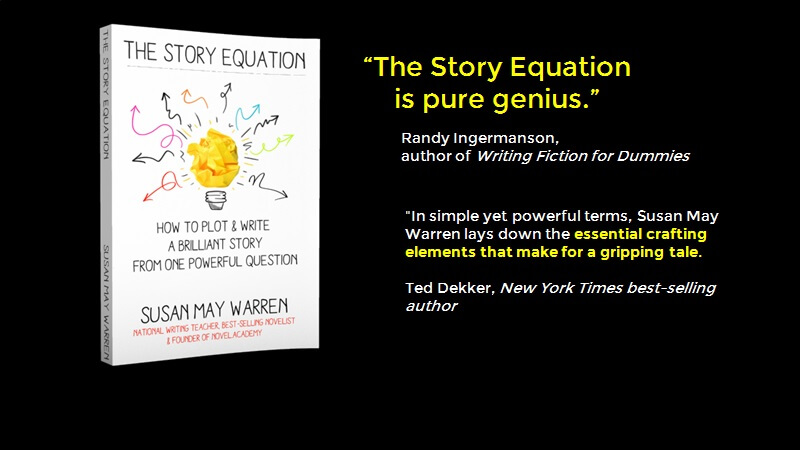
Susan May Warren is owner of Novel Rocket and the founder of Novel.Academy. A Christy and RITA award-winning author of over fifty novels with Tyndale,Barbour, Steeple Hill, Summerside Press and Revell publishers, she's an eight-time Christy award finalist, a three-time RITA Finalist, and a multi-winner of theInspirational Readers Choice award and the ACFW Carol. A popular writing teacher at conferences around the nation, she's also the author of the popular writing method, The Story Equation. A full listing of her titles, reviews and awards can be found at: www.susanmaywarren.com. Contact her at:susan@mybooktherapy.com.

Friday, December 23, 2016

Holiday Non-Writing Tips

by Susan May Warren


Let’s be honest—you’re not writing during the Christmas season. Neither am I. With all the glitter, the Christmas-sing-alongs, the baking and the general melee of the season, congealing your thoughts into a coherent, let-alone tension-filled scene is like trying to choose just one cookie to choose from the Christmas buffet table.
Give it up.
Instead, how about using the next two weeks to prep for an amazing 2017 writing year?
Here are a few ideas to keep your brain simmering on story while you enjoy that spiced cider.
1. Give yourself a break! I’m not talking about simplifying (although, that is good—only one kind of cookie on the tray means less agonizing choices!), but rather—actually going to your room, shutting the door and having a moment of quiet. Listen, I know—if you have little children—quiet isn’t easy. I used to require an hour of reading every day during Christmas breaks (and summer, too!). The kids (if they were little) got to choose books from our special “book basket” to read on their bed. Or I might turn on an audio book and give them a few toys to play with. I might even spread out a blanket on the floor (each child gets their own) and declare it “their zone”—to play/read in.
And then go get a book, something lavish that you are reading just for the pure enjoyment of it (I can recommend a few—Rachel Haucks, A Royal Christmas Wedding, Melissa Tagg’s Christmas novella, One Enchanted EveRonie Kendig's, Conspiracy of Silence) and indulge yourself in a chapter. I read a book for fun nearly every weekend of the year—but I read “biz” books—novels for endorsement, or research, or just to challenge my writing—during the week. But for two weeks during Christmas, I allow myself to indulge in decadent fiction—books I might not normally have time for.
And, in quieting my brain, allowing myself this lavish luxury, inevitably, great ideas for my own writing will surface.
Quiet Time Reading—a little gift you give yourself.
2. Gather around the fire! Bring back the old “Christmas read-aloud” tradition. In our family, we do a Christmas puzzle every season. Often, we listen to Christmas music. But occasionally, we have a family read aloud—I read, while people puzzle. When the kids were younger, each child got to choose one book, one per night, leading up to Christmas. Reading aloud is like yoga for the writing brain. We hear delightful dialogue, savor story world, and become the characters we’re reading. And, when we enjoy a story together, we are reminded not only what makes a great story . . . but why we write.
Some of our family favorites: David Barry’s The Shepherd, the Angel, and Walter the Christmas Miracle Dog
Back To Christmas, by my author friend Dennis Canfield
3. Turn OFF and let your brain turn ON. About 6 months ago, I decided to go device-free on the weekends. Yes, I post our Saturday football game crew on Facebook, but then I turn my social media off until Monday. I find it de-clutters my brain and allows me to just enjoy my people, the game, and the space of life. One of my favorite things to do is take a walk on a Sunday afternoon, let my thoughts air out and get some perspective.
When I do this, I find room for other thoughts—deeper ones that can influence the themes of my stories, the depth of my writing.
So . . . let’s get crazy this holiday and walk away from social media from the 24th through the 26th. Really. And then, maybe get outside, take a walk. Give your brain a rest. It’ll come back online, restored and ready to go after the holidays.
I’ll miss you, but I’ll see you then.
Have a great Christmas holiday!
TWEETABLES
Susan May Warren is owner of Novel Rocket and the founder of Novel.Academy. A Christy and RITA award-winning author of over fifty novels with Tyndale,BarbourSteeple HillSummerside Press and Revell publishers, she's an eight-time Christy award finalist, a three-time RITA Finalist, and a multi-winner of the Inspirational Readers Choice award and the ACFW Carol. A popular writing teacher at conferences around the nation, she's also the author of the popular writing method, The Story Equation. A full listing of her titles, reviews and awards can be found at: www.susanmaywarren.com. Contact her at: susan@mybooktherapy.com.

Wednesday, December 21, 2016

Writing Over The Holidays

by Rachel Hauck

It’s the holiday season and if you’re anything like me, you’re busy. In fact, you’re probably more busy than I am because I don’t have children.

I have a book due and it’s overshadowing the Christmas season. But it’s not the deadline’s fault, it’s how I write. I fast draft a very ugly novel, then I rewrite. Almost from scratch. I layer and fine tune, change and deepen.

I write fast but nevertheless, it takes me a while to think things through. To figure things out. To take the norm and turn it upside down, inside out.

When I calculate how many pages I can rewrite and edit a day, and how many days until the deadline, adding in a visit from a friend and a short visit attached to a business trip, I come up a wee bit short. I can’t afford to take off the holiday!

But I’m going to anyway because despite how much I love writing and how much I am bound by honor to make my deadline, there are moments when “other things” are more important.

Ack, I know. From a writer’s perspective, what is more important? It’s taken me eight years to admit it’s okay to take a break for family, for a vacation or for other worthwhile causes like ministry or even lunch with friends.

But did you now the Lord gives to His beloved in seasons and times of rest? He does!

Psalm 127
Unless the Lord builds the house, its builders labor in vain.Unless the Lord watches over the city, the watchmen stand guard in vain.In vain you rise early and stay up late, toiling for food to eat for he grants sleep to those he loves.Sons are a heritage from the Lord, children a reward from him.Like arrows in the hands of a warrior are sons born in one’s youth.Blessed is the man whose quiver is full of them.They will not be put to shame when they contend with their enemies in the gate.
The Lord impressed this verse upon me the other day. He proved His Word true by the fact that when I awoke from a brief nap, I had the perfect opening line for my rewrite!

Then a pastor friend talked at dinner the other night about “rest” and letting the Lord use him even in a season of rest.

It’s hard for most of us to step back and not do. We feel like it’s more holy and Christian. Or it’s the American way. We may even feel like we don’t know what to do with the rest and quiet.

Maybe we should learn to get used to it. God does want us to rest. He blesses rest. Especially when we rest in and on the Him.

I know that when we writers are not at our computers working, no one covers for us. If I don’t get my 20 pages done, a co-writer isn’t going to take up my slack.

But wait, if the Lord is my co-writer, maybe… just maybe… He will make up the difference. So I can enjoy time with my family over Christmas.

So if you’re debating writing over Christmas, reconsider. At least for a day or two. Trust the Lord to take up the slack, give you words and story in your rest.

Now do what your therapist says… Enjoy Christmas!

JOY!!

TWEETABLES


New York Times, USA Today ​and Wall Street Journal best-selling, award-winning author Rachel Hauck loves a great story. She serves on the Executive Board for American Christian Fiction Writers. She is a past ACFW mentor of the year.  A worship leader and Buckeye football fan, Rachel lives in Florida with her husband and ornery cat, Hepzibah. Read more about Rachel at www.rachelhauck.com.

Friday, November 11, 2016

NaNoWriMo Scene Starter!

by Susan May Warren
[So—like you all, I’m writing a book in month with NaNoWriMo! Just to encourage myself, I dragged out this conversation I had with an aspiring author on how to keep going!
If you want the entire Conversation on How to Write a Novel, check out Conversations with a Writing Coach!]
*****
“How is your NaNoWriMo manuscript going?” I set my coffee down at the table where Sally sat waiting for me, drinking coffee and eating a cookie. A light frost tipped the grass outside, the lake frothy along the rocky shoreline.
“I think my brain is shutting down. I’ve written about two thousand words a day, but I am running out of ideas on how to start my scene.” Sally broke off a piece of her monster cookie, the fresh-baked smell enough to make me wish I hadn’t eaten breakfast.
“Have you done your scene preparation?  Figured out Layer One: what kind of scene it is, and the 5 Ws’?”
“Oh, that’s the easy part. And Layer Two isn’t so hard either. Creating Tension is easy once you understand the equation: a Character we care about who has a goal, as well as something to lose who meets obstacles that feel insurmountable so much so that we fear they’ll fail.”
“Right. The equation is: Sympathetic Character + Stakes + Goals + Obstacles + Fear of Failure.”
She broke off another piece of cookie. A M&M dropped onto her napkin. “But finding the first line and getting going that is stumping me. I feel like the words should just come to me, but…I’m staring at the blank page.”
“I understand. Let me teach you my first line/hook technique that is simple and fast to get you going into the scene. This is Layer Three and it’s simply about making the Hook SHARP.
“S stands for STAKES. What does your character have to lose? What can go wrong? You must have this element or there is simply no reason to have this scene, and especially no reason for your reader to stick with the story. In an Action scene, it’s something that could happen. In a ReAction scene, it might be making a bad decision. To find this, ask: What is the worst thing that could happen to your character right now? What does he/she fear?
“H stands for Hero/Heroine Identification. Why should we care about your character? What about your character makes us understand or even sympathize with him? To find that element ask: What do I have in common with my character? What need, or dream, or situation, or fear, or past experience do we share? And what about that can I extrapolate that fits into my story? Giving your character a realistic, sympathetic situation and realistic emotions is the key to creating that connection between your reader and your character.
“A stand for Anchoring, or Storyworld. Use your inner journalist to create place. By the end of the first paragraph, and for sure the first scene, you should have anchored your character into the scene by using the five W’s. Who, What, Where, When and Why? Then, add in the 5 senses. The Facts and Feelings work together to establish place and evoke emotions. The right storyworld can give us a feeling of happiness, or tension, even doom in the scene. Ask: What is the one emotion you’d like to establish in this first sentence, paragraph, scene? Using the five 5’s, what words can you find that conveys this sense of emotion? Use these in the crafting of your first paragraph.
“R reminds us to start your scene: on the Run. Writing craft instructor Dwight Swain in Techniques of the selling writer says that “a good story being in the middle, retrieves the past and continues to the end.” Your scene should start in the middle of the action, as if drawing back the curtain on the scene to find it already in action on the stage. Ask: How can I start my scene with the characters already engaging the problem of the scene?
“P helps us to identify and weave in the Thematic Problem, or the Story Question, in the scene. You will have one story question, or thematic question that drives your book. This question permeates all the decisions your hero and/or heroine make throughout the story. Ask: What thematic question is my character grappling with in this scene? How can you weave in the theme, or some part of it?
“Once you have identified all these pieces, climb into your POV character’s “skin” (or head) and stand at the edge of the stage, looking at all the activity and ask: What am I (as the character) thinking right now? Not what am I thinking about, but what am I thinking?
“Use this sentence to start your character in the scene. You can change it later, but at this moment, you’ll be in your character’s skin and able to go forward in their POV and write the scene. (Because you’ll know the goals, stakes, obstacles and even the thematic problem they’ll struggle with in the scene).
“What if I get the wrong first line?”
“Sally, there’s no wrong first line. But at this point, you’re just trying to get words on the page. Try it – you’ll be surprised at how the words just start to flow out of you once you figure out these elements.”
“I don’t know. I like to let the scene just . . . flow out of me. Organic. Seat of the pants.”
I looked at her cookie as she finished it off. “When you make cookies, you use the same ingredients for almost every kind of cookie. Sugar. Flour. Eggs. Salt. Baking soda. However, have you ever started making cookies and realized you’ve run out of one of the ingredients? Suddenly you have to run to the store, and your baking is stalled.
“The same thing happens when you are creating a scene. First, you assemble your ingredients. If you skip this part, you don’t know what you’re missing and you’ll suddenly be stalled in your creation process. This way, you’re pulling your “scene ingredients” out of the cupboard (your head) before you start mixing it together. You’re still writing the scene “Seat of the Pants” but you’re using specific ingredients to help you build it. And since you’ve assembled them before hand, you can flow without having to stop and figure out what you’re missing.”
“You’ve been eyeing my cookie all morning haven’t you?”
Truth: Success with scene building and maximizing your writing session is about preparation and gathering your ingredients before you begin. 
Dare: Do your prep work before you begin your writing session. An hour of planning will save you and hour of staring at an empty page!
Have a great writing week!
Go! Write Something Brilliant!
TWEETABLES
Susan May Warren is owner of Novel Rocket and the founder of Novel.Academy. A Christy and RITA award-winning author of over fifty novels with Tyndale, BarbourSteeple HillSummerside Press and Revell publishers, she's an eight-time Christy award finalist, a three-time RITA Finalist, and a multi-winner of the Inspirational Readers Choice award and the ACFW Carol. A popular writing teacher at conferences around the nation, she's also the author of the popular writing method, The Story Equation. A full listing of her titles, reviews and awards can be found at: www.susanmaywarren.com. Contact her at: susan@mybooktherapy.com.
Saturday, November 05, 2016

The Why and How of NaNoWriMo

By Ron Estrada

For those of you living off the grid, NaNoWriMo, which stands for National Novel Writers Month (writers are horrible with acronyms), kicked off this week. Every November, nearly half a million participants attempt to write a 50,000 word novel in one month.
There is no cash prize.
There is no guarantee of publication.
There is not even a guarantee that it will be good.

Wednesday, February 17, 2016

The Pressure of A Novelists Life

By Rachel Hauck

Last Monday I turned in a novel. My second one in seven months.

For some writers, that's a normal feat. Producing good reads every three months, or less, is common.

But that's extraordinary for me.

I've learned to become the fast novelist. In the fall I write a 105K novel in three months. Rewrote it in three weeks.

Then wrote a 52K novel. Very rough first draft. Ha! Blessed are the editors who read my manuscripts.

When my editor and I discussed my deadlines she offered to change them, but that meant releases would be delayed. Um, no, no...

"Let's go for it," I said. "Diamonds come from pressure."

I had peace. I knew the Lord would be with me. It was a season to apply a little elbow grease to the ole schedule.

But you know, it's never easy. Two years ago, that kind of schedule would've sunk me. I knew in my spirit not to take on a heavy load. Come the start of 2014, I knew why.

But last fall, I knew I was in a new season.

Writing always comes with a certain tension. Even on good days, there's a small tension in my gut.

The page is eager for a story not yet fully known. And I'm the only one who can discover it.

A novelist has to hide away when others are playing. Saturdays are not a day off when on deadline. Sometimes there is no "weekend."

When the story is finally finished and turned in, there's an elation. A relief. I liken it to the end of a tough quarter in college.

The sun shines brighter. The warmth is deeper. Music plays from some mysterious place in my heart.

I might go shopping. Or take an afternoon at the beach.

Lunch with friends. Yahoo!

But when creating diamonds...

The pressure never completely lets go.

A week after I turned in my latest novel, I woke up Monday morning with that tautness. "Time to write the next novel."

The next deadline is closing in. No break.

I have research books to read. Novels to endorse for friends. Other responsibilities to the writer community. To my worship team at church

Not to mention houseguests, a writers retreat, and an upcoming move by my in-laws to my town.

And the twist tightens.

The "joy" from the week off fades. Time to get back to work. The blank page is available for the pen of my words. Waiting for a story I have yet to conceive.

It never ends when you're a writer. If you're not writing, you want to be writing. If you're in between those two spaces, you're researching. Thinking. Trying to come up with the next great novel.

Some days I'd love to have a co-worker, you know?

"Hey, I'm going on vacay. Can you write the next three chapters for me? And, you know, make them brilliant."

Or "Hey, I'm a bit under 'it' today. Can you hammer out 2k words for me?"

Nope. There is no such person. I'm the only one who can write my stories.

You're the only one who can write YOUR stories.

Here's the deal. Diamonds DO come from pressure. When we shrink away from pressure -- let the read beware, pressure is different from stress -- we shrink away from the very thing that might produce our best work yet.

Is that the case with the two books I wrote in the fall? I have NO idea. The readers will be my judge.

But I gave the stories my all.  In the time allowed.

Do you feel it? The subtle knot reminding you your job never ends?

The pressure is good for me. It keeps me thinking, working, paying attention to the world around me.

But I have to know when to unplug and just be "me."

When I start to feel burdened or lost along the way, I go to the Lord. "This is your gig. Don't let me make it all about me."

Guess what! He's faithful to provide peace. Hope. Joy! And everything I need for the next story.

Here's some tips for managing the pressure life of a novelist:

1. Avoid comparison.

2. Get ahold of your time. Set hours to write and hours to play. The more you write the more you'll realize your best routine and habits.

3. Take notes. I'm bad about this these days but jot down ideas when you're out and about so you don't forget them.

4. Have faith. The Lord is with you! Period. Give doubt the boot.

5. Use the pressure positively. To help you get to work. When pressure hits during your down time, tuck it away and relax.

6. Hit the gym. Or take a long walk. Exercise is always good for the mind-body connection.

7. Think long range. The "poor" only think of/plan for today. The middle class plans in terms of years. The wealthy of the wealthy think in decades. Give yourself time to become a great author. Stick with it. It will pay off.

Happy writing!

***


Rachel lives in sunny central Florida. 

A graduate of Ohio State University with a degree in Journalism, she worked in the corporate software world before planting her backside in uncomfortable chair to write full time eleven years ago.

She’s the author of USA Today, EPCA and CBA best selling novels. She is a RITA and Christy finalist. 

Her latest book, The Wedding Chapel, was named to Booklist Top Ten Inspirational Novels of 2015.

She co-authored the critically acclaimed Songbird Novels with platinum selling country music artist Sara Evans. Their novel Softly and Tenderly, was one of Booklists 2011 Top Ten Inspirationals.

Rachel serves on the Executive Board for American Christian Fiction Writers. She is a mentor and book therapist at My Book Therapy, a conference speaker and worship leader.

Rachel writes from her two-story tower in an exceedingly more comfy chair. She is a huge Buckeyes football fan.