Get a Free Ebook

Five Inspirational Truths for Authors

Try our Video Classes

Downloadable in-depth learning, with pdf slides

Find out more about My Book Therapy

We want to help you up your writing game. If you are stuck, or just want a boost, please check us out!

Showing posts with label FBI. Show all posts

Saturday, October 11, 2014

Research Tips for Strengthening the Suspense Threads in Your Novel


Sandra Orchard is the award-winning author of Deadly Devotion and Blind Trust with Revell Publishing and of many novels with Love Inspired Suspense. Her stories have garnered several Canadian Christian Writing Awards, a Romantic Times Reviewers’ Choice Award, and a Daphne du Maurier Award for Excellence in Mystery/Suspense. She and her husband of 25+ years live in the heart of Niagara, Canada, not far from their three grown children and two adorable grandchildren. Learn more and check out the special bonus features for all her novels on her website or connect on Facebook

RESEARCH TIPS FOR STRENGTHENING THE SUSPENSE THREADS IN YOUR NOVEL


Since books and movies are fraught with inaccuracies when it comes to police and forensics etc, it’s easy to perpetuate those in our own stories. And to be honest, when I ask my go-to detective or my go-to former FBI agent questions, they’ll often say it’s fiction, you can fudge it to work. But…

The more you know about the elements in your story, the more authentic you can make them sound.

If you write in your contemporary novel that she smelled cordite after a gun was fired, every reader who knows anything about guns will know that you haven’t done your research—not the impression you want to make.

So where do you get your information? 

The internet is most writers first stop. You can input just about any question into Google’s search engine and get hundreds of thousands of answers. Some that might even be right.

But don’t let the internet be your only stop.

Other fabulous secondary sources include training manuals and autobiographies. They are great references and provide tons of inspiration for actual scenes you might use in your book.

When I wrote my upcoming release, Identity Withheld, which has a firefighter hero, I read a firefighter’s training manual and watched countless YouTube videos of fires to see how they travelled and to see what firefighters were doing and to hear what was going on. I often Google sounds and listen to them over and over so I can describe them.

Another great thing about the internet is that it makes it easy to connect with primary sources. Professionals in various fields, from police to lawyers to weapons experts, have started websites or yahoo loops to answer writers’ questions. A couple of my favorites are The Graveyard Shift and the Crime Scene Writers’ Loop.

But don’t be afraid to call or email professionals directly. While researching Identity Withheld, I spoke to volunteer firefighters, full-time firefighters, a retired fire chief, a paramedic and a retired fire marshal. Each provided different insights that proved vital to crafting the story. And all were eager to share their knowledge.

If you can visit such professionals in person, all the better!

Seeing and handling and smelling and otherwise experiencing the things you wish to include in your book is invaluable in depicting it in a gripping way. The Writer’s Police Academy was such an opportunity for me.

I did the same Firearms Training Simulator that recruits do and I’ll tell you when I shot a hostage taker in the head and saw his brains splattered on the wall behind him, in the uncomfortably realistic interactive video, I nearly went ballistic on the cop who commended me on my great shot.

But whew, afterward, could I ever accurately write about what goes through your mind and body in moments like those. And I had a far better appreciation for the internal conflicts my characters might deal with as a result.

Locally, you could visit a shooting range or participate in a citizen’s academy.

Be bold.

Thanks to being bold, I was able to meet my heroine’s “colleagues” at the St. Louis FBI headquarters while visiting the city to research the backdrop for my next mystery series with Revell.

The FBI has a unit dedicated to providing assistance to authors and movie producers. There is a formal process for seeking assistance, which you can read about here: http://www.fbi.gov/news/stories/2008/october/a-guide-for-writers-authors-and-producers-1

My contact has been fabulously helpful and arranged for an on-site interview while I was in St. Louis. The Special Agent and media contact I met while there were incredibly generous with their time, and patient in answering my questions and offering insights into how they operate.

It will be another year before that story hits bookshelves, but in the meantime, you can check out how I incorporated my fire investigation and witness security research into Identity Withheld:

WITNESS IN HIDING

After exposing an illegal adoption ring, newly named “Kara Grant” is promised safety in Witness Protection. But someone has found her—and wants her dead. If only she could trust the handsome firefighter who catches her fleeing from a suspicious fire. Jake Steele seems to think she’s guilty of burning her own home. But how can she tell him who she really is and what she’s been through without bringing danger to the widowed father’s door? Yet with the criminals fast closing in, taking such a risk might be her only chance at survival. Because the price she’ll pay for her silence could be her life.

As a special bonus, Deadly Devotion, first book in Sandra's Port Aster Secrets will be offered in free e-format on October 16th for one day only.

Wednesday, June 11, 2014

Boots on the Ground by DiAnn Mills


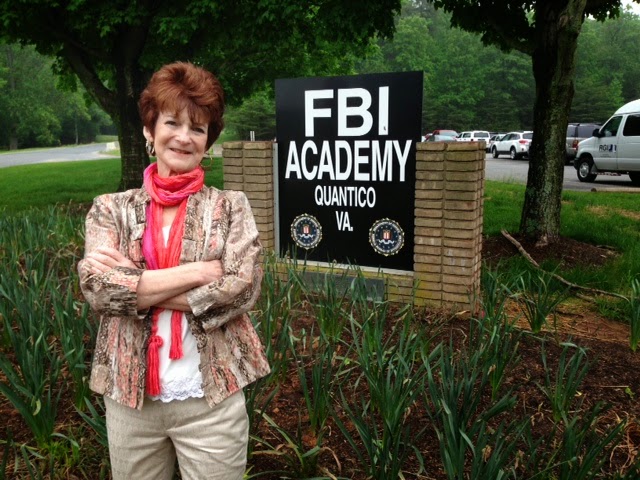
I’m proud to be a member of Houston FBI Citizens Academy Alumni Association. In May we traveled to Washington DC for a tour of the FBI Washington Headquarters and the FBI Training Academy at Quantico. What a fabulous inside scoop on counterterrorism, gang related crimes, behavioral science, and so much more including the intense training for not only FBI special agents but law enforcement groups from around the world.

Exciting and thrilling didn’t begin to describe the
experience.

I’m indebted to the FBICA volunteers and FBI personnel who made the trip informative with often sobering insights into what can happen if crime is not stopped and prevented. Awareness is the key for all citizens.

We heard impressive presentations at FBI Headquarters.

How amazing to have lunch in the FBI Cafeteria! Oddly enough, the men and women all looked normal, but they are super heroes! Afterward, we toured exhibits of FBI history. We saw former Director J. Edgar Hoover’s desk and viewed a demonstration by FBI sharpshooters. I don’t know how much practice it takes to shoot with that accuracy!

In addition to the incredible experience, I found my suspense writing would now take a higher level of credibility. A hitch in the trip was my endeavor to finish edits on a current novel. My editor wanted to know specifically how my bad guy was laundering money. You guessed it! One of the workshops at the FBI Headquarters focused on money laundering.

The next day, we rode a comfy bus to the FBI Training Academy at Quantico, VA. Our tour guide entertained us with his wit, incredible sense of humor, and vast historical knowledge of the FBI and its workings. He was onsite during the filming of Silence of the Lambs with Jodie Foster and explained a few scenes that weren’t accurate FBI protocol. The spookiest presentation was given by the Director of Behavioral Science. He showed us art created by serial killers while incarcerated, including self portraits. More like scenes from a horror movie.

That's my mean look.

Story ideas bannered across my mind when we visited the Hostage Rescue Unit, Tactical Firearms Training Center, and Hogan’s Alley. I didn’t want to leave. For sure if I had a chance to do it all over again, I would have been an FBI special agent. Oh, the writing would be so much easier. 


DiAnn Mills is a bestselling author who believes her readers should expect an adventure. She currently has more than fifty-five books published. Her titles have appeared on the CBA and ECPA bestseller lists; won two Christy Awards; and been finalists for the RITA, Daphne
Du Maurier, Inspirational Readers’ Choice, and Carol award contests. DiAnn is a founding board member of the American Christian Fiction Writers; the 2014 president of the Romance Writers of America’s Faith, Hope, & Love chapter; and a member of Inspirational Writers Alive, Advanced Writers and Speakers Association, and International Thriller Writers. She speaks to various groups and teaches writing workshops around the country.
DiAnn is also a craftsman mentor for the Jerry B. Jenkins
Christian Writers Guild.
She and her husband live in sunny Houston, Texas. Visit her website at www.diannmills.com and connect with her on Facebook (www.facebook.com/DiAnnMills), Twitter (@DiAnnMills), Pinterest (www.pinterest.com/DiAnnMills), and Goodreads (www.goodreads.com/DiAnnMills).

Wednesday, April 09, 2014

How Heavy is a Glock and Other Cool Stuff

How Heavy is a Glock and Other Cool Stuff?
By DiAnn Mills

Ever wonder how much extra weight a Glock adds to an FBI agent? I’m kind of a lightweight, so that thought has cross my mind. I pictured myself as a special agent running after a bad guy. Imagine the drag of a weapon? What was the weight difference between a loaded and unloaded Glock. What about a Kevlar vest? Whoa, I’d need to be in shape to manage my equipment while doing the best job possible.   

I posed those questions to an FBI special agent. After all, my stories need credibility. I was intrigued with what I learned, especially the accuracy, and I wanted to pass it on to you!
                             Glock                    Unloaded                       Loaded
                             Model 22                1.4325 lbs.                    2.15125 lbs.
                             Model 23                1.3225 lbs.                    1.94125 lbs.
                            Model 27               1.234375 lbs.               1.6875 lbs.
  
I quickly realized a baby Glock would be for me.

Oh, yeah, I'm packing.
 
On to my next question about the weight of a Kevlar vest, which I now see is called “body armor.”    Wow ... take a look at my findings. The weight of the body armor is based on “Areal Density of Pounds (lbs) per square foot.” Per the FBI, “Our current version of body armor has an areal density of 1.1 lbs/sq ft.  The conversion of total weight would be based on each individual agent's body measurements.” In my opinion the lighter the special agent, the lighter the equipment. Makes sense to me.
This one will need to be trimmed a bit for me.

  
Here’s another cool fact. For the short agent, the Kevlar vest or body armor might need to be altered. That also means some of the special little pockets could be eliminated. Bummer. So I guess I’d have to slip my baby Glock into my back waistband.


 Think about a female agent’s handbag. Gotta be leather to hold the weight and look good too.
Got my Baby Glock in the bottom, but I can pull it out fast!


Now I’m ready to dive into my next FBI story. Got my gun, my body armor (shortened), and my purse.


DiAnn Mills is a bestselling author who believes her readers should expect an adventure. She currently has more than fifty-five books published.

Her titles have appeared on the CBA and ECPA bestseller lists and have won placements through the American Christian Fiction Writer’s Carol Awards and Inspirational Reader’s Choice awards. DiAnn won the Christy Award in 2010 and 2011.

DiAnn is a founding board member for American Christian Fiction Writers and a member of Inspirational Writers Alive, Romance Writers of America, Faith, Hope & Love, Advanced Writers and Speakers Association, and International Thriller Writers. She speaks to various groups and teaches writing workshops around the country.

She and her husband live in sunny Houston, Texas.

Website: www.diannmills.com
 www.facebook.com/diannmills
 twitter.com/diannmills

Friday, October 11, 2013

Pete Klismet ~ Writing Authentic Characters, Part 1


Pete Klismet served two tours in Vietnam on submarines, attended college in Denver, then was a police officer in Ventura, California for ten years. He was appointed a Special Agent in 1979 and retired from the FBI in 1999 after 30 total years of law enforcement service. He was one of the original ‘profilers’ in the FBI, serving in four FBI offices. He was named the 1999 Law Enforcement Officer of the Year by a national organization.Having recently retired as a college professor, Pete and his wife Nancy live in Colorado Springs, CO.


As many of our readers are novelists I want to pick your expertise a bit and ask you some questions that will help us authentically write in the areas of criminals and profiling.  If a novelist wanted to write a criminal profiler as a main character what major things would be important to include in the characters abilities or tendencies to make the character realistic?

There is one common thread I’ve seen in the best criminal profilers I’ve ever worked with, including two of my mentors – Robert Ressler and Roy Hazelwood.  Bob was one of the brightest and quickest people I’ve ever known.  Bob was a brilliant guy who had the foresight to see into the future and understand the potential of criminal profiling.  Bob’s approach was somewhat ‘shoot from the hip,’ but the neurons in his brain operated at a speed unlike anyone I’ve ever seen.  

Roy, on the other hand, was like a pit bull, doggedly determined, patient, methodical and thorough, almost to a fault.  They were two of the best ever, yet completely different personalities.  The one thing I saw as being common to both Bob and Roy was ‘common sense.’  John Douglas completed the triangle of what I still call the ‘Top Three.’  Douglas was probably the best ever, but was not someone who was personable, perhaps even a little aloof, not an instructor as I recall.  

John, however, possessed an ability to see things very few could see, and using great common sense, could determine the ‘why’ of a crime better than anyone.  He’s still called the “Modern Sherlock Holmes.”  Deservedly so.  The character Jack Crawford in “Silence of the Lambs,” was based on John, who himself has authored quite an impressive number of books. 

Having said that, let me illustrate what I mean:  In Atlanta in the 1980’s, young black boys were being killed at an alarming rate.  Ultimately the death toll reached 33.  During the investigation, Roy Hazelwood was brought down in an effort to provide a profile of this prolific serial killer.  The common belief was the killer was white, probably a member of the KKK.  Roy was with 3 detectives, looking around the area where most of the kidnappings occurred.  All of the detectives happened to be black.  

Suddenly, Roy noticed that all activity stopped and people were looking at the four of them.  He asked a detective what that was about, and the reply was “There’s a white guy (Roy) in the area.”  From that, Roy concluded the killer had to be black, a person who could move around freely without being noticed.  This was not a popular opinion, but it turned out to be correct when one Wayne Williams was arrested and ultimately convicted for the murders.

During the investigation, John Douglas came to Atlanta to help Roy.  After the coroner made a public statement that they were getting good forensic evidence off the bodies which had been found, John made a prediction to investigators.  He said, “The next body will be found in a body of water.”  So, surveillances were established in likely places.  Sure enough, about a week later, an officer on surveillance under a bridge over the Chattahoochee River, heard a big splash.  He then saw a car leaving and stopped the driver.  

With no further evidence to go on, the officer took the driver’s information and description of the car.  A day or so later, the body of Nathaniel Cater was pulled from the river.  Sure enough, the person who threw the body over the side of the bridge was Wayne Williams.  This was the critical link in breaking the case, and all because of a criminal profiler’s experience, knowledge, and the common sense involved in his assessment of the overall situation.