Get a Free Ebook

Five Inspirational Truths for Authors

Try our Video Classes

Downloadable in-depth learning, with pdf slides

Find out more about My Book Therapy

We want to help you up your writing game. If you are stuck, or just want a boost, please check us out!

Showing posts with label Heather Day Gilbert. Show all posts

Saturday, June 11, 2016

Boxed Set Basics

HEATHER DAY GILBERT currently has a novella, Out of Circulation, in the Smoke and Mirrors Romantic Suspense Collection, and she's enjoying every minute of it. Find this highly rated set here on Amazon for only 99c! Heather's Viking historical novel, God's Daughter, is an Amazon Norse bestseller. She is also the author of  Miranda Warning and Trial by Twelve, Books One and Two in the bestselling A Murder in the Mountains mystery series. Trial by Twelve is the 2015 Grace Award winner for Mystery/Romantic Suspense/Thriller/Historical Suspense. Heather has also written the IndiePublishing Handbook: Four Key Elements for the Self-Publisher. You can find Heather on her Website, Facebook, Twitter, Pinterest, and Goodreads.

Boxed Set Basics

Until last year, boxed sets with multiple authors were just a pipe-dream for me. I'd heard good things about them from my author friends, but I hadn't been invited to join one yet!

When I joked with my author friend Karin Kaufman that we should do our own set because we enjoy each other's mysteries so much, we began to realize we could create a boxed set. We just needed to find other authors we felt meshed with our books.

I've since participated in that boxed set, Fatal 5, and one other, Smoke andMirrors, which by no means makes me an expert, but it has given me some perspective on contracts and other issues you'll want to consider before you launch a set of your own.


1) Choose a set theme/rough publication date. This way, you'll have solid facts to take to the authors you ask to join the set so they can make informed decisions. Most sets stick with one genre or a mix of comparable genres (our Fatal 5 included both mysteries and thrillers).

2) Choose your authors carefully. The more big-name authors with large followings you can get, the better. This will necessitate going to quite a few authors to find those who can not only meet your publication deadline, but who are willing to pitch in their time to market the set.

3) Set up a private Facebook group where authors can interact quickly. This is so much faster than trying to set up an email loop, and it's much more effective, because with boxed sets, there will probably be hang-ups that arise that need to be addressed immediately.

4) Write up a contract. For both the sets I've been in, we followed a contract that all the authors agreed to before getting rolling with the set. We posted it on our private Facebook group wall, so authors could refer to it as needed. This contract included the following elements:

         a) Boxed Set Goal: This can include such information as an agreement to keep all the books in Kindle Unlimited if the set is in KU. It can also underline the reason for the set—to drive new readers to all the authors.

         b) Timeline: This lays down a very specific timeline for the authors, including dates drafts are due for formatting and when the book will be uploaded, when the set will be dissolved, and when and how payments will be made.

         c) Theme/Title: This is updated as the group agrees on a theme and title. You want a catchy, memorable title that somehow captures the feel or theme of all the novels/novellas in the set.

         d) Cover: This is updated as the group decides to use talent in the group or pay for a cover artist.

         e) Formatting: This specifies who will format the book—whether someone in-group or hired.

         f) Price for Boxed Set: This specifies the pricing on the boxed set, including specials that will be run. Individual set agreements vary, but some might wish to specify that authors' individual novels/novellas will not undersell the set as a whole for the duration of the set. For example, authors agree not to price their individual novels/novellas below the set price of 99c. This directs attention back to the set and guarantees everyone works hard to promote the set, not just their individual novel/novellas.

         g) Royalty payouts: This specifies when/how authors can expect to be paid by the one who uploads the set to vendors.

         h) Promo expectations: This section clarifies what will be expected from all the authors by way of promo, and it includes an agreement on how ads will be paid for and by whom.

5) Nail down theme/title/cover art/formatter/uploader. These are things that can change as additional authors join the set, but most groups work together to decide the best route to take on these things. Often, decisions are carried by a majority vote. The dynamics of each set vary, but I always see authors working to accommodate each other. Authors in my latest set, Smoke and Mirrors, decided to have our cover art designed, and we were all able to contribute thoughts and were pleased with the outcome:


6) Get rolling toward those deadlines, get the final file out to early readers, market like crazy, then reap the rewards of being in a boxed set!

Inevitably, boxed sets will run into hitches—just ask anyone who's been in one. You might shoot to be in Bookbub and then realize your set doesn't meet the specifications (be sure to read those first—Bookbub requires a 2D cover, novellas and not novels, as well as a certain number of pages per novella). You might have an author who can't make the final deadlines. You might have authors who poop out on marketing and don't participate.

When your set is reviewed, it's inevitable some readers won't like your contribution. You're mixing author styles and some can be vastly different. Don't expect everyone to rate yours highly.

There are any number of variables, but you have to try to be prepared for anything and ride the boxed set waves, however smooth or choppy they may be.

Yet I probably don't have to tell you that the payoff can be huge. Yes, there are a plethora of boxed sets these days, but some are still making the USA Today bestseller lists. Most will bring new readers/newsletter subscribers to each author in the set. Valuable connections are made with the authors you work with and the new readers you gain.

Finally, boxed sets are a lot of fun! If you're asked to be in one, first consider carefully if you can meet the deadlines and if you'll be able to contribute to the marketing, and if so, enjoy the experience! 

TWEETABLES: 6 Basic Points on how to self-publish a boxed set. #writing #PubTip (Click to tweet)

Thursday, January 15, 2015

Interview with Heather Day Gilbert, Author of the Indie Publishing Handbook

(~from Heather Day Gilbert) This is an unusual post, because it's actually my last post for Novel Rocket as a member of Ground Control. I've LOVED my year at Novel Rocket, interviewing people and sharing indie information with readers. But as my own indie career lifted off (a little rocket humor there), I realized I had to pull back on blogging and focus on writing/publishing books.

Friend and follow indie author Ron Estrada agreed to ask me some final indie-oriented questions for this interview. I appreciate his willingness to do so and will share that with you below.

Here's a little bio on who I am so you can find me on the web, post-Novel Rocket. :)

Author Heather Day Gilbert

HEATHER DAY GILBERT has independently published four books. Her debut novel, God's Daughter, has remained on the Amazon Norse Bestseller list and Amazon Norse Top-Ranked list for over one year. Her contemporary mystery, Miranda Warning, is the successful start to the Murder in the Mountains series. Her Indie Publishing Handbook: Four Key Elements for the Self-Publisher shares focused advice on four key steps in the indie publication process. You can find Heather at her website, heatherdaygilbert.com. She is also active on Facebook, Twitter, and Pinterest.

Indie Publishing Handbook: Four Key Elements for the Self-Publisher on Amazon

About Indie Publishing Handbook: Four Key Elements for the Self-Publisher

Are you dreaming of your own career as an independent author and self-publisher? 

This concise handbook covers the four key elements every self-publisher must oversee for successful book publication: (1) editing, (2) creating cover art and blurbs, (3) formatting and uploading books, and (4) marketing. Focused advice will help you maneuver these key elements, whether you outsource or learn to master them yourself. 

You'll also find a bonus section with practical tips from seasoned independent authors. 

Indie Publishing Handbook: Four Key Elements for the Self-Publisher is your one-stop for basics on everything you need to get started and excel as an independent publisher.


Indie Publishing Interview with 
Author Heather Day Gilbert

by: Ron Estrada


RE: What should an unpublished author consider before going indie?

HG: Great question. I would say costs could be a factor, but then again, it is possible to indie publish at a relatively low cost if you can do things yourself or exchange services. My debut novel was produced for...I would say under $200. Maybe more like $100. But I was blessed with a brother who designed my cover and agent edits. Not to mention a crit partner who helped me upload and showed me how to format.


My debut novel, God's Daughter

But the primary thing to consider is the time commitment. You need time to make sure your edits are in place; time to land on the perfect cover; time to upload your books and check proof copies of softcovers; and MOST of all, you need to have time to market.

Yes, you can streamline the process for sure. But for that debut novel, you want to take time to nail all the four key elements covered in my Indie Publishing Handbook (editing; cover art/blurb; formatting/uploading; and marketing) as best you can right out of the gate.


RE:  I always hear “You have to write a series!” But I prefer to write stand-alone books. Will I have trouble being successful as an indie?

HG: You know, just a couple of months ago, I would've said yes, series are the only way to go. It's true, series can boost sales, especially if you have several books to release in a short period of time. It's also true going permafree (permanently free, as Traci Hilton talked about in this excellent Novel Rocket post) with your first in series can drive sales to the rest in the series.

BUT. Lately I've seen fellow indies find success with standalone books. Sally Bradley's Kept, for example. What happens with a standalone is that you don't limit yourself to one genre, and you're not releasing only the first in series, which leaves readers hanging on the line waiting for the next. I should know--I've done that twice! I have two starts to vastly different series out (Viking historical and Contemporary Appalachian mystery). I have readers waiting for the next books in both, and I probably ticked some off when I announced I was following up on the mystery series this year and putting off the Viking sequel until 2016-ish. ;)

So short answer long, I would recommend doing a series if you have at least two books ready to roll in pretty short order. However, even if you don't have two books in the series, sometimes it's just about stepping into the pool and getting your feet wet. Any book out (whether the start to a series or standalone) is a book in your repertoire, able to garner readers, so just make sure it's a humdinger! 


RE: Where and how should I market my self-published books? The options are overwhelming and I have so little time.

HG: Oh, dude, I hear that. I'm telling you, I've been marketing my books non-stop for over a year now. I watch the sales and when the numbers dip, I (obsessively) start casting around for a new marketing angle, be it a new review site, taking out an ad, running a special or giveaway, etc. It's exhausting and I'm officially pulling back on that draining "technique."

I really think it's different for every book, every genre. (Click to Tweet!) For me, I was blessed by going with a Christian review site (The Book Club Network). Although there was expense involved, such as sending out softcovers, it was well worth it to latch onto new and enthusiastic readers.

One of my other most successful techniques was ye olde going free on Amazon. Many say it's becoming passe, because people already have too many free books loaded on their e-readers. However, if you advertise at free book sites such as ENT (E-Reader News Today), you can find many new readers and simultaneously garner a number of reviews.

However, you run the risk of getting low reviews from readers who load random e-books without reading blurbs or sample chapters. It was a risk I was willing to take, but now that I'm about three books into the process, I've decided freebies aren't going to be part of my marketing arsenal so often (though I'm not eliminating the possibility of permafree with a first in series). But for the debut author, freebies and giveaways (such as softcover giveaways on Goodreads or on a blog tour) can be invaluable and build your readership quickly. 

One final strategy: as much as possible, be everywhere. I know that's literally impossible, but when you share pinnables and quotes from your book, when you tweet about your book, when you do an extensive blog tour, you'd be surprised that people often find you instead of you having to go out and find them. This is how I was contacted by a Canadian museum and also by a park in Colorado. Indies can reach all over the world with our books, which is so amazing to me.

So, bottom line: it's a hit and miss process. I would just recommend not spending big bucks right off the bat, as you're building your initial pile of royalties from that debut novel. Then for your second book, you'll have more income to play with. Of course, this is assuming you're as strapped for cash as I tend to be. LOL.


RE: Should I self-publish print books as well? 

HG: I really think it depends on the intent of your book and the reader demographic. For example, with my fiction, I'd be a fool not to get softcovers, because I do book signings and they demand it. Also, my local readers tend to read softcovers. Finally, my readers are ready to purchase softcovers the minute I announce the book has released (I love this! But I was unprepared for it with my debut. It took me a few weeks to get my first softcover loaded/proofed and some of the buzz had dropped off by then).

However, for my Indie Publishing Handbook, I decided to go e-book only for launch. This is because I assumed authors considering indie publishing would have to have to know how to navigate e-readers anyway! LOL.

But on the other hand, if I ever take my Indie Publishing Handbook to a writer's conference, I might try to get a softcover version up for distribution. That's what I mean by discerning the intent of your book.

RE: How do I design a cover?

HG: Cover art is definitely so important. I talked in my Indie Publishing Handbook a bit about opportunities that came my way based on cover art alone. For your debut, I'm convinced you want to produce the strongest cover you can afford.

I know some indie authors who design their own covers and they are amazing. Authors like Jan Thompson (Jane Austen Upside Down); Krista Phillips (A Side of Faith); Becky Doughty (Elderberry Croft); and Joanne Bischof (This Quiet Sky), just to name a few. These authors have what I call "the eye." It's a gift for putting together a visually pleasing cover that will sell.

I, however, don't possess this talent. So outsourcing covers is a must for me. This can vary in cost, from $200-$1000 or even more.

When you work with a cover artist, I think it helps to have your book completed, so you can identify running themes, key characters, etc. A good cover artist can ask questions, send you appealing comps, then design a cover that fits the mood of your book and places it recognizably in its given genre.

Personally, I want a cover that would stop ME in my tracks, because I write what I want to read. (Click to Tweet!) And yet it's always great to get outside input on your cover, whether it's from your crit partner, your Facebook followers, or an objective group.

However, keep in mind, indie authors can change covers if they feel their cover isn't working for some reason or another. For instance, I recently re-did this original Miranda Warning cover:

Original Miranda Warning cover
I had detailed in this Novel Rocket post how my brother and I developed the first cover, above. But because it was the first in series with the same main character throughout, it was going to be difficult to replicate covers with the same model. I needed to go in a different direction, and my brother didn't have time to do a re-do. So I hired a cover designer to come up with a more nature-oriented cover template for the entire Murder in the Mountains series.

This was the finished cover, and I'm very happy with the flexibility it gives us for future covers in the series:

Final Miranda Warning cover, now on Amazon 
Thank you for the questions, Ron! I just want to say another huge thanks to the Novel Rocket crew for letting me jump on board for a year. I've followed this site since I started writing and I will continue following it for relevant info on all kinds of writerly subjects. A special thanks to Gina Holmes and Ane Mulligan for helping me any time I needed advice on a post!

***Finally, comment below by January 22 to be entered to win a free Kindle copy of the Indie Publishing Handbook: Four Key Elements for the Self-Publisher! (Click to Tweet!Be sure to leave your email address so I can contact you if you win!***

All the best to you Novel Rocketeers! Rockettes? Rock on! :)

--Heather

Ron Estrada has multiple published magazine articles, including a regular column in the bi-monthly Women2Women Michigan. He also freelances as a technical writer, specializing in white papers for manufacturing and consumer products. He writes spec fiction, hovering somewhere between post-apocalyptic and dystopian fiction (he prefers the term pre-Last Days), but has also dabbled in Mystery and Suspense. He will be releasing his first YA novel, Now I Knew You, in February 2015. His real-writer’s blog can be found at RonEstradaBooks.com.  You can e-mail him at rmestrada@ameritech.net or catch him (at pretty much any time) on Facebook. Twitter handle is @RonEstrada. CB handle is God’s Gift. 


Thursday, December 18, 2014

Indie Author and Audiobook Narrator, Becky Doughty, & a Christmas E-Book Giveaway!

This interviewee is so close to my heart! Becky Doughty is not only my critique partner, but my friend, my supporter, my sounding-board...and one of the few who encouraged me that I COULD go indie and succeed. I thank God upon every remembrance of her!

Today I wanted to chat with Becky, whose readers haven't ceased begging for more books with her Elderberry Croft protagonist, Willow Goodhope. Accordingly, Becky just released a holiday sequel, Elderberry Days: A Season of Joy.

Honestly, Becky is quite simply one of the most productive authors I know and a true Renaissance Woman. Not only does she have nine indie novels and novellas out, she has also narrated nineteen audiobooks through Audible (one of those is my God's Daughter). You can find her books here and BraveHeart audiobook samples here. ~Heather Day Gilbert

Becky Doughty, Author
Becky Doughty is the author of the best-selling Elderberry Croft series and the voice behind BraveHeart Audiobooks. 

Becky is married to her champion of more than 25 years, Kevin. They have three children, two of whom are grown and starting families of their own, and they all live within a few miles of each other in Southern California.

Author Website: BeckyDoughty.com
BraveHeart Audiobooks Website: BraveheartAudiobooks.com
Email: becky(at)beckydoughty(dot)com
Twitter: @BeckySDoughty
Google Plus+BeckyDoughty
Pinterest: BeckySDoughty

Interview with Becky Doughty, 

Indie Author & Audiobook Narrator


HG: Welcome, my friend! Let's go back in time...say, two years ago. What did your writing career look like then? What led you to go indie?

BD: Heather, thank you so much for inviting me here today! And thank you, Novel Rocket readers, for having me!

Actually, my indie journey began about 4 years ago, although I didn't quite realize that's what I was doing! Like so many authors I know, I've been writing stories, primarily for fun (and therapy!) since I was old enough to string sentences together. I've often considered “getting serious” about my writing, but put marriage and family and my day jobs first...so my writing was just a hobby, just “for me” projects. 

Well, one of the fun projects I took on was writing a series of Bible study stories for our church's women's monthly brunch. The series was well received, and the women requested I compile them into a collection so they could have a copy, and gift copies to friends and family. So I did a little research into the most efficient and cost-effective means to printing this collection, and discovered it was cheaper for me to publish it using a “print-on-demand” system than it would be for me to have a local print shop do them for me...and I wouldn't have to stock the books either! 

So I learned how to format, how to create a cover with the help of a friend who was proficient at PhotoShop, and how to set up my own publishing house (BraveHearts Press), and distributed the book, Life Letters: The Fruit of the Spirit, to the major online booksellers. It truly was the simplest way to create the product this group of women asked for. I had no real intention of doing more indie publishing, nor did I consider this a major milestone in my career.

However, the positive response I received to my writing encouraged me to pick up my pen more seriously, so over the next 18 months, I wrote like a maniac and landed a wonderful agent with my fiction. It was during this time that I met Heather, too!

As my books were being shopped around, I started paying close attention to what was going on in the indie publishing world. I decided to proactively pursue BOTH indie publishing and traditional publishing, and in January of 2013, I began self-publishing a serial novel, Elderberry Croft, first through my website in monthly episodes, then in volumes at the major online booksellers. I then compiled Elderberry Croft: The Complete Collection and published that in January 2014. Over the last two years, the response to Elderberry Croft has grown in leaps and bounds, and because of its success, I opted to indie publish some of my other fiction. As a result of that decision, my agent and I parted ways amicably, but I still consider traditional publishing as a viable option for me and hope to pursue that again in the near future.

HG: Why did you choose to publish your novel, Elderberry Croft, as a serial novel on your blog? How did you go about that? And what was the response to it?

BD: I started writing Elderberry Croft, a serial novel in monthly episodes, as a way to give readers a taste of my story voice. I posted it for free on my website the whole year of 2013, then pulled it in 2014 and published the series as a complete collection. The series is by far my best seller, and I think much of that is due to the steady production, the fact that I wasn't initially looking at this project as a book to SELL, but as a book on which to build a readership, (Click to Tweet!) and therefore, I basically gave it away for a full year. Volume 1, the first 3 episodes of the series, is still FREE. This has been a long term investment project, and I'm beginning to see long term results.

Elderberry Croft: The Complete Collection on Amazon
The response has been very positive and many have asked for more, so last month I published a holiday sequel novella, Elderberry Days:Season of Joy!

Elderberry Days: Season of Joy on Amazon
***And to say “Thank you” and “Merry Christmas” from me to you, I'm giving away digital copies of both Elderberry Croft: The Complete Collection and Elderberry Days: Season of Joy to ALL WHO COMMENT HERE from now until December 25th! (Click to Tweet!) Please be sure to leave your email address and the format you prefer: pdf, mobi for Kindle, or epub.***

HG: Our critique process is crucial for me and I don't feel comfortable publishing a book without your input. You tell me when a story is unworkable and heading the wrong way, when I misspell words I was sure I knew how to spell, or when characters aren't coming across the right way. What do you think is the key thing to look for in a critique partner? I would recommend someone whose writing you respect; someone whose judgment you trust; and someone who brings elements to the table that balance your writing style.

BD: Oh goodness. I always know I can count on you, Heather. Having a critique partner, someone you can trust to read your story without trying to make it sound like their voice is paramount to producing a quality product. And that IS what we're doing. We're not just writing stories. As indie publishers, we're producing a product in its entirety

We want the story to be sound and relevant, the cover to be professional, the editing to be quality, the presentation as a whole to be stellar. This is not about comparing indie to traditional, but about creating the best product possible, period. A critique partner must be of the same mindset. I don't want someone who will let things slide because we're buds. I want someone who will hold me to the highest standard BECAUSE we're buds and because she wants the best for me, just as I want the best for her. That's why I feel so confident in this partnership, Heather.

HG: Thank you and I feel the same way! You have several novels out: Elderberry Croft; Elderberry Days: Season of Joy; Waters Fall; and Juliette and the Monday ManDates. I believe next on your publication agenda is Renata and the Fall from Grace (you know I'm anxiously waiting to read that one!). Can you tell us a little about the four sisters in The Gustafson Girls series and Renata in particular?

BD: Absolutely! The Gustafson Girls is a series about 4 sisters whose parents were killed fifteen years earlier by a drunk driver. Although raised by loving grandparents, it’s the G-FOURce—the Gustafson Four Sisters Club—that binds them together when their differences would tear them apart. All grown up now, Juliette has become the quintessential doormat, Renata, the self-appointed matriarchal figure. Phoebe is, at least according to Renata, borderline narcissistic, and Gia is on the verge of a major identity crisis.

Then there’s Angela Clinton, the senior class darling who drove her cherry black 1970 el Camino into the side of their parents’ car on the night of Juliette’s high school graduation. Angela’s prison sentence is winding down; soon she’ll be eligible for parole and moving back to town. Will the G-FOURce be strong enough to hold them together as they step into the eye of the storm that’s been brewing for the last fifteen years? Will they finally be able to let go of the past and embrace the future, no matter what it holds?
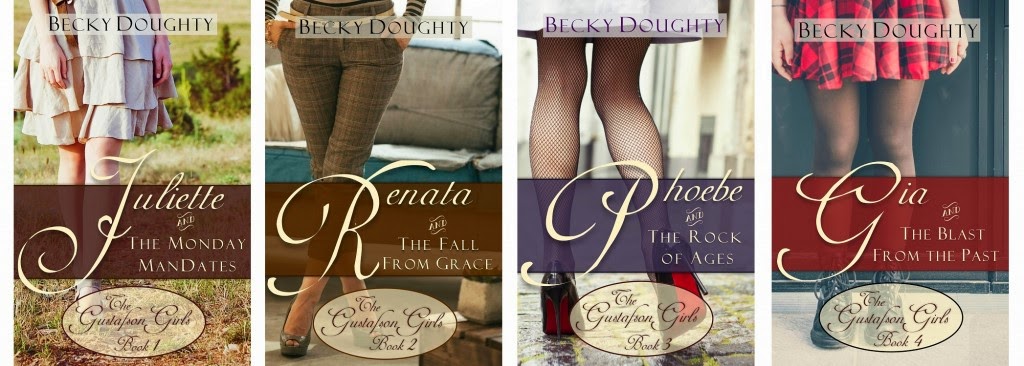
Cover Art for the Gustafson Girls Series
Juliette's story is already available on Amazon (Juliette and the Monday ManDates), and will go to other online booksellers the first of the year. Renata is the second sister, and the only one who is married. She feels responsible for “keeping the other girls in line,” much to everyone else's chagrin. But Renata's own life is about to spin out of her tight-fisted control and no amount of careful planning, pride, or will power is going to save her. Her faith in God, the bonds of her marriage, her role in the G-FOURce, even her black and white ideas of right and wrong, will all be tested.

Renata and the Fall from Grace is scheduled for release in early Spring, around the first of February. Books 3 and 4, Phoebe and the Rock of Ages and Gia the Blast from the Past, will  also be released later in 2015.

HG: How did you decide to go into audiobook narration? How laborious of a process was it to get everything set up for that?

Becky in her audiobook studio
BD: This was actually a huge part of my decision to venture fully into indie publishing last year. I realized that if I was going to be a full time author/publisher, I'd need to diversify and find other income streams within the industry. 

As much as I enjoy editing, after a really difficult experience, I realized it was not a service I could comfortably offer. Although I enjoy creating my own covers, I knew I didn't have the patience or know-how or programs to do them for others. I'm not a consistent blogger, so turning my blog into a source of income stream wasn't a good fit, either. 

But I've spent my whole life reading stories out loud – to my siblings, to the kids on the school bus (usually my own serial novels before I knew they were called that! I'd write a new chapter each night and read it on the way to school the next day), then to my children, and hopefully, one day soon, to my grandchildren. I'm also quite comfortable behind a microphone, being a member of a very musical family (we have a family band, aptly named “The Rowdy Doughtys), and we already had much of the equipment I'd need to narrate from my home.

So my husband and I converted a closet in my office into a sound booth, purchased a few pieces of equipment and software as we could afford it, and now, almost a year later, I just completed my 19th audiobook. I've had some wonderfully patient authors who have ridden the learning curve with me, and I'm really beginning to find my groove with the audiobooks. It's a fairly simple thing to get into, but it requires a lot of work to make the business successful, and a willingness to constantly look for ways to produce better sound, better working relationships, better standards, better voices, better interpretations.

I'm also learning to be selective about material I narrate, not just based on content rating (I've labeled myself as a “Clean Reads” narrator, something that is remarkably subjective in this industry), but also based on the story itself, whether or not it's something I enjoy reading personally. My husband works alongside me in this business, and he can tell when my heart isn't in a project. He's a good filter for me.

As the proverbial shoemaker whose children go barefoot, I have yet to narrate one of my own books, but that's a project I'm looking forward to at the beginning of the year, starting with Elderberry Croft and Elderberry Days.

Thank you, again, Heather, and all the Novel Rocket gang, for having me here today. I've learned so much from what others share on this website. Don't forget! I'm gifting e-book copies of Elderberry Croft and Elderberry Days to all who comment here from now until December 25th! Be sure and leave your email address and the format you prefer: pdf, mobi for Kindle, or epub. Merry Christmas, friends!

HG: Thank you so much, Becky, and your giveaway just shows your heart of giving to others. Thank you for all the time and encouragement you've given to me! And be sure to comment with your email to receive your e-book copies of Becky's books!

Thursday, November 20, 2014

The Small Press Option: Interview with Christina Tarabochia, Co-Founder of Ashberry Lane Press

I'm in a Christian Indie group with Christina Tarabochia, Co-Founder of Ashberry Lane Press, and I knew she'd be the perfect person to explain how small presses help their authors. These days, as many authors investigate options outside traditional publishing, small publishers are a very competitive option and bring unique benefits.

This interview was so informative and I hope you take time to ask Christina any questions below in the comments! ~Heather Day Gilbert


Christina Tarabochia and her mother, Sherrie Ashcraft, 
Co-Founders of Ashberry Lane Press


~Interview with Christina Tarabochia~

HG: Christina, tell me a little about how you decided to start your small press, Ashberry Lane. Also, what is the significance of that name?

CT: My debut novel, The Familiar Stranger, came out in 2009 from Moody Publishing under my then-name of Christina Berry. (The book took 2nd places in the 2008 Genesis.) I had one of the top agents in the business. I was up for a Christy and won the first Contemporary Carol Award in 2010. I had put in my years and years of learning, networking, pitching, honing and my career was going to skyrocket! Yeah!

But it didn’t.

Instead I spent a couple more years writing proposals, getting rejections with specific reasons that had nothing to do with my actual writing, and spinning my wheels. Meantime, I saw the indie movement growing and wanted to jump in right away. For better or worse, I didn’t actually take the plunge until 2013 when my mother, Sherrie Ashcraft, and I left our agent and started our press, Ashberry Lane—a combo of Ashcraft and Berry. (But doesn’t it sound like a nostalgic little road with sweet peas growing along the edges of a path that leads to a cozy cottage?) 


Ashberry Lane

We planned to release our own book, On the Threshold, that we’d been working on for FOURTEEN years and then keep writing more together as I finished up all the others I’d started over the years.


On the Threshold, Winner of the Oregon Cascade Award
Click to Find on Amazon

We released On the Threshold in May of 2013. Within a few weeks, Dianne Price contacted us. She was dying of a slow-moving cancer and would we be interested in publishing her six-book WWII series? We quickly worked up a legally solid contract and signed her with our house. Unfortunately, she passed away one week before Broken Wings released. 


Click to find Broken Wings on Amazon

Next, Bonnie Leon approached us about doing a 20th Anniversary Revised Edition of her debut novel, The Journey of Eleven Moons. (That’s my daughter—the little one on the cover!)


Click to Find The Journey of Eleven Moons on Amazon

Once we signed a known, well-respected author, we were off and running … to the printers.

Since then, we’ve worked with several agencies and signed unagented authors as well, have released eight books, and have contracted nine more. In the words of Ephesians 3:19-20, “Now to Him who is able to do far more abundantly beyond all that we ask or think, according to the power that works within us, to Him be the glory in the church and in Christ Jesus to all generations forever and ever. Amen.” (NASB)

HG: Do you have an editor on staff who screens proposals/manuscripts for possible production? What are some crucial elements you look for in books you choose to publish?

CT: Um … getting a little bit convicted here. ;) I know there will be a point when I need to pass the first-reader responsibility on to someone else within the company, but I just can’t give it up yet! It is so much fun to open an email and see the idea of a new story. Sometimes the synopsis sounds a little outlandish, and then I start reading and the writing can carry that plot. Or a story sounds great, strong hook and good market potential, and the writing can’t quite deliver.

When we do have to say no to a manuscript, we try to offer very specific reasons why and offer to look at the piece again if those changes are made.

Reading submissions is like eating a box of chocolates (Click to Tweet!)—you have a pretty good idea of what you’re going to get because there are labels clearly saying what each candy is! (Humor credit to my daughter, 15-year-old Andrea, who originally came up with that cliché twist.)

So, what are we looking for?

~Nice, tight, no-personal-space-bubble Point of View. Let me become the character and live the book, please.

~Word counts that fit our guidelines: http://ashberrylane.com/submissions-guidelines/

~A story that touches our heart and points the reader toward a better understanding of and closer relationship with the Lord. This can be in any genre, even Sci Fi or Humor. It just has to fit our Tagline: Heartfelt Tales of Faith (& Fun!).

Once I think I might want to flirt with a manuscript—you know, give a wink or a sly glance--I send it on to my mother, President of Ashberry. We both read fulls on our Kindles. If we forget we’re reading an unpublished book and can’t stop reading and fall in love with the writing, it’s pretty much guaranteed we’ll be offering a contract.

HG: You mentioned to me you are somewhat "indie in thought and traditional in practice." Could you elaborate on that?

CT: The foundation of our publishing house is grounded in indie ideas (Click to Tweet!)--things like quick production times, freedom from genre expectations, pricing according to fluctuating markets, instant feedback on promotional efforts, access to sales numbers if we have them, transparency about what works and what doesn’t for marketing at this time, planning permafree with #1 in a series, etc. We’ll try pretty much anything an author wants to try.

But we give the traditional stamp of approval that a publishing house has chosen that manuscript out of all the ones submitted (and we’ve been shocked at how many we’ve already had to turn down) and put money and resources behind getting that story into readers’ hands. We do most of the traditional things for authors. (SEE BELOW)

HG: Give me some examples of what Ashberry Lane does for authors, such as: cover art, formatting, uploading, marketing, etc.

CT: We’ve evolved into quite a complicated machine for being so young. I give a very detailed first edit—I ran an editing business for five years before we started Ashberry Lane so I love this part!—while the author discusses cover ideas with our designer, the amazing Nicole Miller, and starts working on cover copy, gathering endorsers, and building reach with Mom’s help. 

After the author and I go over the first edit together, the manuscript moves on to the second round of editing. We have three editors who provide macro/micro/line edits all put together. I compile those and return the results to the author. After those changes are made, the manuscript goes to three proofers—who all find different things, of course. They check for consistency, grammar, and clarity, but also point out if there are any “big picture” issues left. Compile, return to author, repeat.

No, wait, that’s shampoo.

Either way, the product gets cleaner and cleaner. Meanwhile, we’re all back-and-forthing about the cover and book blurb.

I do a final read-aloud edit to catch the typos we made while fixing typos and any “echo” words that slipped by us. Then I format the paperback version, Nicole finalizes the cover, and we order a proof. I make three different e-formats from the print version. (We have really pretty great distribution for both print and e-books.)

As we use paid advertising, we’re finding which opportunities are worth it and which just don’t give a good ROI. We’ve got some exciting new marketing plans in the works, but this is definitely the area in which we are trying to grow the most! Y’all can help us by signing up for our newsletter at www.ashberrylane.com J We have around 1200 subscribers but would love to have more. And come like us at www.facebook.com/ashberrylanebooks.

HG: What are the benefits to authors with going with a small press like Ashberry Lane? Who would you NOT recommend small presses for?

CT: There are authors who are amazing as indies, but there are also authors who want only the full-blown, huge trad route. In between is a breed of authors who want FREE cover design, several rounds of edits, formatting, distribution, want to have a name-stamp of approval, and mostly just want to write and not do all the business part of indie. Not all small press authors want all those things, but they are considerations.

Also, being part of our small press is being part of a family (Click to Tweet!). Everybody's books have links to everyone else's in the back, we share each other's memes, we share each other’s books in our newsletters, we have a secret page for our authors, we try to remember birthdays, etc.

AGAIN, this is not what everyone wants! If you love to control every aspect of your book, if you love to learn new things, if you see indie as a challenge that God will walk you through, then full indie is probably the best route. But I think it's great for the market place and for authors to have the full spectrum.

HG: (*Raising hand* I do like control--but sometimes it would be nice to have someone else take some of the load!) Could you give me some idea of the royalty breakdown for things like e-books/softcovers through your press--in other words, what do authors keep?

CT: Another area we try to be pro-author/indie-ish in thought is when it comes to royalties. We pay our authors 50% of net on BOTH e-book and paperbacks. We also don’t charge any markup for author copies. By giving the authors more money and taking all the financial risk, the first 1.5 years of the company have definitely been an investment, but as we release more and more great Heartfelt Tales of Faith (& Fun!), the company itself should become more and more profitable, which means more profit will then be passed on to authors. A pretty cool cycle.


HG: I feel like I was talking to you in person, not conducting an e-mail interview! What a wealth of information you have brought to authors today, Christina. All the best to you and your mother as you serve authors and readers with Ashberry Lane!