




A book is about people. Ordinary people doing extraordinary things.
Or, simpler, extra ordinary things.
But to feel for these people and go on the journey with them we have to see them with the eyes of our heart. Of our imagination.
How do we do that as storytellers?
Details!
Beware! I don’t mean physical details although those are great, but I mean personal, down-to-the-soul details.
Describe the protagonist life, hinting at wants, goals, dreams.
Why have they walked onto the page?
Imagine a play if you will.
The stage is dark save for the spotlight.
The main character walks onto the stage, in costume, and begins to speak.
What could they possibly say that will make you lean forward to listen?
What emotion or what story could they share that would make you care?
What opening line would grab you?
That’s how you have to build your characters before you walk them onto the page.
I used to play act as a kid, making up dialog between me and oh, you know, Donny Osmond.
We’d carry on whole conversations.
Now I do the same for my protagonist and secondary characters.
I see them in my mind’s eye.
I do my level best to get to know them in my heart.
Anyone who’s been in a writing class with me has heard the account of how I dug deeper for the characters June and Rebel in Softly and Tenderly, the book I wrote with Sara Evans.
I knew Rebel had been a cheater. And originally I decided that once he fell off the fidelity wagon, he intended not to do it again but just got caught.
Sin will do that — keep you longer than you intended to stay and take you farther than you intended to go.
But as I wrote the confrontation scene it lacked… punch. I felt like I was writing in circles.
I got up to take a break and ended up dialoging with myself, playing both characters, and I know you ALL have done it too, and came upon a break through line.
Here June is confronting him as to why all the affairs. Rebel is a high powered southern lawyer.
BEGIN
“It just got easy, that’s all.”
“Easy? Do you know how many nights I cried myself to sleep… How helpless I felt to stop you… I mentally packed my bags so many times.”
“I told you, it just got easy.”
“Does revenge taste that sweet Reb?” RH: Here’s where I learned June also had an affair. Early in their young marriage when she felt alone during Rebel’s law school years.
Rebel whipped around to face her. “You stole my son, June!” <– BREAK THRU LINE!
END
I gasped here! What does that mean? I didn’t know but I was going to find out. It felt brilliant!
So I dug around until I discovered the whole story! This bit of news popped the story wide open and created much deeper, more complex characters.
Here’s another example from How To Catch A Prince.
I created a fun, over-the-top media mogul, Gigi Beaumont. She’s both a protagonist and antagonist. I know… I know… but I like to bend the rules.
When we first meet her in the heroine’s POV, Gigi is commanding, smartly dressed with perfect hair and nails.
But when we switched to Gigi’s point of view, we see a different character.
BEGIN:
Gigi
Even when she was a girl running barefoot through the hills of her Blue Ridge, Georgia, home, Gigi Beaumont had a nose for news.
She’d collect all the best gossip by sneaking around the wizened mountain women— who had a knack for telling a yarn or two—as they talked in the Mast General or strolled the town square. Then she wrote their stories and mimeographed them on the machine she found in the church basement, producing her first newspaper at the mature age of ten.
When Mama read it, whoa doggies, she gave Gigi a walloping for the ages on account of what she printed about the mayor’s wife. But when it turned out to be true—an affair with the sheriff—Mama became her chief distributor and fact finder.
Forty-six years later, she still crawled around behind the storytellers and gossips, hoping for the scoop. The scandalous story that would turn the world on its ear.
Mercy knows, Beaumont Media needed a break. A big one. Hiring Mark Johnson was just one stealth move to reignite her newspaper’s faltering brand.
END
Here we have a bit of Gigi’s character history (which is very different from backstory!) and we see this woman is both hungry for success and gifted.
She’s following a life long passion, her superpower!
Hopefully I created descriptive elements to help the reader know who they are dealing with in this story.
We don’t need a lot of physical description here. We get it in other scenes.
What I needed in this scene was her heart. To show just who Gigi Beaumont was and why.
So, how do you know if you have a dynamic character that can rise off the page and grab the reader?
Here’s an example from award-winning author Deborah Raney’s novel, Home to Chicory Lane.
BEGIN
Still, despite his rough childhood, and a couple of wild years in high school, Chase had defied the odds and turned into a good guy. A really good guy. Their youth pastor from Langhorne Community Fellowship had taken Chase under his wing, and by the time Landyn was old enough to date, Chase was toeing a pretty straight line.
Well, except for the tattoo. Dad had come completely unglued when he heard Chase had gotten inked. She’d finally calmed him down by explaining that Chase’s Celtic cross––on his collarbone, so it was hidden under most of his shirts––was a symbol of his faith and of the permanence of God’s love for him.
END
I can see this guy, can’t you? Wild, tattooed, but wearing the symbol of his new faith. I get him right away. We see he’s “toeing” the line so perhaps he’s still trying to earn God’s favor. And the tattoo is kind of his reminder, “Behave yourself.” There are a lot of places Deb could’ve taken this. Great description.
Here’s a clip from best selling author Denise Hunter’s Married ‘Til Monday. (Great title, eh?)
BEGIN
After work Saturday Abby showered off the bakery smell, dried her hair, and pulled it back into a messy ponytail. She scrubbed the makeup from her face, exposing the freckles on her nose, and threw on a pair of jeans with her Eagles T-shirt, hating the way her hands trembled. It was just one date. Then he’d leave her alone.
END
What I love about this is her Eagles t-shirt and trembling hands. We know what kind of music she likes and that tells us a lot about the character. And trembling hands indicates she’s nervous. Funny to me she’s going on a date and trying to look her worst. No make up, sloppy ponytail. Makes me ask, “What’s going on here?” Denise took the opposite of the norm. Good idea to always flip a character or scene upside down and see what’s on the other side.
Here’s a few tips on how to create deeper characters:
1. Be specific. Get down to nitty gritty details. Tell a slice of life and use it to shape the character.
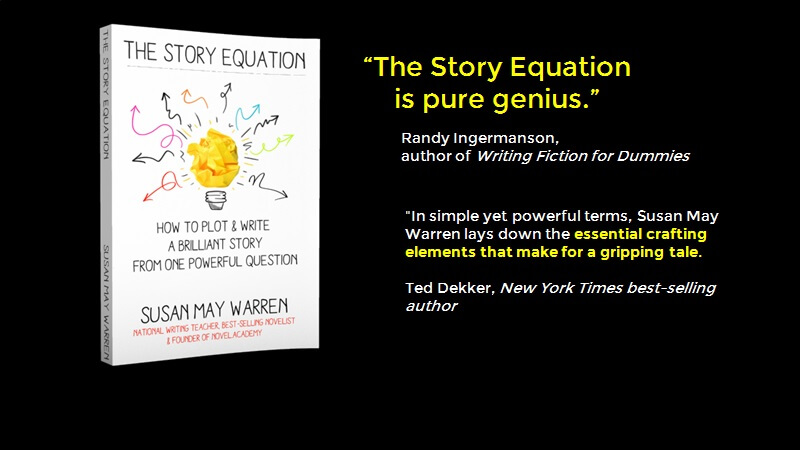
2. Utilize MBT’s Story Equation — the SEQ. Dark wound of the past, lie and fear, contrasted with greatest dream.
3. What’s your character’s happiest moment. (Be specific!)
4. Remember your story is about dealing with a specific issue (notice the word specific is used a lot) so build your details around that one event.
5. Go beneath the surface. Turn a character or situation upside down. Instead of a male character what happens if you make him a her? A character is more than hair or eye color, or skin color. More than she liked cafe mochas and the Beatles. Those are great but you must answer the question: Why does she like those things? Dig deep. Think outside the box.
Now, go write a brilliant character.
TWEETABLES

New York Times, USA Today and Wall Street Journal best-selling, award-winning author Rachel Hauck loves a great story. She serves on the Executive Board for American Christian Fiction Writers. She is a past ACFW mentor of the year. A worship leader and Buckeye football fan, Rachel lives in Florida with her husband and ornery cat, Hepzibah. Read more about Rachel atwww.rachelhauck.com.