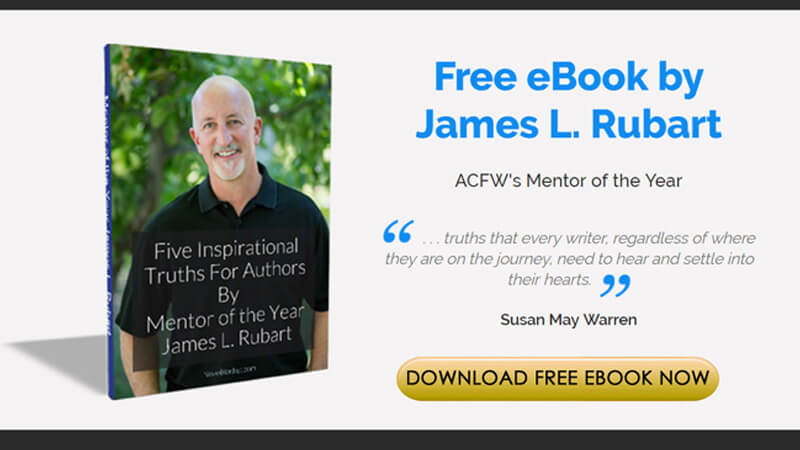




Get a Free Ebook

Five Inspirational Truths for Authors

Try our Video Classes

Downloadable in-depth learning, with pdf slides

Find out more about My Book Therapy

We want to help you up your writing game. If you are stuck, or just want a boost, please check us out!

Showing posts with label Thomas Nelson. Show all posts

Tuesday, August 16, 2016

Getting a Starred Review in PW & Other Questions: James L. Rubart Interview

by Susan May Warren w/ James L. Rubart

Recently I had the chance to sit down and chat with my good friend, James L. Rubart about his new novel, The Long Journey to Jake Palmer. I think this one is going to have a major impact on people, and not just because I’m a character in the book. (More on that in a minute.)


Susie: You’re having quite the year. Your novel The Five Times I Met Myself wins the Christy Awards Book of the Year, you’re up for a Carol Award for the same novel, you’re a finalist for Mentor of the Year at ACFW, and now you get a rare starred review from Publishers Weekly for just released novel, The Long Journey to Jake Palmer. Plus RT Book Reviews gave it 4.5 stars and made it a Top Pick for August. 

James: It’s been fun. 

Susie: Fun? Fun? It has to be a lot more than fun.

James: Really, really fun? Seriously, it has been wonderful and fun and stunning and everything in-between. Getting that starred review and Top Pick meant a lot and I’m so grateful for the people around me that have helped me write far better novels than I ever could have on my own. 


Susie: So you’re getting all this really nice buzz for Jake. When you were writing it did you have the feeling it would be received so well? 

James: No idea. It was probably the most difficult novel to write that I’ve done yet. I tried a lot of ideas that didn’t work, and on top of that I needed to write it really fast.

Susie: How fast?

James: Eight weeks. That’s fast even by your standards, yes?

Susie: True!

James: But I had brilliant input from my wife, and my editors, Amanda Bostic and Erin Healy. Wouldn’t be the same novel without those three.

Susie: And what’s this about this putting me in The Long Journey to Jake Palmer? 

James: Couldn’t help it. You’re the life of the party, but are also about going after the deep things of the heart. And I needed Jake to have a friend like that. So yes, if people want to see what I think about Susie Warren, it's all in there. 

Susie: Any other real life people end up in this one?

James: Yes, one other. But since the character isn’t portrayed as the most pleasant person on the planet, I’m going to keep the secret of who it is to myself. 

Susie: Give us the elevator pitch for the novel.

James: It’s the story of a man searching for a lost corridor at the end of a lake. If he finds it, he'll reach a place where he’ll get what he wants most in the world.

Susie: Love it. What do you want people to take away from this book?

James: I think many of us wonder if we're enough. Enough for our spouses, our friends, our parents, our children. That’s Jake’s struggle too. I want people to walk away knowing they are enough and that there is a beauty inside them so powerful it would stun them if they saw it. I want people to walk away seeing that beauty and power inside themselves.

Susie: And there's an audio version too, right? And you voiced it.

James: Yeah. That was so fun.

Susie: How do people buy the book and where is the best place to be in touch with you?

James: They can pick up the novel just about anywhere books are sold. The best place for people to stay in touch is by signing up for my newsletter on my website.

Susie: Thanks for talking!

James: Loved it.

James L. Rubart is 28 years old, but lives trapped inside an older man's body. He thinks he's still young enough to water ski like a madman and dirt bike with his two grown sons, and loves to send readers on journeys they'll remember months after they finish one of his stories. He's the best-selling, Christy, INSPY, and RT Book Reviews award winning author of eight novels as well as a professional speaker. During the day he runs his branding and marketing company which helps businesses, authors, and publishers make much more coin of the realm. He lives with his amazing wife on a small lake in eastern Washington. More at www.jameslrubart.com


Sunday, June 17, 2012

Lessons From a Rule-Breaker


Marcia Moston, winner of the 2010 Women of Faith Writing Contest and Honorable Mention recipient of the 78th Annual Writer’s Digest Competition, is the author of Call of a Coward-the God of Moses and the Middle-class Housewife. Her nonfiction works reflect the life lessons learned from her varied experiences. She has taught in a Christian high school, worked with orphans in a Mayan village, led mission teams to several Latin American countries, and has lived in everything from tepees to parsonages. She holds degrees from the University of Vermont, Liberty Bible School, and Trinity Theological Seminary. Marcia and her husband live in sunny South Carolina.


Two years ago I squared off against the demons of doubt and with a defiant, “so there!” included the word writer on my first business cards. Still, insecurity gnawed at the edges of my confidence. Before the previous year, I had never taken a writing course, nor read a book on how to write.
And although I admired the sage green background and the way my name flowed out from the tip of a fountain pen, I worried that the legitimate writers and worse yet, authors, at the writers conference I was about to attend, would see instead a hologram trading card—one on which the word writer faded to fraud.

But grace abounds in the Blue Ridge Mountains, and although I’m sure I learned much about the writing craft at that conference, I remember three lessons in particular.

The first lesson hit me during a keynote speaker’s address. He was an author who was miles ahead of me on the path of writing and publication. But he spoke of the difficulties in marketing his books, joked about the small numbers; and then teared up as he told us about one person who had contacted him to say how much his book had touched her life, how instrumental it had been at a crucial time.

And for this one person for whom his words had made an impact, he was thankful. I filed this first lesson—remember the importance of each reader— deep in my heart.

As he continued to speak, I was impressed by his transparency, a trait I have since seen in so many of the Blue Ridge Christian Writers faculty, our own GH included. Although more knowledgeable and successful, these people face some of the same insecurities and challenges as the rest of us yet undiscovered writers. But not only have they learned to push through for themselves, they are willing to share what they know with those of us coming along behind. They freely give of time and talent to help their potential competition. How beautiful is that!

Their examples made me realize lesson two—that although I have much to glean from others, I don’t always need to be in vacuum cleaner mode, forever sucking up information. I too, have something to give to the next in line, even if it’s only an encouraging word.

The third point birthed at that first conference and confirmed now, two years later, is that although you can’t count on them, can’t pitch them, demand them, or teach them, there are rule breakers.

My path to publication is one. My very average size seven-and-a-half foot fit the glass slipper.

God blessed the work of my hands, and after winning a few contests, the otherwise highly unlikely-to-be-published memoir/spiritual growth book, Call of a Coward— the God of Moss and the Middle-class Housewife, which had placed first at Blue Ridge two years ago, went on to win the 2010 Women of Faith Writing Contest, and then, a month after self-publication with WestBow Press, was acquired by Thomas Nelson. It will be re-released August 1, 2012, although it is available now for pre-order on Amazon.


With a thankful heart, I learned lesson three—Do your part, learn the craft, glean from others, trust your own voice, and then, release it all to God. There may be only one way to heaven, but there are many ways to be heard on earth, even for the rule breakers.


Monday, November 07, 2011

Ian Morgan Cron's Jesus, My Father, the CIA

Q & A with Ian Morgan Cron

Why did you decide to write a memoir?
It began with finding a picture of me as a toddler sitting in rowboat on a beach in Greenwich, CT, waving and laughing at the photographer. I had this eerie feeling that this kid somehow knew when the picture was being taken that I would discover it years later when I was ready to take a journey of healing. I framed the picture and put it on my desk. One day I looked at it and knew he wanted me to write this book.

Why call it 'a memoir of sorts'?
I wanted to be transparent with the reader. The book dances on the hyphen between the genres of memoir and autobiographical fiction. I moved timelines and locations around, I changed every name except my own; I conflated characters; I left out or softened material that I thought would be too hurtful to people who didn’t sign up to be in my book, I omitted a few CIA related stories I desperately wanted to tell but some of the people involved are still alive. What’s important for the reader to know is that the book tells the truth about my childhood either in fact or in essence and most often both.

Being selected to be part of B&N’s Discover Great New Writers program is a big honor – did you ever expect to be chosen?
I’m told it’s rare that a book with overt religious themes finds its way into the Discover Great New Writers Program. Someone from B&N told me my book was selected in part because it was spiritual without being preachy; that atheists or people who were skeptical about organized religion had read it and were surprised the spiritual parts of the book didn’t stop them from enjoying it. It’s one of the highest compliments I’ve received to date.

How did your education influence your writing?
Some of the most formative years of my life were spent studying English at Bowdoin College. I write about Larry Hall, a professor who became a close friend and mentor. He had won the O’Henry Prize and the William Faulkner Award for best debut novel. His classes were better than church. His short story The Ledge is so heartbreaking that I have trouble getting through it. It leaves me with the same feeling of desolation and helplessness as Cormac McCarthy’s The Road does.

What were your favorite books as a kid?
My father was a voracious reader so there were piles of books all over our house. I sometimes read ones that were not particularly age appropriate. In sixth grade I showed up at school with a copy of Babi Yar an account of one of the worst mass slaughters of Jews in WWII and my teacher immediately took it away. She was incredulous and phoned my mother to ask if she knew I was reading such a disturbing book and my mother replied, “You’re calling to complain that my son is reading?” Don’t mess with my mother. At ten I was reading books like Steinbeck’s Travels with Charley, Jack London’s Call of the Wild, and I loved anything by PG Wodehouse.

In one chapter you write about the experience of ‘falling into God.’ Can you explain what this means?
This happened at my First Communion Mass when I received the Eucharist. It was an uninvited and momentary experience of profound union with God, a graced-moment that was such a gift to me. Even as a boy I saw the world through a kind of mystical lens. I knew deep in my soul that we lived on a planet brimming with God. The experience of falling into God has only happened to me three times in my life but they changed me forever.

Have you tried to find out more about your father's work with the CIA?
Six or seven years ago I contacted the CIA and asked them under the Freedom of Information Act to tell me what my father had done for them. They don’t make it easy to get an answer. There’s no woman at Langley who answers the phone and says, “Oh you want to know what your dad did for the CIA? No problem honey, let me just grab his file and I’ll tell you.” I had to jump through one hoop after another until one day I finally received a letter that said something like “We can neither confirm nor deny that your father ever worked for the CIA and if he was in the clandestine services we can never tell you.” What I know of his work I’ve learned through others.

Your parents mingled with many celebrities. Tell us about a few….
I was a baby when my parents moved in those circles but I heard the stories over and over again from my older siblings and parents. There was the night when Carl Reiner and Mel Brooks spontaneously performed their famous sketch the 2000-year Old Man in our living room or the time Art Buchwald stood on a chair and took off his clothes to the song The Stripper at a Thanksgiving party. I heard stories about nights out with Judy Garland, the daily visits of our neighbor the author James Jones who wrote From Here to Eternity who would come over to have coffee with my mother after finishing writing for the day. Roger Moore and others were family friends. They all disappeared when we fell on hard times.

What programs helped you into recovery from alcoholism?
A few things happened all at once to bring my drinking days to an end. In the course of 6 months my father died from drinking, my closest friend and drinking buddy went into rehab, and my counselor told me he wouldn’t see me again until I stopped drinking. He was the first person to tell me to my face that I was an alcoholic. Others had expressed concern but he nailed me. It turned out he was in AA and took me to my first meeting. I think if church services were more like AA meetings we wouldn’t know what to do with the crowds that would show up.

What would you advise other children of alcoholics who fear they will become addicts?
I had this very conversation last night with my son who is going away to boarding school next year. I told him the old line: “Alcoholism doesn’t run in our family, it gallops” and we had a good laugh. Fortunately none of my children have fooled with drugs or alcohol but I’ve warned them about the risks.

Readers have been responding strongly to the last chapter about the ‘quarry’ – why do you think it is resonating with readers?
Yes, I’ve received a great deal of email about that chapter. There is something moving in that story especially for fathers who grew up in crazy homes and fear they can’t give their children something they themselves didn’t receive from their parents. For me it’s about baptism being a daily experience. We have to choose to face what terrifies us, boldly jump off our cliffs into the waters of life rather than halfheartedly rolling down the side like ragdolls. I cried three times while writing the book and the end of that chapter was one of them.

Ian Morgan Cron is an Episcopal priest, speaker, and the acclaimed author of Chasing Francis: A Pilgrim's Tale. His literary debut received accolades from the Archbishop of Canterbury Rowan Williams, Brian McLaren, Fr Richard Rohr, Phyllis Tickle, Tony Campolo, Brennan Manning, and artist Makoto Fujimura. Ian is currently the Curator of the Conversations on Courage and Faith Series at Christ Episcopal Church in Greenwich, CT and a doctoral student at Fordham University, where he is studying Christian Spirituality. He enjoys reading, hiking, traveling, and kayaking. Ian and his wife have three children and divide their year between homes in Connecticut and Tennessee.