Novel Journey

ONE OF WRITER'S DIGEST 101 MOST VALUABLE WEBSITES FOR WRITERS, 2008.

Saturday, December 30, 2006

Sunday Devotion: It's Okay to Play


Janet Rubin

Since Christmas day, my daughters have spent countless hours perched on stools at the kitchen island- molding, shaping, giggling, and concentrating. Captivated by the one-dollar packs of modeling clay they found in their stockings, they’ve forsaken all else: the ninety-dollar American Girl dolls, the DVD’s, and toys. I’ve watched the clay morph from neatly packaged blocks of color into flowers, animals, sea creatures—and my favorite—the dinosaurs.

Why are the girls working so hard on these creations? Certainly not to impress people. Were it not for my sudden inspiration to put a picture on Novel Journey, no one would see them at all. It isn’t to build something that will last. At the end of the day, all the creations get squished into a Zip-lock baggie and put away. The young artists' clay-shaping isn’t some kind of “ministry” through which they hope to bless others. And obviously, it isn’t for money. They don’t get paid for their labor.

It doesn’t take a genius to figure it out. The girls are just having fun. Finding joy in creativity because they are made in the image of their Creator. Enjoying life as only children can. Only an adult could suck all of the fun out of art.

If you are like me, with the new year’s dawn, you have writing goals and deadlines looming over you. Finish that novel, edit that rough draft, do some publicity… With all that pressure, we sometimes forget to have fun, but I believe God does want us to have fun. Jesus said, “I have come that they may have life, and have it to the full.” (John 10:10)

Sometimes our writing is an act of obedience or sacrifice. Through the ups and downs of the writing life, God teaches us to have patience, to persevere, to take criticism. And hopefully our work will bless, encourage, and entertain others. But writing is also a gift God has given us to enjoy. Words are the clay we can play with—shaping and reshaping until we have something in front of us that makes us smile. In 2007, work on those goals, but make one of your goals be to find joy in the gift God has given you.

Galatians 5:22-23 But the fruit of the Spirit is love, joy, peace, patience, kindness, goodness, faithfulness, gentleness and self-control.


Labels:

S'up Saturday

Upcoming we will look back at our favorite books of this year and the writing advice or interviews that impacted us most.

We have the anticipated interview with Zondervan's Sr. Acq. Editor: Sue Brower, as well as interviews with some great authors. We'll be critiquing another thousand word submission as well as the ocassional commentary.

I hope y'all will be thinking of your favorite novels of 2006 and WHY they were your favorite. Jess and I have been trying to break down what exactly it is about these works that makes them so good.

If you aren't reading Chip MacGregor's blog, you're missing out btw. He's the best teacher in the biz as far as I'm concerned. He has a way of entertaining, inspiring and making sense of the craft and business of writing. www.chipmacgregor.com.

Friday, December 29, 2006

Below, is a post that was submitted to our critique group, Penwrights, nearly two years ago. I'm not sure whether to call it a rant, muse or a challenge, but it had a lasting impact on me. As we head into a New Year, I once again find myself wrestling with my goals and this post came to mind. I wrote the member and gained permission to dreg up this from ghost from the past. I hope it brings encouragement to those, who like me, are still biding their time, crafting their stories.

Story Arc and Velocity

Every story has an arc - it starts somewhere, at a certain velocity, reaches a certain height, and ends somewhere, propelled or sustained by that velocity. The arc of the story, I imagine, has to do with the velocity. A stronger story (plot / characters) can travel farther and higher. Much like an arrow. A good, well-made arrow (story) has a better chance of going far, especially if a good archer (author), is handling it. Good arrows can be shot badly, just like good ideas can be mishandled. But, even bad arrows can go further in the hands of a good archer. Jesus shot simple ideas (sparrows, lilies, wheat and tares) great distances.

So the craft of writing involves 1.) arrows and 2.) archers; story ideas and how we handle them.

Do you think it's true, that if a writer spends more time in the planning stage of their story - designing the arrow, so to speak - they have a better chance of success? I ask this, because I wonder if many of us are in such a hurry to write a novel (myself included) that we don't spend as much time as we should, on things like timelines, historical details, character complexity and other research. The final feeling is that the story lacks depth. We want to rush out and start shooting, but our arrow is flawed or flimsy or missing a few feathers.

Not only must we learn how to aim and shoot a good story, we must learn how to put it under the light and make it strong and swift, before ever it reaches our bow.

Since I've undertaken writing a novel, I've thought much about the actual writing process. In my previous entry under this heading, I suggested the two basic components of writing could be 1.) Arrow and 2.) Archer.
The arrow represents the story itself, its depth, strings the story and launches at an intended target; he/she executes what's in their brain. My muse (which I'm not sure y'all got) was that, the time we spend on the actual story – researching details, layering characters, nuancing plotlines, developing a unique tale – determines how far that story can go. In other words, good stories (ones with weight / substance / originality / flare) stick with us and last.

We can't JUST WRITE. We must organize thoughts and ideas, research our subject, explore new styles, study people, create people, get into their heads, take them to work, take risks, file papers, learn new words, develop timelines, tweak plotlines and pray. We must craft a swift / solid arrow before we ever shoot it.

Here's my question, are some of us so anxious to write a novel (myself included) that we don't spend enough time actually crafting / creating a good story?

Harper Lee won the Pulitzer Prize in 1961 for, "To Kill a Mockingbird." It took her years and years to write and re-edit and, in the end, it was her only published novel. Think about that! She wrote one book / one story, but it was such a good / solid / endearing tale that it has endured for almost fifty years.

If God told you, you could only write one novel, would it be the one you're writing? Are we willing to invest the time, the sweat, the energy required to bring that one simple story to life? Are we in such a hurry to get published, that we're stringing play arrows, dull and frayed, that will, alas, go nowhere?

Thursday, December 28, 2006

Our First Critique Victim and the Fine Print

Today we share our first on-line critique. Ane, Jess and I have been critique partners for years and thought maybe some stuff we've picked up might be useful to others. Maybe not.

Okay, before anybody suggests we might not knowing what the heck we're talking about being three unpublished novelists, I thought I'd say it for you. Who are we to give advice? If our advice was so great, we'd have juicy multi-book contracts, right?

You're right. We may not having the vaguest idea what we're talking about. Let the proof be in the pudding. Read what are suggestions are, see if you agree or disagree. If we're off, leave a comment letting us know. Our suggestions are just that SUGGESTIONS. The author will be wise to use discernment and pick up what works for him/her and ignore what doesn't.

We're not above learning. We sometimes don't agree with one another's critiques of our work. Sometimes we debate but ninety-five or better percent of the time, we have learned to trust each other.

I trust what these two ladies have to say about my writing above anyone else.

We've each been edited/critiqued by professional editors, best-selling authors, etc and no one has been tougher on us than us. We're each agented and have all made it as far as commitee. But like I said, we are not basking in the glow of book contracts, so feel free to jump in and suggest we're wrong on a point or many points if you think we are.

Our hope is that not only this author who bravely subbed his/her work will benefit, but that some folks reading the critique will be able to apply our suggestions to their own work.

Gina

The Original Chapter

PROLOGUE


She wore makeup for the first time that night. She didn’t know why. Standing in front of the cracked bathroom mirror, she surveyed her face. The purple eye-shadow, ivory foundation, and glossy lipstick -- they transformed her. Her pasty complexion was now a thing of beauty. A majestic painting. Maybe that was it. The makeup made her feel like she was disconnecting from herself, slipping on a costume. Masquerading as a different woman.


An hour later she stood outside her ex’s front door, gloved hand wrapped around the knob. It would be locked, but she knew he kept the spare key under the welcome mat. At this time of night he’d be glued to the sofa, remote in hand, a football game blaring.

She pressed the key into the lock and turned it slowly. Once inside the shadowy hallway, she listened. Yes, there was the tv talking. Nothing else. Reaching beneath her coat, she pulled out the loaded .38, its power burning in her palm. For one moment she balked. Once she crossed this threshold she could never go back. Neither could he. Ever.

She curled her fingers around the gun’s barrel. But it had to be done. He could never touch their child again.

The pounding, blaring music of a truck commercial echoed through the house, and she crept forward down the carpeted hall, quiet as a cat. Around the corner. Into the livingroom. And just as she guessed, there he was: sprawled on the sofa in his old gray sweatsuit, a half dozen dead soldiers littering the coffee table beside him.

She waited until she was standing behind the sofa, staring down at his greasy head. Now. She gripped the gun with both hands, adrenaline surging through her limbs. She could still see the bloody stripes the belt made on his own flesh and blood, and she felt her child’s pain as if her own back was beaten. Never again.

She lifted her chin, her lips pursing in boiling anger. How dare he.

Later, when she was once again before her bathroom mirror, she dipped a cotton ball into the jar of makeup remover and swabbed her cheeks again and again. Until she morphed back into the unremarkable woman whose child needed a mother.
Splashing icy water on her face, she looked herself in the eyes. Everything had gone according to plan, but there was one thing she hadn’t expected. And it’s absence snuck up on her, just like she’d snuck up on him.

She felt no guilt.


Gina's Critique

What I liked about this author's writing was its style/vibe that I see potential in. Mechanics can be taught but I think this author has a talent that will emerge beautifully once he/she gets the elements of story telling and craft nailed. We all have to learn it one step at a time.

I like that the author didn't begin with a lot of backstory and I was interested in what might happen even if I wasn't yet invested.

My suggestion for this author: Keep on honing your craft. Read Self-Editing for the Fiction Writer if you haven't, and Techniques of the Selling Writer and of course apply what you learn, and more than anything, get yourself into a good critique group as soon as possible. They will help you learn and apply what those books preach. Thanks for letting us look at your submission. It's not easy having your work dissected. Use what's useful and right for your story, throw away what's not.

No hard feelings in the least if you hate all my suggestions.


( ) = suggest cutting
[ ] = suggest adding
** comments
GWS = goes without saying
author's original text in black, comments in blue

PROLOGUE


** I think start off by her maybe smearing greasy lipgloss over her lips—are they thin, or full or cracked? She’s looking in the mirror, I should have a better picture of what she looks like. Then maybe she runs the hard tip of the eyeliner over her lid, watching as her small brown eyes take on a harder look. You could really slow this part down and use a metaphor or foreshadow what’s to come.***She wore makeup for the first time that night. She didn’t know why.
**She didn’t know why seems weak to me. Might be stronger if she did know why. If maybe someone’s words rang in her ears, ripping at her gut as she smashed the course bristles of the makeup brush against her cheeks. Though I have no idea what kind of story this is so I could be way off**

Standing in front of the cracked bathroom mirror, she surveyed her face.**I like the crack in the bathroom mirror. One detail that says a lot. It’s a vague description though. You can do better. [A lightning bolt crack zig-zagged through the medicine cabinet mirror and through the center of her face’s reflection.] **maybe that’s not great but what I’m saying here is be more specific. Use smaller details** The purple eye-shadow, ivory foundation, and glossy lipstick (-- they) transformed her. Her pasty complexion was now a thing of beauty. A majestic painting. **seems less of a painting and more of a mask**Maybe that was it. The makeup made her feel like she was disconnecting from herself, slipping on a costume. Masquerading as a different woman.

An hour later **[,]? *punctuation is my weakest link so I could be wrong** she stood outside her ex’s front door, gloved hand wrapped around the knob.
**is it biting cold or is she wearing a latex glove because she’s going to commit a crime? If it’s cold, let see her breath, feel the wind, shiver with her. Maybe she wishes she wore a warmer coat***

It would be locked, but she knew he kept the spare key under the welcome mat
.**this is telling. Better to show her either getting frustrated then remembering with IM (internal monologue) that he has the key, or simply lifting the mat up and pulling up the key. Much stronger to show**

At this time of night he’d be glued to the sofa, remote in hand, a football game blaring.**this is also telling. Sometimes telling is okay but here it seems weak. Maybe have her press her ear against the cold metal door listening for the blare of the football game he listened to every Monday night. **

She pressed the key into the lock and turned it slowly. Once inside the shadowy hallway, she listened.( Yes, there was the tv talking.) **be more specific** [A faint rumble of a crowd cheering, dubbed over by the baritone of an announcers voice meant he sat right where he always did, behind the basement door in his cellar turned rec-room.] **or something to that effect** **you’re using “was” a lot. Was is a weak word that usually means passive writing. Let it be a red flag and always reconsider if you can reword for active writing***

Nothing else. Reaching beneath her coat,
**what kind of coat? Is it a trench that easily concealed the weapon or a leather bomber with an inside jacket, etc***

she pulled out the loaded .38, its power burning in her palm
.**burning? If it’s cold outside I’d imagine she’d feel the coolness of it in her palm. You can use the paradox of it burning too. Something like : {though the metal felt like an ice cube against her trembling palm, the power of the weapon seered her.] or something along those lines***

For one moment she balked. **telling, show it*** Once she crossed this threshold she could never go back. Neither could he. Ever.
*is she shaking, nauseas, second guessing herself. Do the consequences flash in her mind or a memory of him that was pleasant and she pushes it away?**


She curled her fingers around the gun’s barrel. But it had to be done. He could never touch their child again.
**it seems you might have started this story with her finding out about their child. Maybe vowing to do something. Then we have that whole suspensful buildup. Where we start here, I don’t know her, don’t know her child, don’t particularly hate this guy. I’m not invested. Seems it might be a good idea to reel me in first. Starting the story at the point of conflict is good. This doesn’t seem to be that point. That point it seems came when she found out about her child or when she finally snapped and decided to take matters into her own hand. I’m having a hard time buying this without knowing if she went to the police first and maybe they didn’t believe her or whatever***


The pounding, blaring **didn’t you use “blaring” earlier? And if this was blaring then the tv is really loud so she wouldn’t have had to have listened for it when she walked in the house. She would have clearly heard it. And saying “music of a truck commercial is very unspecific. Maybe a snappy jingle that contradicted her mood. Maybe name the company. Maybe the lyrics. Don’t overdo it but specific details really makes fiction real**music of a truck commercial echoed through the house, and she crept forward down the carpeted hall, quiet as a cat. Around the corner. Into the livingroom. And just as she guessed, there he was: sprawled on the sofa in his old gray sweatsuit, a half dozen dead soldiers littering the coffee table beside him. **I like the detail of the dead soldiers. Toy? That says a lot without saying much** I’d make his sweatshirt a different color cause the soldiers we’ll picture as grey. Unless you want that theme of drab which is fine, but then maybe have one more thing be grey so she can bring attention to it. {The plastic soldiers littered across the chipped oak cocktail table wore the same shade of gray as his oversized sweatshirt. The same color gray as the cinder basement walls. Drab and cold like his heart. **That may be horrible but you get the idea of where you could go if you wanted to***

She waited until she was standing behind the sofa, staring down at his greasy head. **more detail here. Take us step by slow step. This is a suspenseful scene but I’m not feeling it. [He coughed, without covering his mouth as usual and reached to the floor, yanking up a crumbled bag of Fritos, pausing halfway up as though listening for something. Could he hear her breathing? Refusing to inhale she froze behind the couch. He grunted and plopped the bag into his lap. Slowly, she expelled the breath screaming within her lungs to get out. .. etc. I didn’t take the time to really pain stake over that but you should. That was just to give you an idea of how to break it down into smaller units. More detail. Some emotion. Tactile things she experiences that will firmly plant us in her POV (point of view)***

Now. She gripped the gun with both hands, adrenaline surging through her limbs. She could still see the bloody stripes the belt made on his own flesh and blood, and she felt her child’s pain as if her own back was beaten. Never again.
**I’ll tell you I’ve got all kinds of questions that are suspending my belief. I’m having a hard time concentrating because I’m thinking if this is a boyfriend, then just dump the guy and press charges. If it’s her husband then again, press charges. He’s got stripes down his back for crying out loud. You’ll have to have convinced me before now that there was no other way***


She lifted her chin, her lips pursing in (boiling) *cliché* anger. How dare he.
**how dare he? That sounds like something my grandmother would say rather than a twenty something or thirty something young mother***

Later, when she was once again before her bathroom mirror, **I feel totally ripped off. What was my payoff here? You skipped the most suspenseful part. I suggest putting at least part of it on stage.**

she dipped a cotton ball into the jar of makeup remover and swabbed her cheeks again and again. Until she morphed back into the unremarkable woman whose child needed a mother. ** I like the metamorphosis idea though I don’t get why putting on makeup helped her transform into a murderer. I mean she looked pretty right? I don’t get the relationship. Maybe if she dressed in all black, combat boots, perhaps, took OFF her makeup, slicked her hair back. Took away everything that made her look motherly. Everything that made her, her.??**
Splashing icy water on her face, she looked herself in the eyes.**what did she see? I want to see it too. I want to see details. Red veining around her dilated pupils, the dark circles undereneath, the shock of black hair she has to wipe from her cheek, etc***
Everything had gone according to plan, but there was one thing she hadn’t expected. And it’s absence snuck up on her, just like she’d snuck up on him.
She felt no guilt
.**I care less about what she didn’t feel and more about what she did. I always say don’t tell me what they didn’t do, say or think, tell me what they did. Or better yet, show me.***


Jess' Critique

To the writer, kudos for submitting to us to critique! It's never easy to submit work publicly, especially when you know it's to have a magnifying glass put over it for critique. It seems to me you know where you're going with this story and know the characters well, but while reading this a few suggestions came immediately to mind.

1.) I suggest giving the character a name. This is the opening of your novel, your only chance for hooking someone cold in a bookstore. This opening wouldn't hook me, although I did like elements of it. The opening didn't hook me partly due to the fact the character isn't named. I'm uncertain why you choose this, but perhaps the reader is supposed to spend the book guessing who "she" is. In which case, I suggest opening with someone your reader can connect to.

2.) In less than 500 words, the character is in three different places. One of your first goals is to let the reader know you are capable of bringing this world to life, making it worth their time to drop the real world and enter yours. I suggest combing this into one scene. For example: the woman washing off the makeup, thinking of the murder, and filling the scene with the five senses—The smell of the makeup remover, the red-lipstick smudged on the white cotton ball reminding her of the blood, the tingly feeling that follows removing makeup, etc…

3.) I noticed a lack of concrete details. Don't over look these. Subconsciously they're important. For example, if she's never worn makeup before, what brand did she buy? This tells me a lot about your character. For example, is it $1 store makeup, cover-girl or Sephora. This tells me her finance, how much she's invested in the murder.

4.) While thinking about the makeup, another thought occurred to me. Because I rarely wear makeup, I'm always struck at how poorly I think I put it on. If your character has never worn makeup before tonight, how does she know how to apply? Is she delusional that she's magnificent? Typically, on a newbie, eyeliner is zigzag, mascara is cakey or making rings under the eyes. I doubt she's been to a makeup consultant, because it's the first time she's worn makeup. Also, the brand of makeup she's wearing will have an effect too. Cheap makeup might give a 'first-timer' a rash, a prickly feeling on her face (as I imagine she perspired while aiming the gun.) The makeup is a small point—but it's what will make your fiction feel alive. People like to experience "new things." I suggest writing this so your reader experiences putting on make up for the first time as an adult.


PROLOGUE


She wore makeup for the first time that night.{{nice opening. It tells the reader that 'this' night is different, thus a great way to keep ppl reading.}} She didn’t know why {{then why did she buy it? Why is it in her houses? }}. Standing in front of the cracked bathroom mirror {{good way to hint at her finances}} , she surveyed her face. The purple eye-shadow, ivory foundation, and glossy lipstick they transformed her.{{weak, suggest deleting the last sentence}} Her pasty complexion was now a thing of beauty. A majestic painting. {{An action beat would smooth the transition of thought. Ex: She touched her painted lips.}}} Maybe that was it. The makeup made her feel like she was disconnecting from herself, slipping on a costume. Masquerading as a different woman. {{You have the same thought twice. Self Editing For Fiction Writers says 1+1+ 1/2. But in this case I think it works. Geisha comes to mind, there's a woman who paints her face and becomes someone else. Depending on how cultural your character is, you could add that thought.}}
An hour later she stood outside her ex’s front door, gloved hand wrapped around the knob. {{That, as mentioned above, was a quick jump. Especially when we've not settled into the story yet. If you're going to jump, I'd layer this more. What time of year? What temperature is it? Here's a good place to "twange" (as Ron Benrey puts it) a sensation, Use her five senses to pull the reader into the scene. What does she taste? Hear? See? Feel? Smell?}} It would be locked, but she knew he kept the spare key under the welcome mat.{{ Also, you expect the reader to jump with you. Is "it would be locked' Internal Monologue? Did she try the door? Action/Reaction. I suggest telling us she turned the knob but it was locked, then using italics to indicate what's internal monologue and what's telling.}}


At this time of night he’d be glued to the sofa, remote in hand, a football game blaring.
She pressed the key into the lock and turned it slowly. Once inside the shadowy hallway, she listened. Yes, there was the tv talking. {{Can you give us a concrete? The sound of Anderson Cooper, or Dog the Bounty Hunter talking tells us more about this character, including if she's mistaken that all he does is watch a football games.}} Nothing else. Reaching beneath her coat, she pulled out the loaded .38, its power burning in her palm. For one moment she balked. {{I would expand a bit here on her thoughts.}} Once she crossed this threshold she could never go back. {{an action beat here would help transition the thought, and give us insight into her character: EX: A smile stretched over her lips.—or—Squaring her shoulders, she grit her teeth. –see how both give us the insight into how she feels about this next thought}} Neither could he. Ever.

She curled her fingers around the gun’s barrel. But {{Why the word "but" here?}} it had to be done. He could {{or would}} never touch their child again.
The pounding, blaring {{you could make this a concrete sound… a lot of these commercials use electric guitar}} music of a truck commercial echoed through the house, {{As she creeps closer, does she see the light from the TV flashing against the walls?}} and she crept forward down the carpeted hall, quiet as a cat{{cliché}}.

Around the corner. Into the livingroom. And just as she guessed, there he was: sprawled on the sofa in his old gray sweatsuit, a half dozen dead soldiers littering the coffee table beside him. {{Nice use of the word "dead" as a foreshadow. You could be bolder in the foreshadow (if she gets caught by the end of the book) by having the "dead solders" toppled over, not one left standing from their war.}}


She waited until she was standing behind the sofa, staring down at his greasy head. Now. {(This is IM, should be in italics. Pull out your Self Editing for the Fiction Writer and dust off that chapter. Also, you could give this word it's own paragraph for emphasis.}} If She gripped the gun with both hands, adrenaline surging through her limbs {{is this sentence complete? Sometimes when we add comments it messes up the formatting, but it looks incomplete to me}}.

She could still see the bloody stripes the belt made on his {{on the man she's about to kill? Or on her son? If she's thinking of her son, this needs to be made clear. The last 'he' mentioned was the man sleeping}} own flesh and blood, and she felt her child’s pain as if her own back was beaten. Never again.

She lifted her chin, her lips pursing in boiling anger. {{boiling anger is cliché}} How dare he. {{This is Internal Monologue, suggest putting it in italics. Even though exclamation points are discouraged, I suggest adding one. How dare he!}}
Later, when she was once again before her bathroom mirror, she dipped a cotton ball into the jar of makeup remover {{scents, sensations?}} and swabbed her cheeks again and again[,] (. U) [u]ntil she morphed back into the unremarkable woman whose child needed a mother.

Splashing icy water on her face, she looked herself in the eyes. Everything had gone according to plan, but there was one thing she hadn’t expected. And it’s absence snuck up on her, just like she’d snuck up on him.
She felt no guilt.

Ane's critique

( ) = suggest cutting
{} = suggestion/comment
[] = suggest adding


My first impression of this was good. I like the style. You have a natural story-telling ability and a good sense of suspense. While I felt it was author-narrated rather than in POV, it still began a "movie" for me of the action. That said, I believe this can be much better. Pull the reader inside this woman's head. Tighten it up. And RUE (explained later)

PROLOGUE

She wore makeup for the first time that night. (She didn’t know why.){{stronger without that}} Standing in front of the cracked bathroom mirror, she (surveyed) [studied] her face. {{The reason I suggest studied is this woman is obviously a bit mental. I know she has reason, but she isn't thinking straight. Everything is surreal. Survey – to me – is lighter in mood than study. With studied, I see her staring at each feature as a stranger. Survey makes me see an author telling us what she looks like}}The purple eye-shadow, ivory foundation, and glossy lipstick -- they transformed her. {{I think you can take this last sentence and draw it all out. HOW did it transform her? The eye shadow: what did it do to her eye color? Did it make her look exotic? Or mysterious?}}


Her pasty complexion was now a thing of beauty. A majestic painting. (Maybe that was it.The makeup made her feel like she was d)[D]isconnect[ed](ing) from herself, slipping on a costume. Masquerading (as a different woman). {{Sometimes, just the word bring up the image. Trust your reader to get it. RUE – Resist the Urge to Explain}}


An hour later she stood outside her ex’s front door, gloved hand wrapped around the knob. It would be locked, but (she knew) he kept the spare key under the welcome mat. At this time of night he’d be glued to the sofa, remote in hand, a football game blaring.

She pressed the key into the lock and [eased the door open](turned it slowly). {{That avoids an adverb}}(Once i)[I]nside the shadowy hallway, she listened. [The TV droned—nothing](Yes, there was the tv talking. Nothing) else. {{This way you're showing us what she heard and not telling us she heard it}}

[She reached](Reaching) beneath her coat(, she)[and] pulled out the loaded .38, its power burning in her palm. {{My first mentor always drilled into me that writing is linear. It is physically impossible to reach in and take out at the same time - they are opposite in direction. When starting a sentence with the "ing" form of a verb, be sure it is physically possible to do. :) }} For one moment she balked.

Once she crossed this threshold[,] she could never go back. [But then, n](N)either could he. Ever.

She curled her fingers around the gun’s barrel. (But it had to be done.) He['d] (could) never touch their child again.
(The)[A] pounding, (blaring) music {{blaring was used above, and one adjective is enough. Pounding infers blaring and loud}}(of a) truck commercial echoed through the house, and she crept forward down the carpeted hall(,)[, scarcely breathing](quiet as a cat.) {{again, your verb crept infers quiet and the simile feels out of place here. You already did a GOOD job of showing her creeping :) }}


Around the corner. Into the livingroom. And just as she guessed, (there) he [lay](was) sprawled on the sofa in his old gray sweatsuit, a half dozen dead soldiers littering the coffee table beside him.
She waited until she (was standing)[stood] behind the sofa, staring down at his greasy head. {{This is a tense, action packed scene. You need to use strong verbs instead of passive ones}}(Now.)


She gripped the gun with both hands, adrenaline surging through her limbs. {{How did she feel? Was she trembling? Was her heart in her throat? Put me inside her head. Unless she's cold and totally without feeling, and then you can show that. But I'm on the outside, watching this movie, not inside her head}}

She could still see the bloody stripes the belt made on his own flesh and blood, and she felt her child’s (too generic. Boy or girl?}} pain as if her own back was beaten. Never again.

She lifted her chin(, her lips pursing in boiling anger). {{Don't tell me, SHOW me her anger. Did her hands begin to shake with it? Her muscles tense, her finger start the squeeze on the trigger?}} (How dare he.) {{RUE - You SHOW this in the lift of her chin. Don't weaken it by explaining. :) Trust yourself as a writer}}
(Later, when she was once again before her bathroom mirror,) {{Weak transition}}
she dipped a cotton ball into the jar of makeup remover and swabbed her cheeks[.] (a)[A]gain and again. Until she (morphed back into)[found] the unremarkable woman whose child needed a mother.


(S)[After s]plashing icy water on her face, she looked herself in the eyes.{{There's another one of those physical impossibilities}} Everything had gone according to plan, but there was one thing she hadn’t expected. And (it’s)[its] absence snuck up on her(, just like she’d snuck up on him). {{The last part weakens it}}
She felt no guilt.
Wednesday, December 27, 2006

Author Interview ~ Linda Hall

Linda Hall is the award-winning author of twelve novels and many short stories. She has worked as a newspaper reporter and feature writer and now writes fiction full time. Both Sadie’s Song and Steal Away were short listed for the Christy Award. She has received the Word Guild award a number of times both for her short stories and her novels. She would invite you to her website: www.writerhall.com


What new book or project would you like to tell us about?

I think I’d like to talk about my Fog Point books. The first one in that series, Dark Water came out last April and the newest one, and second in the series comes out in March of ’07. Black Ice.

Black Ice continues with the stories of the people who inhabit my fictional coastal town of Fog Point. In Black Ice, a girl’s body is found against a snow bank behind a town’s bed-and-breakfast.


Tell us about your publishing journey. How long had you been writing before you got a contract? How did you find out and what went through your mind?

I began as a journalist working for several newspapers as a feature writer. I also wrote lots and of freelance articles for magazines like Focus on the Family. I began my first novel in 1990 and it was accepted by the first publisher I sent it to, and was published in 1993. I thought, “this is easy” But then, reality set in and it’s not been that easy since.

Do you still have self-doubts about your writing?

Oh, of course! Every time I sit down to write a book I don’t think I can do it anymore. Halfway through a book I’m always thinking it’s the worst thing I’ve ever written! There are many times when I’m not very kind to myself in the middle of books. I say to myself things like, “what makes you think you are a writer? What makes you think you can actually to this?

Yes, I go through all sorts of self-doubt. But somehow, long about the fourth or fifth – or maybe it’s the twentieth draft - I’m going through and thinking – “Hey, maybe it’s not as bad as I thought!”

Was there ever a time in your writing career you thought of quitting?

No, that has never even been a possibility. I can’t NOT write. If I found out today that I would never, ever be given another publishing contract, I would wake up tomorrow and begin working on a synopsis for a mystery. I’m happy to write. I’m happy to be doing what I like doing.

What mistakes did you make while seeking a publisher or agent?

I wish I had gotten an agent sooner. I had written ten novels before I began even looking for an agent. I think I would be further ahead in my career if I’d secured the services of an agent sooner. But that too, becomes a kind of self-doubt – if only, if only, if only. I have to realize that God brought me to the right agent at just the right time, and all of this is in God’s hands.

What’s the best writing advice you’ve heard?
Know what you write.

What’s the worst piece of writing advice you’ve ever received?
Write what you know.

Do you have a pet peeve having to do with this biz?

Oh my goodness, don’t get me started, I guess my pet peeve IS this biz and how money driven it is.

What do you wish you’d known early in your career that might have saved you some time and/or frustration in writing? In publishing?

It doesn't get any easier. With almost anything else you do, practice makes perfect. For some mysterious reason, this doesn't seem to be true in writing! Maybe because each story becomes a new thing, it’s not like redoing a task over and over again.

Was there ever a difficult set back that you went through in your writing career?

I didn't have a book out for the three years between 2003 and 2006. That was difficult, because in this business, you’re only as good as your last book, and your last book better not be any older than a year, or you’ll be forgotten.

I went through a difficult time with this, and a winter of depression, but I can see God’s hand on me all through this ‘forced’ sabbatical. A long time ago I heard Anne Lamott say that writing has to be about the writing, and not about publishing. I remember her saying something like, “The publishing industry will let you down.”

Its not that it might let you down, or maybe it could let you down, but that it WILL let you down. I needed to come to the place where my trust and love and my life was based totally on the Lord, and not on the publishing industry. They are not my god anymore.

What are a few of your favorite books?

Oh, I have so many favorites. I love the books by Jane Kirkpatrick. The Ivy Malone mysteries by Lorena McCourtney are also favorites of mine. I love some of the mysteries of authors like Laura Lippman.

On the nonfiction scene – lately I’ve been blown away by Randy Alcorn’s Heaven. Every Christian should own and read this book. It’s been a great comfort to me.

Two of my all time favorite books are The Stand by Stephen King and A Prayer for Owen Meany by John Irving.

What work have you done that you’re especially proud of and why?

This is a difficult question to answer because all of my books are my children and how to do choose your ‘favorite’ child. I on the other hand, I was especially proud of Sadie’s Song, about the Christian woman who was methodically abused by her Christian, on-the-church-board husband.

Having said that, However, I am very much looking forward to the release of Black Ice in March. It has some themes that are very close to my own heart.

Do you have a scripture or quote that has spoken to you lately in regards to your writing?

The last two chapters of the book of Revelation.

Can you give us a look into a typical day for you?

Up around 8 or 9 – write steady at the computer in the morning. Then my wonderfully retired husband will call me in for lunch, where he’s prepared a lovely meal all set out (we often have our big meal at lunchtime). In the afternoon I may run up to Starbucks or another coffee shop with my work and revise what I wrote in the morning, or do other busy work. Or I may meet writing friends in the afternoon for coffee. That’s always nice. I belong to a local group of romance authors and we enjoy getting together.

Do you have a word or page goal you set for each day?

Not really. But I do like to write a full scene per day. If I’m racing toward a deadline it ends up being two or three full scenes per day, but that is hard and exhausting work. One scene a day is wonderful, and then I can revise it in the afternoon.

Are you an SOTP (seat of the pants) writer or a plotter?

Both. Can a writer be both? I used to think I was a total Pantzer – but I recently got a contract from a house that requires a full synopsis of the story, and I found that that worked for me.

What author do you especially admire and why?

This is the only question I can’t answer, because so many people have influenced me through the years. Early on Janette Oke and Maxine Hancock were writers that I looked up to tremendously. Now, there are so many writers I admire.

What is your favorite and least favorite part of being a writer?

Least favorite – First drafts – where you are trying to take words and ideas out of thin air and putting them down on paper

Most favorite – when the book is almost there and I’m editing it. I love the editing process.

How much marketing do you do? What's your favorite part of marketing?

I have a website and a newsletter, and visit bookstores, and I attend a couple of mystery writing conferences per year. I think my favorite part is answering reader emails.

Do you have any parting words of advice?

Read, read, read and write, write, write. Never stop reading and never stop writing. And also, make it more about the writing and less about getting published.


Tuesday, December 26, 2006

How was yours?

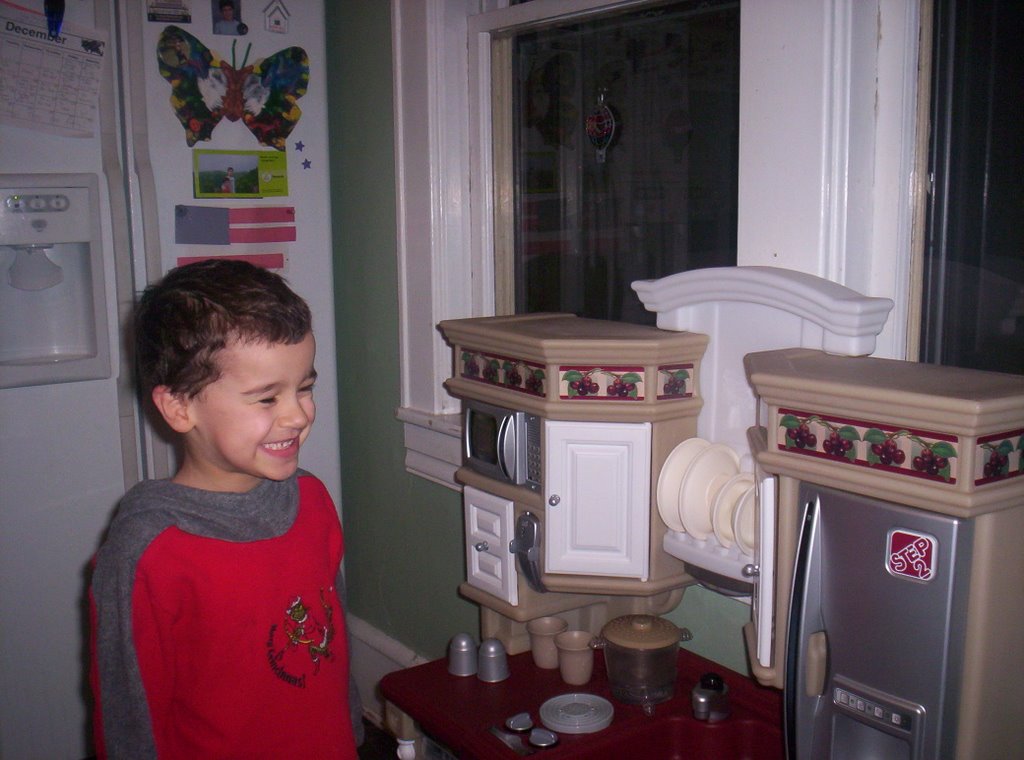
Christmas was lovely. Though we're far from our extended families, our children make up for any joy lost. Seeing my five year old's face as he saw the new kitchen he's wanted, was, well, you know the feeling. He's all boy, but what can I say? The kid likes to cook. We're all for that.


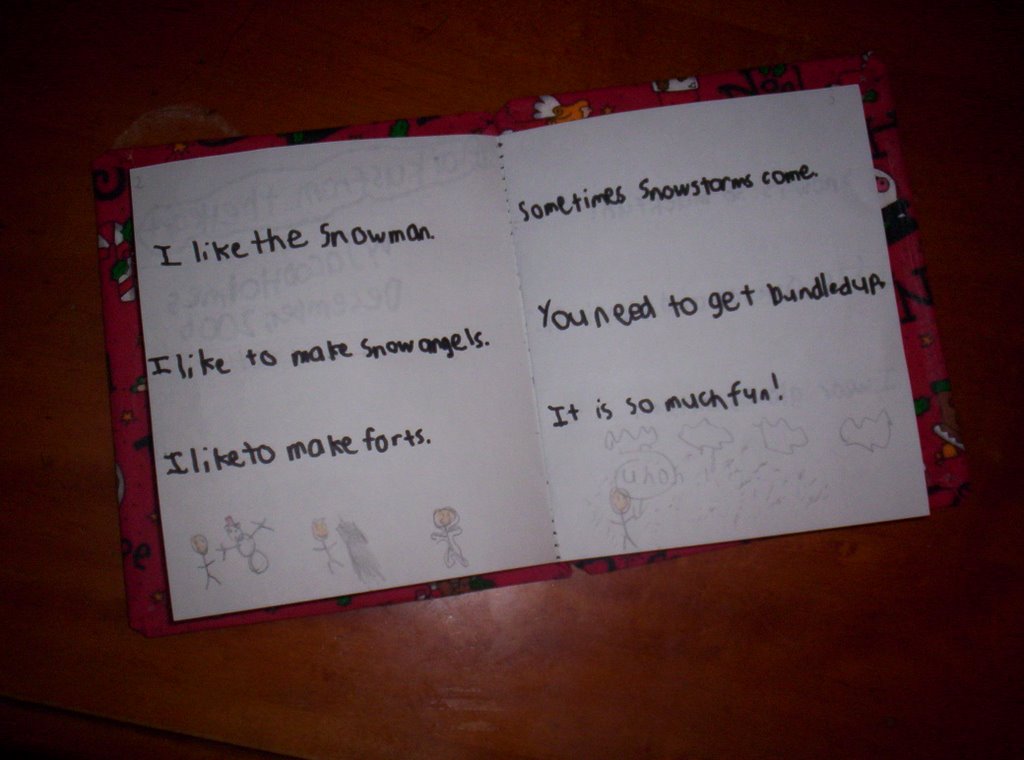
Jacob (9) wanted a playstation and got one, but his biggest smile came from giving his mom and dad a book of haiku verses he wrote himself. Levi made us a plate of cookies at pre-school.

We lounged, ate, laughed, and read The Best Christmas Pageant Ever, but the best part of Christmas? Levi blessed the food and gave a heart-felt thanks to God for sending baby Jesus.

How was your Christmas?


Our first on-line critique is coming up along with some great editor and author interviews. The first day or two of the new year we'll be looking back to our favorite interviews and books of the year.

If you all would be willing to share the writing advice and books you've enjoyed most in 2006, that'd be great.


Monday, December 25, 2006

Merry Christmas!

Novel Journey wishes you a very Merry Christmas. I pray we all take time to appreciate the one gift we've been given that truly matters.

Sunday, December 24, 2006

Mary's Song


...by Luci Shaw

Blue homespun and the bend of my breast

keep warm this small hot naked star

fallen to my arms. (Rest...

you who have had so far to come.)

Now nearness satisfies

the body of God sweetly. Quiet he lies

whose vigor hurled a universe. He sleeps

whose eyelids have not closed before.

His breath (so light it seems

no breath at all) once ruffled the dark deeps

to sprout a world. Charmed by doves' voices,

the whisper of straw, he dreams,

hearing no music from his other spheres.

Breath, mouth, ears, eyes

he is curtailed who overflowed all skies,

all years. Older than eternity, now he

is new. Now native to earth as I am, nailed

to my poor planet, caught

that I might be free, blind in my womb

to know my darkness ended,

brought to this birth for me to be new-born,

and for him to see me mended

I must see him torn.


taken from: John Mark Ministries: http://jmm.aaa.net.au/articles/11892.htm

Saturday, December 23, 2006

Novel Journey Critiques

Gina, Jessica and I are critique partners who are passionate about good fiction. To that end, we pledged never to allow each other to settle for mediocrity. Our critiques are tough to say the least.

I've received comments like: "Yawn." "No way." and "I don't believe this character would do that." among other remarks. I've even had them suggest I scrap entire chapters. But they do encourage me to reach for the best I can be. The point is: I could do better. And I did. We all do.

We've grown up together in our writing, teaching one another as we each learn something new. We've learned to show and not tell, use action instead of passive. POV, characterization and description are bywords of our critiques. Once we had all that down, we learned when to break the rules, and how to do it with panache.

After receiving a number of requests for critiques, we decided to do a series on Novel Journey. You're invited to submit 1,000 words for a free critique by each of us and posted (author to remain anonymous) on Novel Journey.

Our first brave soul will be critiqued on Thursday, Dec. 28th.

Also upcoming: author interviews with Michael Palmer, Zondervan Sr. Fiction Editor: Sue Brower, Jeff Andrew, and lots of other folks.

Friday, December 22, 2006

For Your Enjoyment ...

http://www.elfyourself.com/?userid=aa7f857c83956c0fbe9600dG06122216

(link shared by this clown.)

Crusaders Series

One of my dearest friends, Cindy Sproles of Mountain Breeze Ministries, launches her Crusaders for Christ series discussing the ministry of Novel Journey.

She asked tough questions that made me really question what the heck we're doing over here.
Click here to read.


Thursday, December 21, 2006

Author Interview ~ Nancy Farrier

NANCY J. FARRIER is an award-winning author from Arizona. Apart from family activities, she pours her heart into writing vivid stories.


What new book or project would you like to tell us about?

Most recently Tuscon, part of the Sonoran Secret series was released in hardback, large print edition.


Tell us about your publishing journey. How long had you been writing before you got a contract? How did you find out and what went through your mind?

I always loved stories, reading them and writing them. In my early twenties, I started several books, but never tried to publish anything. When I became a Christian, I was such an awful person that I gave up everything associated with my former life, including writing. I wanted to live only for Jesus. I thought that meant giving up my writing too.

About twelve years ago, I began to have a growing desire to write again. Since I still associated this with my former self, I fought the desire. It came to the point where I would wake up crying in the night. I was a mess. I prayed that God would take this from me, but he didn’t. Finally, I prayed that if this was His will that I write for Him, He would show me by allowing me to have something accepted for publication that year. I submitted three short articles and stories that whole year. On December 11th, I received payment for a children’s devotional. I knew then that God was calling me to write; that this wasn’t a selfish desire.

That same week I started writing a children’s book. I completed it in a couple of months, but didn’t have a clue what to do with it. When I happened to see an ad for a Christian Writer’s conference near where I lived, I attended and found out I didn’t know anything about writing. That started the learning process.

This was in 1995 and my first book was published in 2000. I have to say that my first book was for Heartsong. I sent them the proposal. When I got the manila envelope in the mail, I almost didn’t open it, because I was sure it was a rejection. In fact, I think I left it sitting for a couple of days. When I did open the envelope, I found a request for a complete manuscript. I was thrilled.

Do you still have self-doubts about your writing?

Daily. I think Satan delights in whispering doubts in my ear. Doubts about my Christianity, my being a good mother or wife, and doubts about my writing abilities and call. It’s an ongoing battle, but I try to cling to God’s promises. I love Romans 8:1, “There is therefore, no condemnation for those who are in Christ Jesus.”

Was there ever a time in your writing career you thought of quitting?

Writing is full of discouragements. Editors, readers, critics, while meaning well can be harsh. Yes, I have thought of quitting. I usually have some chocolate and get back to it the next day.

What mistakes did you make while seeking a publisher or agent?

Tough question. Being prideful. Being too assertive. Not being assertive enough. I don’t know. Even when I think I’ve learned a lesson, I still make mistakes. I’m not sure I can point to any certain one.

What’s the best writing advice you’ve heard?

To write. I know you’ve all heard that a million times, but it’s true. When I look back at earlier pieces I wrote, I cringe. Everything you write makes you a little better. If you think about the practice it makes sense. A pianist doesn’t sit around waiting for a concert to be scheduled and then try to learn the music. The pianist practices and learns for years before being accomplished enough to play a concert. Writers, too, need to practice their craft.

Do you have a pet peeve having to do with this biz?

Yes, it’s those editors who are calling me day and night begging me to write for their publishing house. Oops! That was supposed to be…those editors who AREN’T calling me day and night…

What do you wish you’d known early in your career that might have saved you some time and/or frustration in writing? In publishing?

Being a writer doesn’t mean you have to be published immediately. Take the time to learn the craft. I didn’t like to tell people I was a writer because then they wanted to know what I’d published. I can still see some of the smirks when I said I wasn’t published yet, or only had a couple of articles published. There isn’t a lot of respect out there for pre-published authors, and I don’t think that’s fair.

Was there ever a difficult set back that you went through in your writing career?

I think I am still going through a setback. A few years ago I began a time of difficulty emotionally and spiritually. I won’t go into detail, but that “thorn in my flesh” is still there. God has done an amazing work through this in tendering my heart towards others. I believe my lack of success in gaining writing contracts has to do with this spiritual journey.


The main lesson I’ve learned is that God is calling me to be faithful to write for Him. That doesn’t mean He wants me to be a great, published author. Being successful to God, and successful in the eyes of the world, even the world of Christian publishing is very different. I believe, because of my faithfulness, I am a success in God’s eyes and that is what counts. That said, I do have to admit to a human failing in myself, and a desire to be able to publish more books.

What are a few of your favorite books?

It’s hard to just name a few when I like so many. Breaking Point by Karen Ball, Arena or the Legend of the Guardian King series by Karen Hancock, The Ruby Taylor series by Sharon Dunn are all books I often recommend to others.

What work have you done that you’re especially proud of and why?

I can’t think of any one book that stands out above the others. Each book I write has a message in it for me from God. He always uses the writing process to teach me some truth about Him.

Do you have a scripture or quote that has spoken to you lately in regards to your writing?

My favorite writing verse is Habakkuk 2:2 “Then the Lord replied: Write down the revelation and make it plain on tablets…” I try to write to encourage people in their faith; to make it plain how much God loves us.

Can you give us a look into a typical day for you?

I’m usually up by 6:30am. I get my college age daughter up so she can be ready to go by 7:30 when I take her to work. I come home, have breakfast, and get school work ready for my other two daughters. They start school by 8:15 to 8:30. We do school until around 2pm. I get to write then with a minimum of three million interruptions, including 20 to 30 minutes for piano practice. On good days, I write until 4:20 when my husband gets home. Then I have to work on supper, pick my daughter up from college and do family stuff until 9pm when my husband goes to bed. Then I have until 10:30 to finish any writing, get my daughters to bed, and take a few minutes for myself.

Do you have a word or page goal you set for each day?

I try to write about 2000 to 2500 words per day, four to five days per week.

Are you an SOTP (seat of the pants) writer or a plotter?

I am more an SOTP writer. I do know where the story is going, but I like to allow for changes and surprises on the way. I plot more than I used to, but I find that when I write too detailed a plot I tend to stress as I’m writing. I feel like I have to stay with the script and can’t allow for creativity. It’s stifling.

What author do you especially admire and why?

I admire Karen Ball so much. She is a great writer, editor and Christian. She has such passion for her work, and compassion for those she works with that I can’t help but be encouraged by her.

What is your favorite and least favorite part of being a writer?

I love the creative process. Getting new story ideas is so exciting. I also love reading the galleys when I haven’t seen the story in months and finding a place that speaks to me. I can see how God has used that part of the story, and that is a thrill. My least favorite part would be the stress of wanting to write and not having the time. I know God called me to be a wife and mother first, but sometimes that’s frustrating for me as a writer. (Most of the time I’m fine with it.)

How much marketing do you do? What's your favorite part of marketing?

I don’t do a lot of marketing at this point. I do enjoy talking with groups about writing and books. I’ve done that a few times, and have loved the opportunity to meet my readers.

Do you have any parting words of advice?

Do what the Lord calls you to do. Be faithful to Him no matter how hard your call is and no matter what other people say to you. The rewards of serving Him are worth any sacrifice.

Wednesday, December 20, 2006

Author Interview ~ Paul Maier


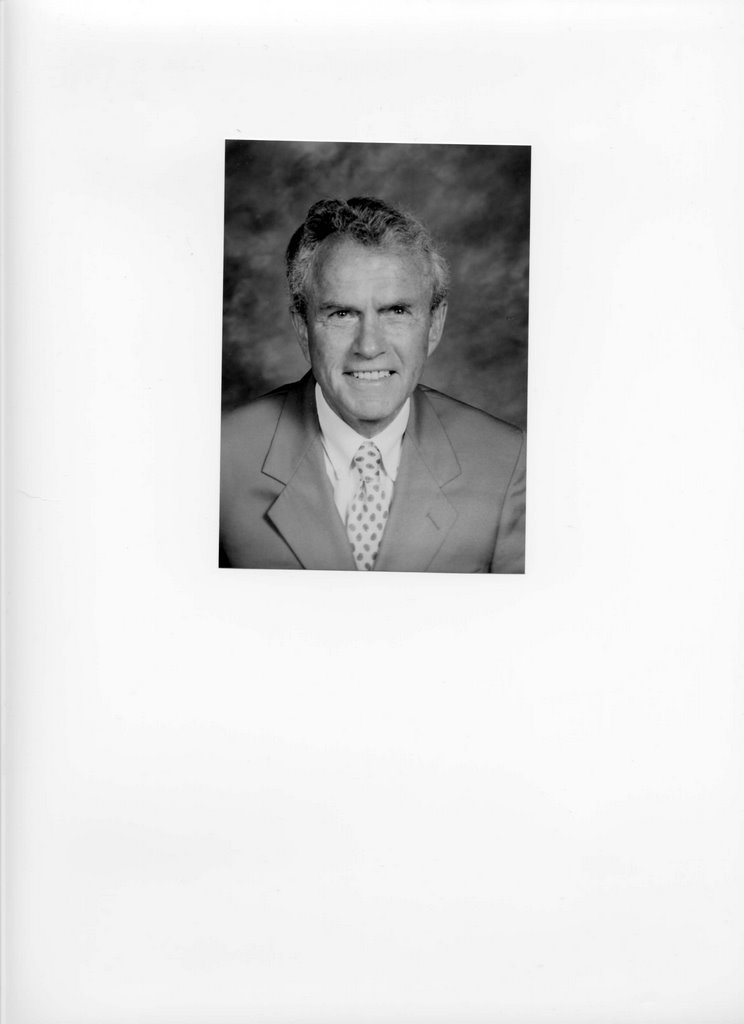
Dr. Paul L. Maier is a professor of Ancient History at Western Michigan University. He holds degrees from Harvard University and Concordia Seminary. He has published numerous articles and books, both fiction and non-fiction, with several million in print in a dozen languages. Dr. Maier lectures widely and is frequently interviewed for national radio, television, and newspapers. He and his wife, Joan, have four grown daughters.

What new book or project would you like to tell us about?


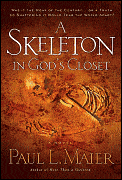
I’m at work on “Skeleton 3,” that is, the successor to A SKELETON IN GOD’S CLOSET and MORE THAN A SKELETON.


Tell us about your publishing journey. How long had you been writing before you got a contract? How did you find out and what went through your mind?

It started with articles for magazines. Then I decided that my father’s story had to be told – he started the longest-running religious broadcast in the history of radio “The Lutheran Hour,” and McGraw-Hill published my first book, A MAN SPOKE, A WORLD LISTENED in 1968.

Do you still have self-doubts about your writing?

Not at all.

Was there ever a time in your writing career you thought of quitting?

No, because I was fortunate to be published rather quickly.

What mistakes did you make while seeking a publisher or agent?

Once I tried several submissions at once to different publishers, and they were “offended.” However, I understand that is rather common now.

What’s the best writing advice you’ve heard?

Get involved with your own material, and the project starts writing itself.

What’s the worst piece of writing advice you’ve ever received?

You HAVE to use an agent.

Do you have a pet peeve having to do with this biz?

Yes, the continual (almost revolving-door) changes in editors and publishing personnel.

What do you wish you’d known early in your career that might have saved you some time and/or frustration in writing? In publishing?

To ignore any rejection slips, but try to learn from them.

Was there ever a difficult set back that you went through in your writing career?

Not really, other than several rejections early on.

What are a few of your favorite books?

I’ve always been turned on by the classical historical novels, such as QUO VADIS. I also admire and use the C.S. Lewis books.

What work have you done that you’re especially proud of and why?

In non-fiction: my new translations/commentaries on JOSEPHUS and EUSEBIUS, since both authors are such crucial sources for the early history of Christianity.

In fiction: my novels PONTIUS PILATE and A SKELETON IN GOD’S CLOSET, since both have fresh plots that are of paramount significance for Christianity.

Do you have a scripture or quote that has spoken to you lately in regards to your writing?

1 Peter 3:15: “Be ready to give an answer to anyone who asks the reason for the hope that is in you.”

Can you give us a look into a typical day for you?

Teach my history courses at Western Michigan University in the mornings, work on my acreage in the early afternoons, do e-mail and correspondence in the late afternoons, and write at night.

Do you have a word or page goal you set for each day?

No. That’s too artificial: let the pen (computer!) go where it will.

What author do you especially admire and why?

C. S. Lewis and my fellow defenders of the faith, Josh McDowell, Lee Strobel, Hank Hanegraaff, Jeff Sheler, Ed Yamauchi, and others. All write clearly and incisively against the radical, revisionist critics who have attacked Christianity in past and present.

What is your favorite and least favorite part of being a writer?

Favorite: Sharing my insights and creative efforts with others.

Least favorite: Proofreading

How much marketing do you do? What's your favorite part of marketing?

Quite a bit, to make sure that it’s done properly. My favorite part would be network exposure, rather than one single radio or television station.

Do you have any parting words of advice?

Be sure of your publisher’s promotional efforts well in advance of the publication date. This is especially important in the case of the rapidly-changing personnel situation so notorious at publishers today.

Tuesday, December 19, 2006

Author Interview ~ Christy Barritt

Christy Barritt is a freelance writer, author, speaker and worship leader. When she’s not working on books, Christy has written articles for various publications and writes a weekly feature article called Thumbs Up, which salutes someone doing something positive in the community, for The Chesapeake Clipper, part of The Virginian-Pilot. She’s married to Scott, a teacher and funny man extraordinaire. They have one son, Eli Samuel, and two dogs, Duchess and Benji. When Christy’s not writing, she enjoys having coffee with friends, taking crazy road trips that usually involve no maps and flipping coins, and making her son giggle.


What book or project is coming out or has come out that you’d like to tell us about?

My current book is Hazardous Duty. It's about a crime-scene cleaner named Gabby St. Claire. Gabby had to drop out of college on her way to getting a degree in forensic science due to some family issues. So she decided to do the next best thing--clean crime scenes. But, like all good amateur sleuths, Gabby has a nose for trouble. She just can't resist getting involved with the police investigations, especially when she finds evidence while cleaning which points her to a suspect different than the one targeted by police.
Tell us about your journey to publication. How long had you been writing before you got the call you had a contract, how you heard and what went through your head.

I’ve always loved stories. In high school, I wrote a romance novel and submitted it to a publisher. It was rejected, but I didn’t give up. In college, I would write pieces of my novel as I sat in Old Testament History class (not recommended to any students out there—pay attention in class!). I submitted that book my junior year and the publisher asked for a complete! I was thrilled. Ultimately, that book was rejected also. The last semester of my senior year, I began working part time at a local Christian publishing house as an assistant editor. After graduating, I was hired full-time.

I really enjoyed working at the publishing house. Then I got a call from my mother, asking me to move back home. My father had received an official diagnosis: Alzheimer’s, and it was progressing rapidly. I wrestled with what I should do. I wish I could say that decision was easy, but it wasn’t. After a lot of prayer and tears, I ultimately decided to move back home.

I went from being an independent career woman to living with my parents and working part-time at a bookstore. I watched my father, as he became a shell of the strong man he used to be. As an outlet, I began to write again. In fact, I wrote my first novel that sold while sitting at my father’s bedside. I dedicated that novel to my father, who died four years ago last month.

A couple of years later, I received a manuscript proposal from an editor at the publishing house I’d worked for. An editor was sending me a proposal? How great was that? It was for a non-fiction book about Christian music. The strangest part was that I’d written a proposal a couple years earlier for a book with the same idea—I just never sent it out.

Meanwhile, one of the publications I was writing for had an assignment for a profile of a crime-scene cleaner. As soon as I read those words, a novel came to life in my head. Gabby St. Claire wouldn’t let me rest until I told her story. I probably wrote Hazardous Duty in six months. A well-known writer read the first three chapters and loved it. She really encouraged me to pursue publication.

I sent it to an agent who asked me for some revisions. I revised. Then she asked for more revisions so I revised some more. Ultimately, she rejected it, which was a huge bummer. In the meantime, I’d submitted it to Kregel. They wrote back that they liked it but it needed some changes. So, I made those changes and submitted it along with the changes I’d already made. A few months later, they offered me a contract. A year later, the book is being released.

Whew! Did you get all of that?

Do you still experience self-doubts regarding your work?

Oh yeah. I don’t think they’ll ever go away. They keep me humble, though.

What’s the best advice you’ve heard on writing/publication?

God doesn’t call us to greatness but to faithfulness. I think if we keep our eye on the goal of pleasing God, then everything else will fall into place. It’s easy to get our priorities out of order. When we do, it ultimately leads to misery. Been there, done that.

What’s the worst piece of writing advice you’ve heard?

Any advice that comes across as an absolute. If we were talking about it in the Christian realm, it would be labeled “legalism.” For instance, I remember hearing over and over again that if you’re going to get published, you need to adhere to this certain set of writing rules that can’t be broken by first-timers, find an agent, yada, yada, yada. That’s the way it HAS to be done if you’re ever going to get published.

It’s not that that isn’t good advice. There are four of us in my critique group who are published and none of us got a contract that way. In fact, some of us sold our first books on proposal only! Another has a book dealing with a so-called taboo subject in CBA. The writing journey is different for everyone. Listen to advice, but don’t let anyone box you in. God isn’t a formula God, and he’s given us each different paths.

What’s something you wish you’d known earlier that might have saved you some time/frustration in the publishing business?

Don’t have too many cooks in the kitchen. Better said, don’t listen to too many opinions about your WIP. Choose your critique partners wisely. A bad critique partner will try to rewrite your book in his or her voice. There was a time I had as many people who would critique my book, critique it. One person would love it; one person wouldn’t. One person thought I should make major changes in the plot; another wouldn’t. When you have too many opinions as to what you should do, it can cloud your vision of what the book should be. A good critique partner will make your book stronger but also allow it to stand its own ground.

Is there a particularly difficult set back that you’ve gone through in your writing career you are willing to share?

Every day could be a set back if I let it. I really think it’s the small things that can get to us the most—time constraints, bad days, rejection letters. Sometimes I think that even if I wanted to stop writing, I couldn’t, because it’s a passion God gave me and just one way I worship him.

What are a few of your favorite books?

This changes almost daily, but right now I’d say “Kissing Adrien” by Siri Mitchell and “My Life as a Doormat” by Rene Gutteridge.

What piece of writing have you done that you’re particularly proud of and why?

I have to say that I really do love Hazardous Duty. I also have another book that’s currently being considered at another publishing house called The Good Girl that absolutely love. It explores some themes from my own life and writing the book really helped me figure out a few things about myself.

Do you have a pet peeve having to do with this biz?

That would probably go back to the legalistic “advice” I mentioned earlier. Too many rules about the art of writing can rob your joy.

Can you give us a view into a typical day of your writing life?

I laughed when I read this question because ever since I had my first baby in June, there’s been no typical day. My answer today would be: write for five minutes; wipe spit-up from baby’s face; answer an email; stop to listen to baby cooing, think about how cute the baby looks so grab the camera and take a picture; force myself to concentrate; open up my WIP; realize it’s time to feed baby, etc., etc.

My mother lives right down the street from me, so she watches Baby Eli on Tuesdays and Thursdays. I try to get the bulk of my writing done at that time and some in the evenings. I really having to learn balance and how to juggle writing with the baby—I haven’t quite figured it out yet!

If you could choose to have one strength of another writer, what would it be and from whom?

This is such a hard question! There are things that I admire about many writers. But, if I had to choose one, I guess it would be Linda Hall. Linda is the most subtle writer I’ve ever read. She explores amazing themes and does it without the reader realizing the hard-hitting truths in the book until the very end. She’s a master wordsmith. I wish I had just a touch of her talent.

Do you have a dream for the future of your writing, something you would love to accomplish?

I would love to simply keep writing. I don’t want to be a “one book wonder.” I want to make a career of this. I love writing—it’s my passion. What could be more wonderful than doing what you love until you’re old and gray?

Was there ever a time in your writing career you thought of quitting?

Honestly, not really. Not for more than five minutes, at least—and that was usually when I got a rejection letter or a particularly scathing critique.

What is your favorite and least favorite part of being a writer?

My favorite part is the creative stuff. I love getting to know my characters and watching where they take me in the story. My least favorite part is editing. I obsess over it. I read my manuscripts over and over and over until I have to force myself put the pages down. Then, once I finally decide to let go and send the piece in, I’ll find a mistake I missed. Argh… I really hate editing.

How much marketing do you do? Any advice in this area?

I’m still learning about marketing. I’m trying to do as much as I can for as little money. I think word-of-mouth is really the best publicity. I’ve also found that speaking really helps to sell books. Ask me again in six months and I’ll let you know if any of my “bright” ideas for marketing worked!

Parting words?

Thanks for the interview. I’ve probably been way too longwinded already, so I’ll end now! Thanks again!


Monday, December 18, 2006

Who Do You Mentor/Who Mentors You?

Mary DeMuth


I met Sandra Glahn several years ago, at the point in my life that I really felt God nudging me toward publication. I sat next to her at a church potluck. Sounds normal, right? Well, we had just visited her church that day. Someone asked us to join the church for a barbecue meal and we said sure. If we hadn't, I wonder if I ever would've met Sandi.

"So, what do you do?" she asked.

"I want to be a writer," I told her.

"Really?"

"Yes."

"You know what I like to do? I like to mentor writers."

It wasn't until later I realized she'd been multi-published and was a magazine editor. That was the beginning of an amazing relationship. Sandi looked at my faltering adverb/adjective glut of prose. She encouraged me. She helped me with my first query letter (it had been two pages--yikes!). I took her out to lunch from the proceeds of my first sale.

When I started writing my first novel and was essentially stuck, she gave me just a few good words--words that re-steered the storyline enough for me to go forward with zeal. When I met my agent, she rejoiced with me. When I made my first book sale, she jumped alongside me. Through it all, we've become the closest of friends.

Sandi was in France for a few days and spoke at our Riviera Writer's group. She and her husband Gary took Patrick and I out to a fabulous dinner.

I asked her, "When do you know when to say no when other writers send you their work?"

She looked at me and said, "When you figure that out, you let me know." Then, almost as an afterthought she said, "You know, if I had been good about saying no six years ago, we might've never met. One of the richest parts of my life has been knowing you. Had I said no, I would never have experienced that."

Sandi has a way with words that makes me want to cry. She is authentic, deep, intelligent, a killer writer and an amazing mentor. I pray that the Lord sends folks like Sandi your way. I know I am utterly richer because of her.


Click the book for more information on Mary's second novel, Wishing on Dandelions.


Gina Here:

I'm curious, how many of you have writing mentors, and how many of you are writing mentors. Ane, Jess, and I mentor a critique group of a dozen or so. We're there to answer questions, sometimes read proposals and first chapters before they send them out, and that sort of thing. They help us too. It goes both ways.

I have quite a few people who help me in different areas of my writing journey. Robert Liparulo, Tony Hines, Colleen Coble, Deb Raney, Don Brown, Camy Tang, Chip MacGregor, Brandilyn Collins and many others.

I wouldn't say those folks are my mentors in the standard sense but they have mentored me in something, somewhere along the line.

I do have two mentors. Alton Gansky and I met at a 2004 Blue Ridge Mtn Writers Conference. We hit it off right away. Similar sense of humor, similar tastes in writing style. He has been there for me since then and has answered my questions, read my work: sometimes tearing it, sometimes praising it. He's been a shoulder to cry one with rejections and a cheerleader when something positive has happened. I appreciate him so much.

Kathy and I met at the 2005 ACFW conference, though we emailed a little before that. I sat on her shoulders and we bonded instantly. She's a wacky lady, just my kind of people. I love her writing and she seems to think I don't suck too bad. Like Al, she's been there for me, encouraging, pushing, critiquing, and praying.

I encourage those of you who do not mentor, to be open to this. It will bless you, not just the person you guide. Don't think that you have to be multi-published or have won an award to mentor someone, like my friend Chip says, you just have to be further along than that person on your writing journey.

And if you don't have a mentor, I encourage you to be open to who God would have for you. It's not always who you think it ought to be either. If you're looking for someone, pray, don't push and wait patiently. The person will reveal themself.

Saturday, December 16, 2006

Sunday Devotion: With a Voice of Singing

Janet Rubin

Fifty high school students dressed in black shuffled onto risers probably designed to hold twenty. One girl stumbled in her spiky heels, sending a wave of giggles through the group. A teen in the audience faked a loud sneeze and others chortled while the chorus lined up. In the seat behind me, a woman whispered a pizza order into her cell phone. After several moments of arranging themselves, the chorus faced forward and watched the director. My Chelsey was to the left, a nervous smile on her lips. I scanned the faces, picking out her friends. All of them looked beautiful.

With a count of four and a wave of Mr. Fiorvanti’s hand, the teens erupted into their traditional singing of The Carol of the Bells, then moved onto December’s Keep by Frederic Chopin. Mr. Fiorvanti turned to the microphone to tell us about the last piece, a song called, With a Voice of Singing by Martin Shaw- a song he said had been sung by choirs since 1923. It seemed to me there was a twinkle in his eye and pride on his face as he said, “I hope you enjoy it.”

They burst into song, voices crystal clear, harmonies perfect. Rising, falling, annunciating each word, and yes, bringing me to tears. As I thought about the joy the performance brought me, I considered how much work went into it. The kids had practiced every other day for months, but before that there was an author—someone who wrote the lovely, passionate lyrics, composed the music, and arranged the parts. It had to have taken a lot of hard work to write such a beautiful and complex piece, and it took a lot of hard work to learn to perform.

Works of excellence take time, but if we write to honor an awesome God, we must strive for excellence. The Bible says, “Do everything as unto the Lord.” Everything would include my writing, wouldn’t it? If I were writing for the Lord, I’d want my finished product to be good! Sometimes, in my rush to put my stuff “out there,” I consider submitting work that isn’t my best. I’m too lazy to do the mind-stretching, dictionary-opening, thesaurus-searching, information-seeking work that will make my writing excellent.

How might you improve your standards of excellence? Waste less time on the internet? Edit more? Research more? Listen to that annoying crit partner who is so hard on your work? Above all, don’t try to do your task without God’s help. He is our source of strength and the Giver of all wisdom. Like any good parent, God doesn't expect perfection (He knows we aren't capable of that), but He wants our best efforts.

I’ll bet that Martin Shaw got tired during his writing and composing, but he pressed on. And because his song is so well done, students in public high schools are singing its lyrics of praise to God nearly a century later.

Lord, You are worthy of our very best efforts. You have entrusted us with the gifts of imagination, a passion for words, and a desire to write. We want to be good stewards of these gifts, and we want to offer our most excellent work back to You. Please help us to persevere through the hard parts and invest the amount of time needed to do our best. Thank You for giving us Your best. Amen.

Labels:

S'up Saturday

Well, I'm a little late posting today. Many of you know I'm a registered nurse as well as writer. I started working on a postpartum floor a few months back. I'm enjoying it, except that I work night shift. I'm a day person. I feel my best when I rise before six am and can run, get coffee, sit on the porch and get with God before I start my day.

Now I sleep most of the daylight hours and pull into Starbucks about six thirty pm for coffee.

Anyway, it's great research for the novel I'm working on which is set, where else? A mother-baby floor. If I didn't work here, I'd get some of the details wrong. In fact the hospital setting has changed so much since the last time I worked here, about a decade ago, that I would have gotten tons of details wrong. Now to get medications out, I have to have my finger laser-scanned each and every time I want so much as a Motrin.


Anyway, I worked last night and knew you wouldn't mind if I got a little shut eye before posting.

Coming up we have Zondervan's Sr. Acq. Editor--Sue Brower, author interviews with Christy Barritt (and many others), commentary from Mary DeMuth and yours truly, and of course, we're beginning our on-line critique series, which ought to get things stirred up pretty good. Stay tuned.


**Here's an interesting resource, and the price is right Straight Talk from an Editor

Friday, December 15, 2006

Conclusion of Novel Journey's Chat with Liz Curtis Higgs

Last week, we featured the first part of an interview with Liz Curtis Higgs. This week is the conclusion. To learn more about Liz Curtis Higgs, her books, her ministry, and to join her newsletter and more, please visit www.lizcurtishiggs.com.

[Interview conducted via the phone with Jessica Dotta]


Do you ever find yourself not putting something you want in your novel because you're afraid of how your reader may react?

Actually, my theory of the writing process is to put everything in and not censor it—thinking in terms of what's acceptable, what's appropriate, what might step on a toe. I'm trying to write all the way to my heart, so I put on the page everything. Then, when I go back the next day and edit that scene, I'm going to start taking stuff out, because now I’m thinking like an editor or reader, and I'm saying, "Ooh, that one phrase or thought takes it a little too farther than I think some people will want to go." And so out it comes. You've read Grace In Thine Eyes.

Loved it.

Well, bless you. You put an amazing review on Amazon, and I'm ever grateful for that.

Well, you know, I was reading the novel and had not realized what biblical story you were patterning it after.

That's good.

And I hit the middle of the book and I'm like, ”Oh no she did not!"

[laughing] Oh, yes she did

And that is what I love about your writing. I sincerely recommend your books to everyone. When I get your books, I do not open them until I have nothing on my plate that day, because I get so enwrapped in your novels.

Well, that's the goal, so thank you so much for falling right in line with that. Anyway, mentioning Grace in Thine Eyes and getting back to what I don't put in, there's a good example of a very difficult scene that occurs in that book. We don't have to go into details, it was hard enough to write, yet I knew I had to write it as realistically as I could. Because I was writing a great deal of personal experience, I could go deeper than some writers might, simply because I've been there. And so then, once all that pain, frankly, was on the page, I could go back and take out—sometimes it was just a word—or sometimes it would be just a phrase added that was just a little more than we needed to say. However, I want it to be real to my readers, I want them to experience exactly what the heroine was experiencing, so I fight for some things.

A couple of reviewers have said of Grace this is a book for mature readers, but honestly, I write for women. I don't write for teens. In fact I think one of the dangers of Christian fiction is that it's so sanitized that it doesn't speak to us at all. That it doesn't come to any deep place, because it's skimming across the surface of what a woman really experiences in life. And so, with care, and much prayer, I'm writing. If God ever checks my spirit and He pulls me back, I'm obedient, believe me. I never want something in my novels just to shock or be graphic. That is not my goal. But sometimes we have to feel what the woman is feeling in the story, and that means sharing a detail that will make us all sigh and say, 'I know what that's like.'

Do you ever grow frustrated by the limitations in the CBA?

Not at all, because some of them are wonderful and wise. Let's not go some places, you know. I'm grateful. I do have a lot of readers to write and say, 'I'm used to reading secular novels and I'm so grateful that in your novels you don't have A. B. C. or D'. I think we offer a wonderful alterative to that. I have never, ever, felt cramped by the expectations of my publisher. Ever. But, I also have a really fabulous publisher that understands what I'm trying to do and is supportive of it, and they know I'll listen if they flag something. But I try to get to it before they do. In other words, I try to do that in my self-editing process before I ever turn the manuscript in.

What feedback have you received from non-Christians or those who only read ABA fiction?

Well, that's been thrilling for me because I only came to know Christ at 27, so I had a number of years out there in the big, bad world. My heart is always for that woman, who has not found the Christ yet, doesn’t know how much God loves her, and happens to read fiction.

I love to reach that woman, and we have very carefully packaged these books to appeal to a reader who might not normally reach for Christian fiction. For example, the trilogy is very clearly based on Jacob, Leah and Rachel, but it never says that on the book cover. Grace in Thine Eyes, very clearly—about half way through the book you figure out—is based on Dinah from Genesis 34, but we don't say that. You could have on the back, 'Here is Dinah, moved to 19th century Scotland' but I think that would do more harm than good.

I want every reader to come to these stories, ready to be taught, ready to have an experience, and ready to travel with me, not having preconceived notions about what they're going to find there.

Do you receive fan mail (from secular readers)?

Oh, absolutely. The publisher has been very gracious about not only putting my books in the general market bookstores, but also by buying ads in magazines like Scottish Life, The Highlander, which are read by Americans of Scottish descent, who just love books about Scotland and have no clue that these books have Christian content. And so that's been thrilling. I did get one woman, oh this was just fascinating, she wrote me a letter and said, 'I've read Thorn in my Heart, you're a wonderful writer, but I kept thinking how much better this book would be if you just didn't have all that religious stuff.

[laughing] Oh no!!

It was fascinating to enter into dialogue with her because her e-mail was kind of 'I'm sure you'll never write me back'. That's absolutely not true, I write everybody back, however critical they would be, because usually if someone is critical, it isn't as much about my book as it about something that my book touched inside them. So my goal is to minister to them and not worry about what they say. The key is how can I encourage you?

So I wrote to her and I said, 'Oh that was such a fascinating comment, and I'm going to take it that you like my writing, but I'm also going to say there would be no story without this faith element from me. I could never write a novel separate from my faith in Jesus Christ and my desire to sit down and share that faith with anyone who will sit down and listen.' Then, of course, she opened up and said 'here's why I'm so negative on religion.' We just went back and forth a few times in e-mails. It was a fabulous time. We ended on such a sweet note together. She said 'I will look forward to reading your future novels, and that was amazing, since she started out by saying 'yuck.'

I just invite that dialogue with my readers, because they teach me and they give me a chance to minister, which is really what it's all about to me.

When your fans write you, or you meet them in person, what do they most want to know about you?

Well, a lot of times it's 'What's this Scottish connection?' I wish I could say, "Oh well, my great grandmother lived in . . . " But the fact is, we've done our family lineage back a couple of centuries, and we've yet to hit any root there. We're in Ireland, Wales, England, and we're in France. We do have Walkers and Crawfords on my side of the family. So I feel certain there's either Scots or Scots-Irish blood back there somewhere. But that wasn't the connection. It was simply God saying—a sort of—"Go to Nineveh—Go to Scotland."

And now, it's just such a part of my life, it's literally my home away from home. That's a question people often ask, is why Scotland.

I just did a wonderful book signing, oh the people were so fun. They had wild questions, one said, "I've never been in a castle, describe what it's like to stand in a castle." So I got to stand up and try to do this visual imagery for everybody.

A lot of times they ask, 'Did you always want to be a fiction writer?' And I can point back to my childhood when I wrote I don't know how many novels in my teens. I mean they were awful. [Laughs]You don't want to read them, but clearly that desire to tell stories goes way back for me. Between the ages of ten and seventeen I did a bunch, then went silent while I spent ten years as a bad girl. And then when I came to the Lord, the first thing I felt called to do was speak, and so I've been a public speaker for twenty years. Then, of course, I segued into writing but that was non-fiction, and then it was children's, and then came the Scottish historical fiction call. The rest is what we've shared already.

Lots of fiction writers are going to tell you they started writing in their teens and twenties, but I waited because God said wait—until my forties, and I think that's okay.

What do you think are misconceptions that people have about you?

Wow, you might have to ask them that. Misconceptions? Well, I think people in general assume that fiction writing is easy, that you sit down and the stories just flow out of you. It is the hardest work I have ever done. I've done full time radio, I've done speaking before twenty thousand people—no problem. I've done lots of different things, but fiction is so hard.

First you have to go to that world in your head. Because my world isn't the one that's out the window, because it's a couple of centuries back, I can take a couple of hours just to get myself settled in to 18-whatever, and hear the cadence of the voices, feel the flow of the day. We run around like chickens now, and then, it was a different pace. You know, you read Jane Austin and it's like, "You did what all day? It took you a whole day to write a letter?" This is a different world than we know.

So there's the getting into that place, and the hard part is that today's world, the contemporary world keeps busting into your historical head. You'll just be there, and then all the sudden, somebody is at the door or saying "Liz, you got a phone call." They don't have phones in 1789, how can the phone be ringing?

Funny story, I get so into the world of my books that I sometimes lose touch with what's going on. My family and I were riding to church, and I looked out the window and said "Wow, look at all these flowers for April. I can't believe we have this many flowers in people's gardens in April. And they turned around and said, "Mom, it's August." But I had been so in April, in my books that I was still there. So that can happen, and they'll tease me.

So there's getting into the world, and knowing if you're going in the right direction. In other words, because I do play it a little loose when I go into a scene, I let the characters go. I just follow them. Sometimes they say amazing things. Amazing as in "What? Where are you going? Why would you have that discussion? Well, okay, I'll keep going with you. I'll see."

At the end of the writing day, you can think 'wow, that was fascinating' but it didn't advance the plot one iota. Then you have to throw it all out and start over again the next day. Those kind of three steps forward, two steps back can be very frustrating and also you begin to second guess yourself. Was I right to dump that? Should I have kept that? It's a lot of that—back and forth. Every word is fought for in fiction.

Do you bounce your story off a reader or critique group as you write?

Never. First of all because I'm not sure what's going to happen, and I'm such a people pleaser, I know if I describe the story to somebody, and they even wrinkle their brow, I would be thinking, oh, okay, this isn't going to work. So no.

Of course, I do have a proposal and outline, which I share with my editor and agent, but it's so big picture, it's so general that it leaves me lots of room to move around. When I compare that description to the actual finished novel, I always laugh. However much I thought I'd cover, I cover half that, and so much that I thought would happen, didn't happen.

One thing I'm asked often is why did you not number Thorn in My Heart, Fair is the Rose and Whence Came a Prince—1, 2 & 3. Real simple. I had no idea there was going to be a series. I thought I was writing one novel, Thorn in My Heart that's it. Half way through, I thought, 'Oh my goodness, look what happens next in the biblical story, when Rachel says give me children or I'll die. Oh wow, this is drama, I have to write that book, but I'll finish the story in the second book.' So there's Fair is the Rose, and I'm figuring this will be it. Halfway through that, I thought, okay, we're never going to get this all covered because we've got to get Jamie back home. He's got to face his brother, face his father who he deceived. So there were three books. The trilogy really does end with Whence Came a Prince.

Grace in Thine Eyes is meant to be a stand-alone. You can come into it cold—not having read the trilogy. But it is sort of a part two, but I wouldn't have dared give it a number. So, I can confound readers that way, and I don't mean to. That would qualify me as a hem-of-the-skirt-writer, wouldn't it?

Now the next trilogy, I'm going into it, expecting it to be a trilogy. But I guarantee you, it will either be two books or four. I went to the right pub house—who says, 'Whatever, Liz, keep writing, and we'll make it work.' I am so grateful.

What do you wish you had known earlier, when you started to write fiction that might have saved you time or frustrations?

I think frustration and the time spent is all part of the package. I think if I would have known, back in 1995 when God said Scottish historical fiction, if I had known what was ahead of me, I would have said, 'Thanks for the suggestion, but I'm not going there,' because it is such hard work, because these books take so long. Grace in Thine Eyes was a 14-month writing project for me. And I never take that long with any book. Bad Girls of the Bible took me six months.

What new author are you excited about—that you see coming up on the horizon?

Wow, that is such a good question. I have the blessing of reading manuscripts before they're published to offer a word of endorsements. I'm reading a novel right now that I'm just knocked out by. It's by Allison K. Pittman. It's the second in a series, and I'm so excited about this one. It's called Speak through the Wind, coming out Spring of 2007. I can't wait to finish it. Write my endorsement. Back up and read the first one, which was Ten Thousand Charms. And let me tell you, I don't say that very often.

She has a wonderful sense of how much to include in the historical and when you're overkill. She also does an exceptional job of engaging all the senses. Writers often forget about sense of smell. We need to know they're there. She just includes unique ones. I think I'm impressed with the uniqueness of the details.

The writing is really there, so there's one name I'd love to throw out there to check out.

Did you want to leave with any parting words?

Oh, I love parting words. If you are a reader, may I simply say, 'God bless you for being there.' I am so, so grateful to my readers. I don't know if you can understand how much it means to a writer. When you write, it means you're alone. You are alone in that room. It's you and the Lord and the computer, and that's it. So when a reader responds, even a couple of sentences to say, 'I really enjoyed this book,' those are treasures. So never hesitate to write, email a writer because it is the payment that we get that matters far more than royalties or any of that.

If you're a writer, my beloved brother or sister, hang in there. If you're not published yet and God has clearly called you to write—nobody would ever write for the fun of it, when it's such hard work—so hang in there. Keep polishing your craft, and worry more about craft than any other element in the writing business—marketing or promotion, or agents or publishers. You just get the 'write' right, and I believe God will take care of it.

About the Author:
Liz Curtis Higgs is the author of twenty-four books, with more than three million copies in print. In her series of best-selling Bad Girls of the Bible books, Liz Curtis Higgs breathes new life into ancient tales about the most infamous—and intriguing—women in scriptural history. Her best-selling historical novels, which transport the stories of Rebecca, Leah, Rachel, and Dinah to eighteenth-century Scotland, also help readers see these familiar characters in a new light.

As a gifted speaker, Liz Curtis Higgs has presented more than 1,500 encouraging programs for audiences both nationally and internationally. She received the Council of Peers Award for Excellence from the National Speakers Association, becoming one of only thirty women in the world named to their Speaker Hall of Fame
.

Wednesday, December 13, 2006

Author Interview ~ T. Davis Bunn

T. Davis Bunn left the United States after completing his undergraduate studies at Wake Forest. He first took a Masters in international economics and finance in London, then began assignments that took him to more than thirty countries in Europe, Africa, and the Middle East. Since his first book, The Presence, was released in 1990, he has had more than nineteen national bestsellers. His books have sold in excess of four million copies in sixteen languages and have received three Christy Awards for excellence in fiction—the most awarded to any author. Davis and his wife Isabella split their time between Oxford, where Davis is Writer In Residence at the Baptist college, and Florida.


While I haven't read every book you've written, I do own 10 of them. I've loved every one and was thrilled when you agreed to this interview. Where did the inspiration for Heartland come from?

I began working on my first Hollywood project six years ago. The experiences have been amazing, both amazingly good and astonishingly difficult at times. I have been looking for over two years for a concept that might illustrate what it is like to be a Christian working inside the Hollywood system.


Is any part of the book factual?

Absolutely. The way the television program was put together, both on the sound stage and on location, is based on fact. As is the issue of going to digital filming.

But what I think you really mean is, can the environment inside the system really be that anti-Christian. There are two responses to this question.

First, the few movies that are coming out these days with stories that are in harmony with our faith and values all have come from outside the Hollywood system. This was true with Mel Gibson’s Passion and it is still true today.

Second, Movieguide Magazine, the faith-based focus group that oversees Hollywood, considered the book real enough in its perspective to give Heartland its highest rating.

You have a remarkable range of genres in which you write, from historical, to suspense and Intrigue…and now Fantasy. What is your favorite genre, and why?

First of all, I did not see Heartland as fantasy. I know that sounds wild, especially if you have already read the book. If you haven’t, I won’t go into why it is, yes, okay, pretty fantastical. But what I was looking for was a story that illustrated the absolute impossibility of working as an evangelical Christian inside the big studio structure—studios are the major film and television groups, like Paramount and Dreamworks and Touchstone, etc. We are all hoping and praying that this will change, and soon. And there are cracks in the barriers, thank goodness. But right now, we are too often seen as either not important, or as the enemy.

So to have a major television studio group work on a program that was really and truly faith-based was, well, a miracle. And to have this continue, it would have to be a miracle that made it work.

The question then was, how can I make the miracle a part of the story, and not have it seem like God is answering all the impossible questions, and undoing all the hostile barriers, but rather operating in that quiet and incredibly wise manner that is so often how we see His glory? Heartland was the answer.

Our readers would love to hear about your publishing journey. How long had you been writing before you got a contract? How did you find out and what went through your mind?

I wrote for nine years and finished seven books before my first was accepted for publication.

In my own case, the commitment and discipline required to find success as a novelist also helped me learn the discipline required to grow in faith. I came to faith as an adult—I was 28—and started writing two weeks later. I had never picked up a pen to write more than a business memo before that time. I feel God used my passion for writing as the instrument to help reshape me, and redraw me without so much of the world, and the self-centered life I had known up until then.

My first contract came two weeks after I was married. Isabella had begun working as my agent after my first agent, a dear friend, took early retirement because his wife was ill. She sold my first book. She received the contract. She told me it had come. It was a moment of sheer illumination.

Do you ever have self-doubts about your writing?

Oh my, yes. Then and now.

From the manner of these questions, I assume many of your readers are hoping to become authors. So let me add one point of self discovery here.

Many times early on, I found myself not just questioning the original point that troubled me about the text or the paragraph or the character. I began questioning EVERYTHING. I doubted all my abilities.

The best way to deal with doubt, I have discovered, is to accept with honesty that there probably is a real reason why you have this uncertainty. The worst way to deal with it is to question whether you can write at all.

Everyone has weaknesses. Use these moments of doubt to come to terms with what is probably a weakness, an issue that you need to focus upon and grow through.

Was there ever a time in your writing career you thought of quitting?

You mean, since yesterday?

Seriously, there are many moments when the fatigue or emotional stress or outside world or the commercial hiccups just overwhelm. But the next day, or the next week, the flame of passion resumes its constant flame. The call is still there. You just get up and go on. And then suddenly there is the moment when it all just happens. The work and the pain and the stress become steps along the process to where you are looking at a body of work, and a carefully honed ability to create life on a blank page, and entertain people you have never even met.

How cool is that?

You've written some series with your wife. How do you divide up the work?

Every partnership, be it writing or marriage or business, must develop singular guidelines as you go along. If I were to offer any advice here, it would be this: Do not begin writing with other people until you are certain you have firmly established your own true voice. When you know who you are on the page, then and only then can you enter into a writing relationship with another person, and know at the end of the day you will still retain your own voice, and grow as an individual artist, further along the line.

What’s the best writing advice you’ve heard?


When I was just starting off, I think maybe I was closing in on finishing my first manuscript, I was put in contact with two professional writers. One was a woman who wrote for ABC, a secret Christian—you’d think we were talking about the church in China, thankfully things have gotten a LOT better since those days—and the other was Arthur C. Clarke.

They both said the same thing. Writing is best learned by first drafting. Not rewriting and polishing and trying to improve on the first idea. Sometimes you have to give up on the first one, no matter how precious it may seem, in order to truly be successful at the craft. Remember: Your commitment is not to one manuscript. It is to the PROFESSION. The PROFESSION of writing, the long term view, the author who sees this as an ongoing passion.

What’s the worst piece of writing advice you’ve ever received?

Write what you know.

What person alive today can truly know how life was in the seventeenth century? And yet millions of fans devour books, both romance and adventure, set in distant places and lands.

The critical issue is to strive to understand, to fathom the depths, but not, I repeat not, make the research your goal.

Your goal, first and foremost, is to entertain.

What do you wish you’d known early in your career that might have saved you some time and/or frustration in writing? In publishing?

I came to faith and began my writing career while living in Germany. I only had one contact with a writing seminar, and that was at a non-Christian event. Definitely, and utterly, non-Christian. The atmosphere was pretty awful. There was this tiny cluster of acolytes who were permitted to cluster about the big name draw, while everybody else commiserated over how tough the industry was.

What a total and utter self-destructive waste of time. I never went to another until I was invited to teach at a CHRISTIAN event.

Man, let me tell you. Night and day.

There are some great Christian writers’ workshops around the country. Go to one. Go to one. Go to one TODAY.

Choose one that lasts five days, and make sure they are big enough and powerful enough to draw in the top editors from major houses that publish the sort of books you want to write, and that you buy. These five-day biggies are doubly powerful. The teachers are there because they are known to be committed to genuinely helping. It is an act of service, to foster greatness in the next generation. And, these five day biggies bring in publishers and guarantee each participant a face to face individual contact. The publisher will have read the book. When they tell you why they won’t buy it, or why they will, you are seeing the publishing world through the eyes of the power who can offer a contract.

This makes such a huge difference. The odds of becoming published are cut by as much as four-fifths. The rule of thumb is, you go to one and you learn what needs redoing. You go back and you work a year. You go to the next and either you sell, or you hone. Year three, in either case, you go for the multiple book contract.

Can you give us a look into a typical day for you? Do you have a word or page goal you set for each day?

I’m a morning person. The closer I come to the climax, particularly in first drafting, the earlier I rise. In second draft time and at the beginning of a new project, I am at my desk by seven. In climax time, I’m there between four-thirty and five.

At the start of a book, I strive to complete one scene per day, usually three or four pages, around a thousand words. By the midpoint this has doubled, and it goes up from there.

As important as the ‘desk time’ is the ‘down time’. I have a list of things that will draw me completely away from the work, which for me is a crucial part of being able to hit the ground running the next day.

What is your favorite and least favorite part of being a writer?

Let me change that around just a bit and speak to those of your group who are aspiring writers.

The favorite task of many early writers is to reread what has been done on the ‘good days’, when the words flow and the power is high. There are two problems to this. First, you compare every day to this high. And second, you often don’t find the same high there when you reread. Instead, you doubt. You pick. And the despair sets in. It really wasn’t so good, you were fooling yourself, and on and on and on.

Nix that here and now.

Your task, your challenge, is to FILL THE EMPTY PAGE. You learn through doing. Not through re-doing. Yes, okay, to make it commercial you must rewrite, and rewriting is a genuine professional aspiration.

But. And this is a very big but.

Writing, first drafting, requires one thing above all else: CONFIDENCE. You have a story that must be told. And you also have the ability.

Rewriting, on the other hand, requires one trait above all else: Doubt.

You question everything. You reconsider all decisions.

Do you see where this is headed? The two simply do not co-exist. Oil and water.

The key, the crux of the whole matter, is to FINISH YOUR MANUSCRIPT. You must learn to see this as the goal. Not the perfect word or the polished paragraph. A finished text. In my opinion, in the early days you would be far better served to wait and complete the manuscript before doing any rereading or rewriting at all. Sure, issues will come up and you make note of them. But don’t involve yourself in doing these changes now. Make notes at the top of that scene. Do this, change that, fix the person or the action. Then put it aside and move on.

You will discover something amazing. At the end, once the climax is done, the rewriting goes a thousand times smoother. A billion times. Why?

Because you have something to aim for.

One of the critical parts of a good rewrite is to make everything in the story keep careful aim at the climax. How can you do this until you know what the climax is?

A final admission from an author who has published more than forty books:

The climax often changes.

If you wait until it is written, and then rewrite, you have a target on which you can focus. It makes all the difference in the world.

I wish you every success.


Author Interview ~ Peter Blauner

Peter Blauner is the author of six novels, including Slow Motion Riot, which won an Edgar Allan Poe award for best first novel of the year, and The Intruder, a New York Times bestseller and an international bestseller. His books have been translated into sixteen languages. His most recent novel is Slipping Into Darkness. For more information, visit www.peterblauner.com


What book or project is coming out or has come out that you’d like to tell us about?

I published a book earlier this year called Slipping Into Darkness, which will be coming out in paperback in February. It’s the story of two men and two murders. In 1983, a young female doctor is brutally murdered on the Upper East Side of Manhattan.


A raw-knuckled detective named Francis X. Loughlin catches the case and quickly zeroes in on Julian “Hoolian” Vega, the seventeen-year-old son of the building’s superintendent, as his suspect. Francis puts Hoolian through a mind-bending interrogation and manages to get the kid to incriminate himself.

Twenty years later, Hoolian gets out of prison early at the age of thirty-seven, still very much a boy in a man’s body, thoroughly alienated from society. There’s another murder very similar to the first one. Same type of victim, same MO. And like the first victim, the woman who’s just been killed has traces of skin cells under her fingernails as if she scratched her assailant. Francis, on the verge of retirement and going through a health crisis, decides this will be a slam dunk. With the new DNA technology, it’s a cinch that he can just compare the samples and prove Hoolian was the killer in both cases. But the results blow up in Francis’s face, because: A) It turns out the sample does not match Hoolian’s profile. B) It doesn’t even come from a man. C) It turns that it’s actually the DNA of the first victim, killed twenty years before, that’s under the second victim’s fingernails.

Tell us about your journey to publication. How long had you been writing before you got the call you had a contract, how you heard and what went through your head.


I started writing seriously when I was around thirteen, shortly after falling under the spell of The Loneliness of the Long Distance Runner. Over the next seventeen years, I worked as hard as I could to become a good writer. I was in journalism for quite some time, because writers I admired, like Graham Greene and Ernest Hemingway, had done it, and also because I thought it would be a good way to pick up some worldly experience.

In any event, I had written a number of novels that didn’t get published before I finally got the call in 1990. I was on vacation with my wife at a hotel in Jamaica that didn’t have any phones in the rooms. On a whim one night, I went by the main desk and looked in the message slots. There was one thin pink piece of paper tucked under the room number. I took it out and saw it was from my agent. The rest, as they say, is history. It was something I’d wanted for a very long time. So what I mainly felt was not just joy, but relief that I wouldn’t have to keep wanting it. The irony and lesson, of course, is that the call only came because I wasn’t sitting by the phone waiting for it.

What are the elements of a good thriller?

I don’t know what the elements of a good thriller are. All I know is what I enjoy in a book: A good story, unique characters, strong writing, and a fresh way of looking at the world.

What, in your opinion, separates a thriller from straight suspense?

Maybe the amount of noise the guns make? Seriously, it’s not something I’ve given a lot of thought to, beyond what Hitchcock once said about the difference between surprise and suspense. Surprise, he said, is when you and I sit on a park bench talking about baseball for ten minutes and then a bomb blows up. Suspense is when you and I sit down on a park bench and the camera immediately shows a bomb under our seats ticking away patiently while we have the exact same conversation. Only now every word counts.

Is there another genre you long to write in?

Sure. There’s a lot of good stories that don’t necessarily begin with a dead body. I’ve been going in that direction for a long time anyway.


Do you still experience self-doubts regarding your work?

Of course. I don’t know how you get to be a better writer if you don’t experience them. A little bit of self-doubt can push you to be more exacting, more vivid, more forceful and concise in your writing. On the other hand, if you have so much self-doubt that you can’t actually put your fingers on the keys, that’s not so hot. The right answer is probably somewhere in between the conviction that you have something very important that only you can say and the understanding that you can always find a better way to say it.

What mistakes have you made while seeking publication?

Showing work before it was ready.

What’s the best advice you’ve heard on writing/publication?

“Forget it, Jake, it’s Chinatown.” Give it your best shot, write the best book you have in you at that moment and then move on. There aren’t a lot of happy endings in the publishing business. If you can survive and keep writing, that’s an achievement.

What’s the worst piece of writing advice you’ve heard?

“Recite daily affirmations and go stare at the space on the shelf where your book would sit in the store.” Forget that. If you want to be a writer, then write.

What’s something you wish you’d known earlier that might have saved you some time/frustration in the publishing business?

That there’s almost nothing that will save you time and frustration in the publishing business.

Is there a particularly difficult set back that you’ve gone through in your writing career you are willing to share?

Nope. No one asked me to volunteer. You take your lumps and keep your mouth shut. No one likes to hear a writer complain.

What are a few of your favorite books? (Not written by you.)

The Things They Carried by Tim O’Brien. Call It Sleep by Henry Roth. The Short Stories of Ernest Hemingway. House of Mirth by Edith Wharton. The Friends of Eddie Coyle by George V. Higgins.

What piece of writing have you done that you’re particularly proud of and why?

Probably Chapter Two of Slipping Into Darkness. It doesn’t try to thrill or move the plot forward or send chills down your spine. It simply tells you what it’s like to be let out of prison after twenty years and dumped on Queens Boulevard in the middle of the night, with no one to call or give you a ride, and no sense of where life is going to take you. All it means to do is feel real.

Do you have a pet peeve having to do with this biz?

Almost everything other than the writing itself and talking to readers.


Would you give us a view into a typical day of your writing life?

Get up, get the kids off to school, get down to work as quickly as possible. Try to write three pages – no more, no less on a first draft. Hemingway said three is a good number, because if it’s going well you have a good place to pick up the next day. On the other hand, if it’s going badly, three bad pages aren’t too much to recover from. The rest of my time I spend on research.

If you could choose to have one strength of another writer, what would it be and from whom?

I wish I could be as prolific and adventurous as Stephen King. He’s written a lot of books and he’s not afraid to take a chance.

Do you have a dream for the future of your writing, something you would love to accomplish?

To hang in there and keep doing it.

Was there ever a time in your writing career you thought of quitting?

For a few seconds, here and there. But a lack of any other useful skills have given me a wonderful sense of determination.


What is your favorite and least favorite part of being a writer?

My favorite parts are getting to the heart of a piece of writing and connecting with a reader. My least favorite part is promotion. I have no talent for selling myself and I know it.

What do you do to publicize your work?

I have a website, www.peterblauner.com.

Parting words?

I run into a lot of people these days who say they think they have a book in them and then turn around and blithely confess that they don’t read much themselves. It’s hard to know what to say. Except that it’s almost impossible to become a better writer without becoming a better reader.


Monday, December 11, 2006

River Finds ~ An Essay By J.Mark Bertrand

“[A novel is] a machine for generating interpretations.”
UMBERTO ECO


It’s a strange feeling for a writer to listen as other people discuss his work. I made these people up, I invented their story, and now you’re talking about it as if it were real, as if it has an existence apart from me. So the experience is surreal. It can also be painful. The ultimate value of writing workshops, it sometimes seems, is to thicken the authorial skin. Bad reviews can sting, but at least they aren’t delivered in person before a roomful of nodding heads. The ritual humiliation of the workshop inures the author to future abuse.

But these discussions are painful for reasons apart from disapprobation. Sometimes it is merely the trauma of hearing one’s words twisted, the inevitable misinterpretations that ensue. We have all heard our stories praised, but for the wrong reasons.

My standard illustration of the point concerns the phallic symbol I never intended. I wrote a story set in Nuremburg during the first Gulf War, in which an American officer’s wife has an affair with an older German, the cultured owner of a nearby ratskeller. In one scene, the couple ventures into the old city, into an antique store where all the swastikas on the mid-century memorabilia are scrupulously hidden behind white tape. The German lover investigates an umbrella stand and discovers a withered old eighteenth century smallsword, the blade wavy from corrosion.

“It’s a river find,” the owner explains, a sword corroded by its long sojourn underwater. There was an ancient custom of committing swords to the deep (as evidenced by Arthur’s last instructions to Bedevere concerning Excalibur), so it’s not unusual for such pieces to show up. In the story, my German takes the handle in one hand and the blade’s point in the other and attempts to bend it, imitating the classic fencer’s pose. Instead of flexing, the blade snaps.

When this story was discussed by my workshop partners, everyone seized on the broken sword as a phallic symbol. For some of them, the significance of that image—the blade snapping in the seducer’s hand—was the thing they liked most about the tale. At the time, I was accustomed to rather brutal workshop experiences, but this one turned out positive. I was still chagrined, because the thing people liked most simply wasn’t there. To paraphrase Freud, sometimes a sword is just a sword.

As it happens, the incident in the story was transposed almost entirely from real life. I’d visited the shop in question on a trip to Nuremberg, had seen the tape-covered swastikas and the river find sword. (Fortunately, I didn’t break the thing, but I came close, and it was that experience I channeled as I wrote.) There was no symbolism in the event, at least none that I consciously intended.

But re-reading the story much later, I discovered something unsettling. It was there. No, I hadn’t intended to provide a visual commentary on my character, to show the brittle nature of the old world charm that made him so attractive, the thinly veiled history of brutality. Somehow, though, I’d written the story that way. I provided the material and my audience came up with an obvious, justified interpretation.

The lesson I learned was one that most writers will be familiar with. We put more into our work than we realize. Sometimes the finest inventions aren’t intentional. As a professor of mine always insisted, the author deserves credit for everything that’s on the page. That doesn’t mean he really knows what’s there.

Unfounded Findings?

A novelist I respect once told me his debut novel was intended as a theological study of the nature of evil, only none of the reviewers had noticed. When I read the book, I could see what he meant—his intention was realized—but I could also see why readers would have taken things in a different direction.

Our stories, no matter how much of a closed system we attempt to make them, are always open to interpretation.

Umberto Eco once called the novel a “machine for generating interpretations,” and Harold Bloom popularized the idea that all reading is misreading. It’s the reader who unpacks the story, and getting it wrong is an inevitable part of the process. The fundamental lesson of the fiction workshop is that authors can’t control how their work will be read. In my graduate program, authors were not even allowed to speak during the process. We bit our tongues and listened, and only once the discussion was over could we add our two cents and ask questions. In real life, we wouldn’t be able to hold readers by the hand and steer their interpretation, so we weren’t allowed that privilege in the classroom.

The thought of interpretation leaves some writers uneasy. For a Christian novelist, who may have a very specific message to get across, the idea of not communicating it, of leaving questions unanswered or conclusions open-ended, is just too much to risk. If the reader is free to find symbols where there are none or miss the ones that are there, then what is the point of writing from a Christian perspective at all?

All of this, I think, is an anxiety over process.

The writing process is so convoluted, so unsystematic and subjective. What works is so idiosyncratic, and the process resists universals so vigorously that for a writer with a message there is much to fear. We tend to favor what is most important to us, and if clarity of meaning looms large in our minds—if it is essential for readers not to miss the point—then the uncertainty inherent in creation and interpretation conjures all sorts of fear.

I know what it feels like to have written what I consider a profoundly theological work, only to hear a fellow believer complain about the absence of a clear Christian message. I also know what it’s like to have a view I abhor and certainly never intended read into my work. But instead of worrying over these phenomena, let’s draw a different lesson. If it’s possible for readers to find in our stories things we didn’t intend or didn’t realize were there, that means we can write more than we’re consciously capable of. It means that, intellectually and artistically speaking, we can sometimes punch above our weight. A writer can’t control how his work is interpreted, but there’s one tool available that can influence interpretation: Revision.

Dragging the River

In addition to that Nuremberg smallsword, I’ve handled two other river finds. One was from the collection of Ewart Oakeshott, the medieval sword expect who died in 2002. It was a sword fished out of the Dordogne, near the site of the fifteenth century battle of Castillon. The second was a ninth century Viking sword in a London museum. In both cases I found that looks can be deceiving. After centuries in the water, these swords look like rusty, deep-notched wrecks. You’d expect them to be heavy and unwieldy, but they aren’t. In the museum, I donned a pair of white curator’s gloves and held that ancient Viking sword, and it transmitted all its original power and menace to my hand. In spite of the damage of years, I wouldn’t have been surprised to find it could still lop off an arm.

You never know what you’ll find when you drag a river, or what use you might be able to get out of it. In many ways a manuscript is like a river, twisting and deep, sometimes still and occasionally punctuated by rapids. Just by being what it is, the thing accumulates debris and sediment. A novel is a big, complex thing, pointing in many directions. It is by nature untidy, even mysterious. And when you drag its bottom occasionally you will find things you didn’t realize were there, things you can use.

Revision is a process of refinement. Part of the process involves coming to terms with what you’ve written, judging its strengths and flaws. Even an author who begins with an outline and sticks to it tenaciously only realizes what he’s created once he can step back and see it all from a critical distance. The focus of revision is often on cutting—a reduction of ten percent is the going norm—with a goal of eliminating “fat” and leaving the manuscript’s strengths in higher relief. First, you must know what those strengths are.

When it came time to revise my Nuremberg story, I had to make peace with my unintended symbol. Reading the piece again, I could see it was there, and I could also think of ways to make use of it in the larger manuscript. What I’d written turned out to be more layered than I realized, but the layering was imperfect. So I did what I could in revision to make the most of that withered river find.

If the novel is a machine for generating interpretations, then writers are mechanics and our job is not complete without some tinkering. Revision involves re-reading—perhaps even creatively misreading—our original version, an opportunity to twist our own words before anyone else gets the chance.


J. Mark Bertrand is a writer who lives with his wife Laurie in South Dakota. He has a BA in English from
Union University and an MFA in Creative Writing from the University of Houston, where he worked as production editor of the literary magazine Gulf Coast. He is the fiction editor at Relief Journal. He has written a novel, The Pattern of Wounds, and his recent short fiction has appeared in The New Pantagruel, Hardluck Stories and The Ankeny Briefcase.

Sunday, December 10, 2006

Sunday Devotion: Bah! Humbug!

Janet Rubin

I’m finally sitting down to read the Dickens’ classic, A Christmas Carol. Of course I’ve seen Albert Finney play Ebenezer forever. I grew up watching Mickey’s Christmas Carol and The Muppet’s Christmas Carol and, more recently, Bill Murry in Scrooged. So I figure it’s high time I get serious and read the book. If you haven’t read it yourself, the first chapter begins with the statement, “Marley was dead.” The first four paragraphs reiterate this point.

“There is no doubt that Marley was dead. This must be distinctly understood, or nothing wonderful can come of the story I am going to relate. If we were not perfectly convinced that Hamlet’s father died before the play began, there would be nothing more remarkable in his taking a stroll at night, in an easterly wind, upon his own ramparts, than there would be in any other middle-aged gentleman rashly turning out after dark in a breezy spot—say Saint Paul’s Churchyard for instance—literally to astonish his son’s weak mind.”

Scrooge’s heart was hard, bitterness encrusted on his soul like years of soot in a chimney. It took something extraordinary to change him—starting with the appearance of his dead friend. Ebenezer was accustomed to people trying to talk sense into him. He never listened. But when the deceased Marley showed up, that got his attention!

In God’s great story—the story of our salvation—there is an equally important point: Jesus Christ was dead. He died on a cross to pay for our sins, then rose again. If He was not dead, His resurrection was a farce and had no power to save us and give us new hearts. If Jesus were only a baby in a manger, not a savior who came to die… we’d be forever lost. He had to give His life in order for us to be saved. When you see the baby in the manger scene, with tender, flailing, infant hands and feet, remember why He came. He came to die. To have those hands and feet pierced, that we may live. That’s what really makes His arrival amazing.

Romans 10:9 If you confess with your mouth 'Jesus is Lord,' and believe in your heart that God raised Him from the dead, you will be saved."

Knowing and accepting this truth about our Lord is what enables us to be made new, given a second chance like Ebenezer. There's nothing to humbug about that!

1 Corinthians 15:3-4 And we know that Christ died for our sins according to the scriptures, and that He was buried and that He rose again the third day according to the scriptures.

Labels:

Saturday, December 09, 2006

S'up Saturday

Coming up we have interviews with T. Davis Bunn (it's a great one!) and Zondervan Sr. Acquisitions Editor: Sue Brower. Davis shares brilliant and inspiring, um, stuff (it's early, give me a break) and Sue will give you some valuble insider information if you're hoping to break into Zondervan's line-up.

We'll be trying something new in the upcoming weeks: on-line critiques.

Ane, Jess and I have been critique partners for years. We've had our stuff edited by best-selling authors, professional editors, etc. We've concluded that no one has been tougher on our work than the three of us have been. So, for the sake of learning purposes, we've recruited some tough-skinned folks who love us despite our blood-thirsty ways and have agreed to let us massacre their literary masterpieces for the good of all.

We'll encourage you all to read our critiques. See if you can apply some of our comments to your wip (work in progress) or if you think we're wrong, to heckle us. We do it to each other. Sometimes we critique one another's critiques.

Our skin is like an armadillo (they have skin right?). Well, most of the time.

We think it will be fun and informative and maybe we'll all learn a few things.

The first week of January we'll spend looking back. We'll ask you to do a little soul-searching as well and share how the Lord is working in your life or where you are in your writing journey compared to a year ago.

Friday, December 08, 2006

A Chat with Liz Curtis Higgs ~ Part I

Liz Curtis Higgs is the author of twenty-four books, with more than three million copies in print. In her series of best-selling Bad Girls of the Bible books, Liz Curtis Higgs breathes new life into ancient tales about the most infamous—and intriguing—women in scriptural history. Her best-selling historical novels, which transport the stories of Rebecca, Leah, Rachel, and Dinah to eighteenth-century Scotland, also help readers see these familiar characters in a new light.

As a gifted speaker, Liz has presented more than 1,500 encouraging programs for audiences both nationally and internationally. She received the Council of Peers Award for Excellence from the National Speakers Association, becoming one of only thirty women in the world named to their Speaker Hall of Fame.


~Interview conducted via telephone by Jessica Dotta, 2006~

Can you tell us what book or project you are coming out with next?

I have a book coming out in February, it's called My Heart's in the Lowlands, Ten Days in Bonny Scotland, and yes we're going to go to Scotland, but not with a fictional story but with a true one. It is me, taking you with me on one of my many trips to Scotland. We spend ten days going about Galloway in this book, going to all the places that my characters have lived and breathed in, at least in our imaginations, and getting to know modern Scotland. It was so fun to write and that's coming out in February 2007.

As far as novels go, I am freshly back from Edinburgh, where I did research for the next trilogy, which releases in March 2008 with Here Burns My Candle. We're going to back up the time a little bit. It's 1745 when the first novel begins, when Bonny Prince Charles shows up in Edinburgh and turns the town upside down. The story will begin there and probably cover a couple of years. You never know until you're in the writing, at least I never do, how much ground we're going to cover as far as days, months, years. It's always a surprise to me.

You haven't started this novel yet then?

I'm at the research stage for it. I have not actually written page one yet, but that's the next one coming. March 2008 for that one.

Are you a plotter or seat of the pants writer?

[Laughs] I always love that seat of the pants when I'm a woman who never wears pants. By the hem of the skirt, aye? I guess I'll have to compare notes with other writers to give you a definitive answer.

On the one hand, I do plot big picture stuff, then during the writing process, I tend to say in this chapter, this is going to happen—here's the goal of the chapter. What I don't know is how that's going to happen. That is always the surprise to me. So, I don't know whether I'm a plotter or a hem of the skirt writer, but I guess it's sort of a combo of both.

Is it true that you knew for the first time that you were going to write fiction while reading a Jack Cavanaugh novel?

Yes, I read Jack Cavanaugh's series and was just blown away by the power of his writing and his ability to communicate faith in a fictional context. I'm a huge reader of fiction, but up until then had only read general market fiction. His was the first Christian novel I ever read, soon followed by The Mark of the Lion series by Francine Rivers. I started out with two of the very best and was immediately captured by their stories, and what could be accomplished for the Kingdom in a fiction setting. That's when God whispered to my heart 'Scottish Historical Fiction.'

That was 1995, quite a while ago now. And I just thought, that can't be the Lord, that doesn't make any sense. At that point, I'd never been to Scotland, I'd gotten a C in History in high school and college, and I had yet to write a novel—or even a short story as an adult writer. I did it as a kid, but I'd not written fiction as a writer, ever.

The very concept was 'Surely, Lord, you've whispered into the wrong ear. How could that be what you're calling me to do?' But I dutifully went to Scotland in 1996. No idea what story I was going to tell, but knowing I better get there to find out what the story was.

I went in 1996, twice in 1998, in 2000, and in 2002 before I knew categorically what the story would be.

So just on the faith of: 'I know I'm supposed to write about it, so I'm going to go?'

That's right. I'm going to do the research. I'm going to buy books. I have a ridiculous number—825 books about Scotland. They completely overwhelm my office. I've been to Scotland nine times now, and two more times beyond that to England. I just kept doing research. I have the right husband, because he was willing to let me spend my frequent flyer miles to keep going to Scotland and coming home with books and saying 'Wow, it's going to be a great place to put a story when I know what the story is.'

Of course the other key is, between 1995 and 2003 when Thorn in My Heart was published, I wrote and published 15 other books. So it wasn't like I was goofing off. I was just waiting for the word from the Lord—'Now.'

I needed those years of maturity, both in my life, my spiritual life, and also in my writing life. I'm very grateful looking back that it took that long. But I gotta tell you, through the process, it was getting kind of embarrassing. [Mimicking voice] "You're going to Scotland, again?"

[Laughing.] That's really good what you said about how you needed the maturity as a woman. Your fiction doesn't shy away from taboo topics. It doesn't shy away from issues. In my opinion, it breaks new ground. What's your theory on writing? Can you expand on what your goal is, and why you allow deeper issues into your fiction?

Well, that's really where our spiritual life is tested, I think, when we go deeper. I wrote two contemporary novels back at the end of the century. They were light and fun and I had a ball writing them, but when you write light, you can't go deep too—at least that's my personal experience. You've got to choose what your tone is going to be.

In my case, I wanted to be more dramatic, I wanted to go deeper. So I had to leave behind that lighter, comedic touch and just go as deep as the story needed to go. Of course it's based on Leah, Jacob and Rachel from the Old Testament—an R rated story if ever there was one. In many ways, I am less . . . let me try to think of how I want to say this, my material is not as shocking as the biblical material. Let's put it that way. Jacob ends up with four women, at least I don't have my Jamie having an affair with Annabel and Eliza as well as the two women, Rose and Leana. If anything, I toned down that element for my fiction. I felt the love triangle was painful enough, was going to pull at our hearts hard enough, without having to add the other elements.

One of the challenges is speaking to the biblical story, and yet when necessary because of it being in 18th century Scotland, changing the biblical and following the historical. What that means is you have readers who say 'Well, she didn't follow the biblical story exactly' and the historical reader who says, 'Well, I'm sorry she followed the biblical story so exactly.' That's the risk that you take. Any time that you write honestly, where God says go, you're going to have some reader unhappy with you. But I would rather have them unhappy with me because I moved them emotionally, and that's when I hear about it. They're unhappy because I got to them—or more importantly the story got to them. I try to say in the background.

That is definitely a huge goal for me, to move my readers at the deepest level they're willing to be moved. Some people choose not to read fiction that really makes them work, as it were. I throw in Scotch words, so there's a glossary in the back . . . I try to keep it all in context so that I don't make my readers work harder than they have to. But the reality is, I wanted to write something that stretches us a little, that gives us some insight into another time and place, rather than just sticking everybody in a long dress and in a carriage. I wanted to do the research and bring that element in, the good and the bad. The only thing I refused to embrace was that in 1788-89-90 when my trilogy was set, people took a bath once a year. I am not going there. We know it was a reality, but do we have to put it on the page?

The first and foremost thing is the character themselves, to create them in a believably enough [manner.] They're certainly real to me, I can only hope they're real to my readers. In fact, that's the hardest part of finishing a long trilogy. I was with these folks for three long years with the trilogy, and of course Jamie and Leana in Grace in Thine Eyes. It's like having members of your family with you, living under your roof for years, and then they leave. They no longer exist except in my heart and on the page. But I, of course, want to know what they're doing now. [Laughs.]

Do you ever find yourself not putting something you want in your novel because you're afraid of how your reader may react?


To be continued next Friday...

Thursday, December 07, 2006

Author Interview ~ Kate Lloyd

Kate Lloyd grew up in a colorful household of artists and intellectuals. Before becoming a writer, she worked a variety of jobs, including restaurant proprietor and car salesman. She lives in Seattle, where she writes daily, tends her garden, and walks with friends. She enjoys beach combing at her family’s summer home, learning Italian, and singing. But her first love is for her husband, Noel, and her two sons, Bryan and Chris. Kate graduated from college with a degree in Art, and a minored Art History, and her home is adorned with her and other family members’ paintings and sculpture.

What new book or project would you like to tell us about?


My first novel A Portrait of Marguerite, RiverOak/Cook released September 2006. It’s the story of a Seattle painter who recaptures her creative passion and learns about God’s forgiveness after her son leaves for college.

To read a review of A Portrait of Marguerite, click here.


Tell us about your publishing journey. How long had you been writing before you got a contract? How did you find out and what went through your mind?

I did not have much writing experience when I started A Portrait of Marguerite. I studied art and art history in college and later dabbled with kids’ poetry and songs, and made a stab at a romance novel. Seven years ago, while journaling one morning, the storyline, the ending, and the characters appeared on the page. Very exciting! I kept writing longhand and then asked my husband for a computer so I could type up the chapters. The manuscript was far from perfect, but I kept honing and fixing and rewriting. (I’ve joked that Rewrite is my middle name.) I joined a critique group and attended many writers conferences, where I learned the craft, made friends I intend to keep for a lifetime, and met my first agent. Completing A Portrait of Marguerite was worth every reject letter I received along the way. I feel honored and grateful.

Do you still have self-doubts about your writing?

For the most part I’ve tamed the negative voice nattering in my head that only notices my mistakes and doesn’t take compliments well. About ten years ago, I set a framed photo of myself as a two-year-old by my bed. Whenever I got on my case for not being perfect (“That was dumb, Kate, you’ll never get it right, don’t you know anything?”) I’d remind myself that inside me dwelled that same sweet little girl—so be nice to her, the way you’d treat any child. It really helped.

Was there ever a time in your writing career you thought of quitting?

Of course. But I’m persistent, what my husband calls disciplined. This morning I wondered if I really wanted to meet my friend for a neighborhood walk knowing I’d get drenched. But I put on the raingear and went out because she was relying on my company. Which makes me think about finding friends who are willing to venture out into stormy weather—encouragers, like my critique partners. I belong to the best critique group! I prayed to find them for five years.

What mistakes did you make while seeking a publisher or agent?

My manuscript was not ready for publication when I first put it out, but that was okay. Sometimes the reject notes included tips and ideas for improvement. Failures are opportunities to learn.

What’s the best writing advice you’ve heard?

Don’t tell others your story idea before writing it out, so it maintains strength.

Train yourself to write anywhere and at any time, whether you’re stuck in an airport terminal or waiting for your car to get its oil changed.

What’s the worst piece of writing advice you’ve ever received?

After reading my manuscript, someone suggested I delete my quirky descriptions, which is what makes my voice unique. The lesson learned: trust your instincts and sift through others’ advice.

What do you wish you’d known early in your career that might have saved you some time and/or frustration in writing? In publishing?

Read the WIN Informer, a bimonthly publication by Elaine Colvin, and/or Sally Stuart’s Christian Writer’s Market Guide to keep up on the latest publishing news.

Before going to writers conferences, know the market: visit bookstores and get online to scope out what the publishing houses are printing and what they’re looking for. It makes conversations with editors and agents much more productive.

Learn to write an intriguing query letter and strong proposal. Several agents provide free examples online, not to mention the many excellent books available.

What are a few of your favorite books?

I recently enjoyed The Novelist (Hunt), The Pot Luck Club (Everson & Shepherd), Straight Up (Samson), Susannah’s Garden (Macomber), Presumed Guilty (Bell), and When Love Dies (Bodmer).

All time favorites include Anna Karenina, War and Peace, Rebecca, Tale of Two Cities, and Ninety-Three (Victor Hugo). Heavy, but life-changing literature.

Do you have a scripture or quote that has spoken to you lately in regards to your writing?

1 Samuel 3:10, “… Then Samuel said, ‘Speak, for your servant is listening.’” (NIV)

My desire is to hear God’s direction for my life and my writing.

Can you give us a look into a typical day for you?

I’m a creature of habit. First thing each morning, I read Magnificent Prayer, a daily devotional by Nick Harrison, I pray, then I plunge into journaling or writing. If I start my morning off writing, I feel I’ve accomplished something no matter how the rest of the day goes.

Do you have a word or page goal you set for each day?

When writing a new manuscript, I try to produce a chapter a week. Even if it’s rough, I can go back and polish later.

Are you an SOTP (seat of the pants) writer or a plotter?

I could probably save myself a lot of time and headache by outlining, but I enjoy the adventure of writing a story. Writing and getting to know my characters is fun!

What author do you especially admire and why?

I admire Angela Hunt, Gayle Roper, and James Scott Bell. Their writing is top-notch and they are thoughtful and generous when sharing their knowledge with beginners at conferences, on their websites, or in articles. I admire prolific and adventurous DiAnn Mills, just back from the Sudan gathering information for her next book, and Lisa Samson because she’s a gutsy writer.

What is your favorite and least favorite part of being a writer?

I love spending time with other writers, and the thrill of finding elusive words and phrases that pop into mind when I’m gardening or walking the beach.

My least favorite part of being a writer is receiving reject letters, but that’s part of the business. I used to sell cars and learned to accept that not everyone is going to want what I’m selling.

How much marketing do you do? What's your favorite part of marketing?

I hired Jessica Dotta from Glass Road Publicity, specializing in fiction, to help launch A Portrait of Marguerite. Worth the investment.

My husband and I put on a festive launch party at a wonderful neighborhood café/bakery. We decided to treat the evening as our chance to entertain about seventy friends, neighbors, business contacts, and family. Fun to hear the lively chatter and laughter. New friendships were made, old friendships rekindled, and lots of books sold.

I have been very blessed. A Portrait of Marguerite was favorably reviewed by Aspiring Retail Magazine in October 2006, Northwest Christian Writers Association, and it was recently featured in the Seattle Times.

My favorite part about marketing is giving away free copies to people who would not have purchased one for themselves.

Do you have any parting words of advice?

Don’t give up! I read this quote by J. Hudson Taylor in Magnificent Prayer.

“I have found that there are three stages to every great work of God: first, it is impossible, then it is difficult, then it is done.”

Wednesday, December 06, 2006

Novelist Robert Liparulo Gives it Away

Robert Liparulo is an award-winning author of over a thousand published articles and short stories. He is currently a contributing editor for New Man magazine. His work has appeared in Reader's Digest, Travel & Leisure, Modern Bride, Consumers Digest, Chief Executive, and The Arizona Daily Star, among other publications. In addition, he previously worked as a celebrity journalist, interviewing Stephen King, Tom Clancy, Charlton Heston, and others for magazines such as Rocky Road, Preview, and L.A. Weekly. He has sold or optioned three screenplays. Robert is an avid scuba diver, swimmer, reader, traveler, and a law enforcement and military enthusiast. He lives in Colorado with his wife and four children.


What new project would you like to tell us about?

My latest novel is called Germ. It’s about a designer virus that’s encoded with a specific person’s DNA. It travels from human to human as a cold until it finds the DNA that matches the strand within it. Then it becomes Ebola and kills the victim. A group of unlikely comrades—a CDC/FBI agent, a physician and a pastor—come together to figure out why assassins are trying to kill them, and ultimately to try to stop the creator of the virus from releasing it on the world. He’s already targeted ten thousand people as a show of his power.

You caused a bit of controversy with your debut novel, Comes A Horseman. Did you get a lot of feedback on the severed head and other violence portrayed?

Surprisingly, no. A lot of people said they hesitated toward the beginning because of the violence, but once they got further into it, they realized how necessary those scenes were. They also appreciated that the violence wasn’t overly described, but were only briefly depicted. I used Gladiator as my example. The violence in that movie was always cut off a few frames sooner than in most other movies. We got the idea, but didn’t have to dwell on it. I think most people realize that violence is part of our world, and for a story to examine good and evil, it often needs to show the violence that evil produces.

Were you surprised at the great reviews and Christy nomination of that book?

I was very pleased. I wrote Comes a Horseman mostly to entertain. It’s a high-concept, commercial piece of storytelling (though I didn’t write it to be commercial, only to be appealing to people who like “big” stories). Critics and people who give out awards tend to like smaller stories, more literary compositions. The reviews and the nomination made me feel that people won’t automatically discount a novel just because it’s the kind of story you could see as a movie staring Bruce Willis.

What do you know now that your second novel is released that you didn't know before you had a novel published?

That a writer’s work doesn’t end with the writing. There’s so much more to getting your story published and read. You have to do book tours, interviews, website designs, conventions, and on and on. It’s a lot of work. I like meeting readers and booksellers, but sometimes all I want to do is hole up and write.

You've been writing for a long time. Tell us about your writing history and why it took you so long to give us our first taste of Liparulo book length fiction.

I wanted to be a writer since I was in fifth grade. I started writing several novels in my teens. I wanted to make a living writing, so I got into journalism. I wrote and published short stories, newspaper articles, celebrity profiles. I edited an entertainment magazine for a couple of years. I got married young and worked to support a family. Time slipped away. Before I realized it, I wasn’t so young anymore and I hadn’t done what was always in my heart to do—write novels.

I couldn’t take the time out of my workday to write something as speculative as a novel, so I started getting up at three or four in the morning to do it. Pretty soon I had enough of a novel to shop around. I showed it to an editor at WestBow and they bought it.

How did your inclusion on James Patterson's short story compliation, Thriller, come about?

I had met David Morrell years ago at a writer’s conference. I’ve been a fan of his since First Blood in the early seventies. I think I was about twelve when I first read it. I pulled him aside and spent about two hours talking to him about writing. He was very gracious and generous with his time and advice. So later, when I was working on Comes a Horseman, I sent him a few chapters. He said he liked them and offered to look at the entire novel. Then he said he was part of a group of suspense authors who had started an organization called the International Thriller Writers, and would I like to join. Of course, I did. About a year later, the group decided to put together an anthology of short stories that would demonstrate the eclectic nature of thriller stories and how thrillers differ from mysteries. They put out a call to the ITW membership for submission. I sent my story in—it’s called “Kill Zone”—and it was accepted.

Did you get to talk with James Patterson about this project?

Yes, he was the editor. He and Steve Berry were responsible for helping shape the stories and writing the biographies. Most of my communication with him was via email.

Did you find anything about him surprising?

He’s very soft spoken and kind. I sort of expected this literary titan who was used to getting his way. You know, “Here’s what I need and when I need it.” Click. But he likes to praise other writers and listen to their ideas. He’s humble and kind.

There's been some criticism in the Christian fiction community about some CBA novels that have seemingly no Christian elements in them. What are your thoughts on that?

God works in many and mysterious ways. I struggled with how much spirituality I should put in my stories. I felt the desire to write to entertain, not to preach, but I wondered if that’s what God wanted from me. I prayed about it and read a lot about vocations and using one’s gifts. I woke up one morning with the image of a mountain in my head. I felt God telling me, “Is my name on that mountain?” No, not literally. “But am I there?” Yes, of course. “I will be in your stories the way I am in that mountain.”


So I don’t try to put Him in my stories; He’s there.
I think He’s there more powerfully than if I tried to put Him there my way—by overtly writing Him into my stories. That’s not they way it should be for every writer or every story, but I believe that’s how God wants to work through
me.


What is your purpose in writing fiction? Is it simply to entertain, to make a living, or is there more?

The gift of writing that God put in me was meant to bless other people. It’s not just for me. If I fail to “give it away,” then I’m withholding blessings that God wants other people to have.

So, I want people to read what I write, because I believe that’s what God wants. That also means that I should be able to make a living at it, since it’s what God wants me to do. But because of what I said before about God being in my writing even though I’m not overtly putting Him there, I do write to entertain.


At the end of the day, I think, “Is what I wrote
entertaining? Will people enjoy the time spent reading it?” That’s how I measure whether I’ve done my job, and I think that’s okay with
God.


What makes for a good thriller in your opinion?

Thrillers have to thrill. They should be like other things that thrill: a rollercoaster ride, a haunted house. There’s something breathtaking about them.

Is there a difference between suspense and a true thriller?

There’s less difference between thriller and suspense than there is between thriller and mystery. True mysteries are “who dun it?” But where a suspense story can keep you on edge without necessarily taking your breath away, I think thrillers do both.

It’s in the pacing, the speed at which the author hurls you through a story. Along the way, the reader should feel tension—that’s the suspense—but also he or she should cut his fingers turning the pages so fast—that’s the thriller part.

Is there an upcoming author you're particularly excited about?

There are quite a few. Some general market authors who are not really new, but are just now getting the recognition they deserve—people like Jeff Abbott and Greg Hurwitz.

I’m really excited about what a handful of new authors who are also Christians are writing. Chris Well, Robin Parrish, Creston Mapes, Eric Wilson, Mark Andrew Olsen, Brandylin Collins, TL Hines, Kathy Mackel, Tim Downs—they’re all writing what I would call cutting-edge suspense from a Christian perspective.

Success is said to change a person. Are you finding that of yourself?

I’m a little more confident. I don’t think a person really believes he can write a novel that’s accepted by readers until he does it (that’s a generic “he”). So it lets me think less about the process and more about the story. I hope that translates into better stories.

As far as my personal life, I think I’m pretty much the same person. I have the same values. I love God and my family. I love my job. I’m anxious about my family’s health and well being and meeting deadlines. Maybe God waited to give me some success in this business until I could handle it. I might have grown a big head if I got it in my twenties.

What's next for you?

Right now, I’m finishing up Deadfall for publication next October. It’s a action-suspense story that takes place entirely in the Canadian wilderness. I can’t say much more about it just yet, but people who liked Comes a Horseman and Germ will get a kick out of it, I’m sure, even though it doesn’t encompass the globe, as those stories did. It’s more intimate, but very bit as scary and breathtaking.

After that one, I’ll work on the script to Germ. Whether my version makes it to the screen or not, who knows? But at least I’ll get a crack at it.The book after Deadfall had an interesting genesis. Mike Medavoy, who used to run Universal Studio and started both Tri-Star and Orion (he now heads up Phoenix Pictures) read Comes a Horseman and apparently liked it.

He called my agent and set up a meeting with me. He explained that he’s had an idea for a political thriller for years, but couldn’t get it off the ground as a screenplay. He asked if I’d write a novel, based on his idea. It was literally a one-line premise; that gave me lots of latitude in developing the story and characters, so I agreed. I’ll start writing it in February for a July, 2008, release. Phoenix Pictures has pre-purchased the movie rights to the novel.

Parting words?

For the writers reading this, I want to encourage you to never stop pursuing your dream. God does not frustrate us. He would not put the desire to write in you if He wasn’t going to see it through. He doesn’t simply pick us up and put us in the territory He’s staked out for us. He makes us walk to it, sometimes through terrible wilderness, but always for good reason. If you keep walking, you’ll reach it. Guarantied.


Tuesday, December 05, 2006

Part II Literary Agent Intervew ~ Kelly Mortimer

What’s the worst piece of writing advice you’ve ever received?

Some people are going to send me hate mail for this, but it’ll give me something to read while I’m in the bathroom. I don’t like critique groups. You often get too many people who say the exact opposite of what the others do, and some aren’t qualified to edit your grocery list. On one book, I went back and forth, trying to please everyone and by the time I finished, I never wanted to write again. Some group members say they want you to succeed. They really mean they want you to succeed as long as you succeed after they do. There are exceptions, of course (you know who you are). I’d rather have a partner (ah, that’s a critique partner). I have two worth their weight in gold: Julie Lessman, and Sherri Andervich. Tough if you don't like your names in print, ’cause this is my interview. Oh, the power.

Who do you like to read?

You mean in my spare time after I’ve read all the manuscripts my clients give me to line edit? I read my Bible. Then it’s on to submissions. I need to read the Bible first, so I remember I’m to find SOMETHING, SOMEWHERE, I can praise the writer for. After that, suspense and historicals are my favorite.

Do you have time to read for pleasure with so many submissions to look at?

Yes, I read three minutes each day in between editing for clients and taking a bite of an apple dipped in peanut butter (my standard lunch). Really, not a whole lotta time. I do read my friends’ books. I love Rebecca Forster, Karen Kay, Charlene Sands, and Liz Curtis Higgs. It’s important to keep up with the market, though. I have to get a feel for what each editor likes, so I know what to offer them. I’m always reading something.

Do you have a pet peeve having to do with this biz?

Do you really want me to answer that? Where do I start? Publishing houses, IMHO, don't pay the author what they’re worth. If the industry didn’t have writers, they wouldn’t have an industry. For that matter, they don’t pay editors what they’re worth, either.


Let’s see, what else. Oh, writers who know I’m not taking submissions, but send them anyway because they know I didn’t mean their submission. And one more. There are loads of Web sites that tell everyone how rotten certain agents are, and some of the stuff is true, but not all. Some is sour grapes. I wanna know where there’s a site or loop where agents can warn other agents about who I’ve dubbed, “Authorzillas.” Those writers who send pages of e-mails everyday or call excessively, have to have their finger in every minute detail of the business, therefore making it difficult for us to do our jobs, or writers who don't make deadlines and blame everyone but themselves.

We have to let them go, then they tell everyone we’re bad agents. Sheesh! Somebody stop me! I think the phrase should be, “No client is better than a bad client.” Fortunately, I’m blessed by every one of my clients. I stand behind them 100%, unless someone shoots a bullet at ’em, and then I jump in front.

Can you give us a look into a typical day for you?

I get up around 4 A.M. and read my bible, then answer e-mails. After that I look at outside submissions and queries, if I have any, and I usually do. When I request a partial, I give a short line edit (one to five pages), even if I reject. It takes more time than straight reading.


Why do I do this? Because I’m truly in the business to help people. If a writer gets some guidance, they won’t keep sending the same flawed stuff out. I also give them the six-page Grammar Guide I formulated showing the errors I see most often in submissions and how to fix them. Let’s face it, there’s a lot of competition out there. Sending in a clean submission helps.

Then I get my daughter and husband off to school and work, straighten the house, start the laundry, and roam around my 20 acres for exercise with my dogs, while saying my prayers (haveta multi-task). After that, I eat breakfast, and depending on the day, make calls, study the market, update spreadsheets, edit my client’s work, answer more e-mails, agree to be the final judge in a contest, agree to help a non-client edit their manuscript in my “spare” time, watch “Law and Order” while eating my lunch, then everything starts all over. I work until 7 p.m. most nights, unless there’s a TV show on at 6 p.m. I HAVE to watch. “Dog, the Bounty Hunter” is on Tuesday nights. There are SOME things more important than the publishing industry.

What author do you especially admire and why?

I’m not gonna single anyone out. Too many have admirable qualities. Generally, the author who writes for years and years and never gives up until they’re published because they know it’s their gift, and the writer who writes for years and years and gives up because they realize writing isn’t their gift, and when they stop, they’ll figure out what their true gift is.

What is your favorite and least favorite part of being an agent?

My favorite part, after calling someone to offer representation, is getting an unpublished writer published, especially if I figured out why their manuscript was getting rejected, and helped them fix it. Also, I have tons of thank you notes from authors I had to reject, but have taken the time to help, and I save every one, both e-mail and paper notes. Love getting those.


Least favorite: not being able to help more writers. I can do the work of three people, but only three. There are some people I have to say no to, and it especially hurts when I know and like the person.

What's that special something you look for in a manuscript?

Hard to pinpoint. Would I rather take the writer’s manuscript into the tub with me instead of the paperback I’m currently reading? Is it different in some way? Is it snappy? Does it have great dialogue without superfluous words and storylines? This question is kinda like, “How do you know when you’re in love?” You just … know.

What are some things that set off red flags?

The writer has no basic writing skills whatsoever. There are manuscripts where I can spot flaws and take the time to work with the writer to fix them. Some are beyond hope, at least with the amount of time I have. Also, adding scenes for the sake of making a specific word count. Some writers stick scenes in here or there and it’s obvious what they’re doing. Another thing, I dislike lots of description and backstory all at once right up front.


Writers take note: I give a writer five pages to grab me. After that, I have to move on. I’ve heard of some editors/agents who dump the submission if they don’t think the first line is a strong enough hook.

What makes a manuscript stand out from the rest?

The $100.00 bill taped to the title page. Okay, I like good dialogue and lots of action. I’m in the “plot-driven more than character-driven” crowd, but obviously, great characters are important. I want the characters to grow and change, but it’s not the most important thing to me.
I compare manuscripts to the mega-hit songs we get every once in a while. To me, it’s all about the music. If the notes have a haunting quality or the music really rocks (Evanescence is my favorite band), the words aren’t as important. If you have the most beautiful lyrics ever written, but the music is below average, who wants to listen to it? I want an opening that draws me in right away. I wanna know what the book’s about, and I like fast-paced stories.

We all hear how subjective this business is. Can you elaborate on that?

Just because your writing isn’t my thing, doesn't mean it isn’t someone else’s. When that’s the case, I say so. I’ll use the, “It’s not you, it’s me” line. And I mean it. I started reading a great paranormal the other day, but it was too dark for me. So, I pointed out to the author which editors like her kind of book. There are books no one will like. But for most, if well written, the writer will find someone who the story will connect with.

What's the best piece of advice you can give our readers about getting published?

Get a great critique partner with experience who you can trust to tell you the truth without purposefully being hurtful. If you disagree on a major point, have someone in reserve for a second opinion (no, I already told you, I’m too busy). Keep writing and learning. Even Barbara Streisand still takes voice lessons. Now, if someone could get her to use her mouth to sing … sorry, my bad.
Build relationships with people. Try to be nice to everyone, as your reputation is important in this small industry. Word of mouth could crush you no matter how well you write. No agent or editor wants to sign an “Authorzilla.” Work hard, but take time to dream (I have a two minute block scheduled as soon as I finish this interview).

Let's say I have an intriguing query, a well-developed synopsis and my three sample chapters are strong. Why might I still get a rejection?

You write in a genre I don't represent, and since everything I represent is on my Web site, I shouldn't have received a submission from you. Or, I already represent too many clients in that genre and you’ll be more competition for them. If I can think of an agent who’s looking for that genre, I’ll give a referral. Believe it or not, most of us agents aren’t into this big competitive thing. There are more than enough clients to go around. We help each other when possible. Most of us, anyway. There are exceptions, who will remain nameless.

Do you have any parting words of advice?

Set goals and stick to them. Even if you can only write one page a day, write it. Do something writing related. Edit, follow the market, read an article on promotion, etc. Keep your head in the game. Don't take rejections too hard, everyone gets them. Have a sense of humor. Keep submitting. And remember, nice guys can finish first.

Monday, December 04, 2006

Part One: Literary Agent Interview ~ Kelly Mortimer

Welcome Kelly. Tell us a little about yourself, your agency and what type of writing you’d like to represent.

Hasn’t anyone ever told you? You can’t ask an Italian to tell you “a little bit” about anything! Okay, so I’ll give it a shot. Most importantly, I’m a Jesus lovin’ woman. What I do has to be legal, but moral as well. I’m bipolar, but only every other day. I love to make others laugh. No, not by showing up at a conference without my make-up on. I like to put others at ease, and getting them to laugh is a good start. And I’m not above laughing at myself, either. I’m loyal, kind, and generous. Now, if I just had time to shower, I could be a Girl Scout.

I’m proud to say the agency will be RWA approved in January, 2007. I started Mortimer Literary so I could get some worthy unpublished writers published, both in the ABA and the CBA. I want every client to feel as if they’re my only client. My first order of business was to write down everything I hated about agents and agencies, and vow to do the exact opposite. Most agents (and it isn’t their fault) only have time to take on writers with “publisher ready” manuscripts, or writers who are already published. Since I don't need to be an agent to make a living, I can take more time to assist a writer who’s close to publication, but needs some help.
I have a gift for line editing, and I use it. I wield a red pen like James Bond wields a Martini. I want an editor to see my envelope and know what’s inside is clean. My name and the names of my writers are very important to me. We’re partners for better or worse, when published and not published, for as long as we both agree. And, no, they don’t haveta kiss me after the signing ceremony—not that there’s anything wrong with that….

What I represent is listed on my site, but it changes. Once I learn a new market, I add it to the list. Once I get a lot of submissions in a certain genre, I add it to the “not looking for” list. I like Contemporary and Historical, Paranormal, Suspense, Legal Suspense, Military and Spy Thrillers, Inspirational, and just about everything else except Erotica, Chick Lit, and Westerns.

Your signature line is, “diabolically diligent.” What does that mean in practical terms?

It means that I don’t fool around. Well, that’s not exactly what it means. I don't waste a second of my day. I can’t even stand still and wait for the microwave to finish heating something up. I’ll answer an e-mail, read a few pages of a manuscript, or file something. When my authors’ manuscripts arrive, three copies go out the next business day to pre-selected editors who are waiting for them. No, you don’t haveta re-read that line. I said THE NEXT DAY.
There are exceptions, but very few. I strive to do my absolute best, no matter what I’m working on. If I had two broken legs and one broken arm, I’d use my good arm to drag the manuscripts to the FedEx shop. That’s what diligence means to me. I do what I say I’ll do. If by some strange occurrence I can’t, I don't hedge. I’ll call the author and tell them what happened, and I appreciate the same. Just give me the truth, straight up—unless the truth is you missed your deadline. In that case, HIDE!

Are you also a writer?

Yes and no. How’s that for a direct answer? Before I became an agent, I wrote 3 1/3 manuscripts, but didn’t actively seek to sell them. I entered my first two in some contests, both Medievals, and each finaled several times. I also wrote a RS/Mystery, and started a sequel. This last March, my dad died. He was my muse. He’d read more historical romances than Carter’s has pills. I interviewed him for hours on his tour of duty as a Marine in Korea, and I found out the article sold the day I found out my dad went to heaven. I haven’t written anything since, other than editing. Before that, I had 2 articles published in e-zines and sold 7 greeting card captions (I know, but I was told they count). I still maintain my writers Web site at:
http://www.kellymortimer.com/, and know one day I’ll go back to writing, but not on my clients’ time.

Share with us how a prospective client would submit to you for consideration.

Sadly, in order to keep my level of attention per client high, I have to keep a short list. I do have details on the agency site:
http://www.mortimerliterary.com/. Pretty standard. One-page e-mail queries only. Then three chapters and a short synopsis if requested, also via e-mail attachment. If I want a full manuscript, I need a hard copy. The agency does have one unique feature. If I ask for a full, the writer can e-mail the manuscript to my Staples Office Supply Store, and pay them over the phone with a gift card (they’ll have to purchase the gift card at their Staples). No credit card transactions are permitted over the phone. If the writer was going to pay for the copies anyway, it saves them shipping costs. And how do I get the manuscript? Don't faint. I actually take the 35 minute drive (one way) to pick the manuscript up. I’m only taking referrals from existing clients right now, but check the site for updates. As each client needs me less (sniffle, sniffle), I can add more.

Every agent has areas they are particularly strong in. What aspect of agenting do you excel at?

How many pages do I have? Sorry. First, sales. I sell over the phone with all the enthusiasm I can muster (which is quite a bit!). I don't send queries and partials. I have a database of over 250 editors, and what they want. When I sign someone, I ask them if they have a particular house(s) they’d like to write for, and if not, I’ll choose.
Then I make calls until I find three editors who want the full manuscript. Saves everyone time, and I make a personal connection with the editor. I also have degrees in contract law and finance, and a real estate license. So, after I present an offer you agree to, and I make sure the contract covers your, ah, behind, as best I can, I can invest your advance on a great piece of land (I’m currently selling one-acre lots in Yosemite National Park).
Also, I excel at organization and efficiency. I’m maniacal. I keep spreadsheets of everything and each client gets a report once a month so they know exactly where their manuscripts are, and if I’ve called to check on the status, etc. One more and then I’ll stop. No, really! I like to make the business personal. For every editor rejection we receive, I send a handwritten thank you note on a nice card from both me and my author. And for an editor who buys a manuscript from the agency for the first time, I send a designer soap, which I make myself. A little appreciation and consideration go a long way to forging solid relationships.

What does your dream client look like?

Colin Farrell, if you meant that literally. If you’re not talking about looks, I’d like to represent writers who’ll work as hard as I will (good luck), who won’t give their editors any trouble (I don't wanna haveta slap my clients around), and who’ll trust me and let me do my job, which is to make the writer look good, and get them published. And most importantly, I’d like to represent authors who’d like nothing more than to write and promote, knowing I’m handling everything else for them.

What are some questions an author should ask of a prospective agent?

Has the agent ever sold a book to a reputable publisher? Self-explanatory. Ask to see a list of clients you can get in touch with BEFORE you sign a contract with the agent. Any agent who won’t tell you who they represent usually has a reason. If you really wanna know about an agent, see what their clients have to say about them. My clients gave voluntary quotes for the Home Page of my Web site,
http://www.mortimerliterary.com/ . Does the agent charge up-front fees? Mortimer Literary doesn’t charge a penny—just lots of dollars. Not really. I keep tabs on the shipping charges, but don't charge writers monthly.
When I sell one of the writer’s books, the shipping and overseas phone call costs (if any) come out of the advance, and I send all receipts to the writer. If their books never sell (like that could possibly happen), they never pay those costs. How long does it take to get paid? I send the writer a check within 7 days of the publisher’s check clearing the bank. What if the writer has lots of questions? Can they call or e-mail the agent and ask?
I have a ‘FAQ’ page I send when I request a full manuscript. It answers most questions a client would ask, and I’m happy to e-mail a copy of the Agency/Writer contract ahead of time if they’d like to see it. And, yes, a writer can call me. I’m insane enough to have my phone number listed on my Web site—may all other agents forgive me.
How long does the agent “sit” on manuscripts before sending them out?
For me, not long, but I’ve heard horror stories of clients waiting 12-18 months with nothing to show for it. Is the agent accessible? I have business hours, and appreciate it when writers stick to them, but I love to be in communication with my authors. I respond within 24 hours to calls and e-mails.

What’s the best writing advice you’ve heard?

Write. Edit. Write some more. Writing is re-writing what you’ve just re-written. A writer has to be able to edit without it feeling like they’ve cut off an arm. They’re just words on a piece of paper. A lot of us have children, and none of them are books. Don't send a manuscript out before it’s ready. Have someone you trust look at it (no, I’m too busy). Take rejections for what they are—a bunch of idiots who have no idea you’re the biggest talent to come along since “Gone with the Wind” was written. Then smile, and find the person who’s high on your work without being on drugs.

What’s the worst piece of writing advice you’ve ever received?

To be continued tomorrow ...


Sunday, December 03, 2006

Sunday Devotion: Wishing for Greatness

Janet Rubin

The other parents and I gawk at the gymnasts through the observation window as if we are patrons at an aquarium and the children are some fascinating species of sea life. My little Chloe’s class works on tumbles in one area of the gymnasium—some rolling effortlessly like tires on the road, others only making it halfway over before falling back in defeat. Chloe’s tumbles have improved. Last year she’d make it halfway, then topple sideways. Now she’s one of the “tires.”

I catch her pausing from time to time, and staring open-mouthed at the teenage girls on the other side of the room. Lean, muscular, and more flexible than Gumby, they cartwheel on the high balance beam, swing like monkeys from the bars, and perform jumps and flips that would land me in the ER if I tried them.

Through the glass, I hear the teacher’s muffled voice snapping Chloe to attention. For a while Chloe focuses on her work, but inevitably goes back to observing the big girls. I know she is impressed, inspired, wondering to herself if she too will someday be capable of such feats.

After gymnastics, our next stop is ballet for Cassidy. On our way to her class, we pass the open door of a room where beautiful and graceful teens on Pointe dance like sugarplum fairies. Cassidy slows her pace by the door and rubbernecks as we pass. This year, she is dancing in her first Nutcracker. She starts, like all little ballerinas, as a mouse, but dreams of the day she might be Clara.

My daughters’ feelings resemble mine when I read the great authors. Wow! This writing is incredible. Will I ever be capable of weaving such a story, creating such unique metaphors, describing with such eloquence, fashioning such interesting, sympathetic characters?

The answers to our questions depend on several things: Are we willing to work as hard as those we admire did to get to where they are? To fall off the beam, wobble on the toe shoes, and suffer the rejections and rewrites that are necessary on the way? Also, has God gifted us in these areas, and is the pursuit of these dreams His will? If we seek Him, He will show us.

There are spiritual “greats” I admire too—mature Christians I know, missionaries, Bible heroes, and above all, Jesus. As I stumble on the basics of Bible study and prayer, blundering through my Christian walk, I look to these examples and wonder, “Will I ever be like that?” Unlike my writing aspirations, my hope of spiritual perfection is certain. I am a work in progress that will be complete upon arrival in Heaven.

Philippians 1:6 being confident of this, that he who began a good work in you will carry it on to completion until the day of Christ Jesus.

1 John 3:2 Dear friends, now we are children of God, and what we will be has not yet been made known. But we know that when He appears, we shall be like Him, for we shall see Him as He is.

Labels:

Monday and Tuesday...interview with Literary agent, Kelly Mortimer.

Saturday, December 02, 2006

A Site Worth Your Time

Literary Agent, author and once publisher, Chip MacGregor has started a blog on his web-site:

www.chipmacgregor.com.

He has just the right balance of knowledge, passion and cynicism. Check it out.