
Novel Journey

ONE OF WRITER'S DIGEST 101 MOST VALUABLE WEBSITES FOR WRITERS, 2008.

Tuesday, January 31, 2006

Author Interview ~ Brandt Dodson


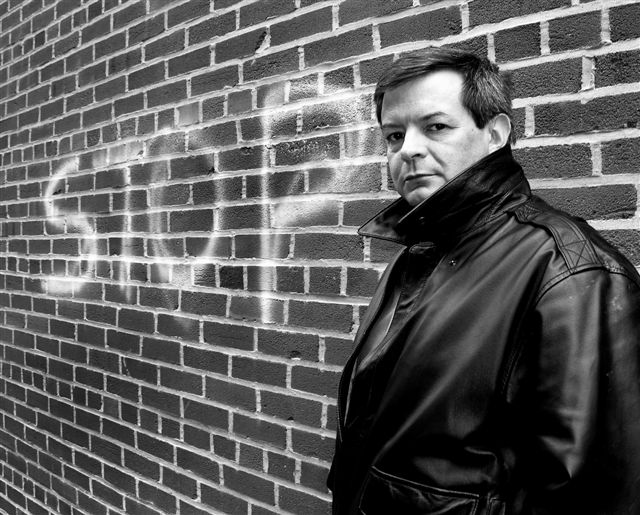
Brandt Dodson comes from a long line of police officers, spanning several generations.He was employed with the Indianapolis office of the FBI and served eight years as a United States Naval Reserve officer. He is a podiatrist and an elder in his church, a past President of the Indiana Podiatric Medical Association, and a recipient of the association’s highest honor, “The Theodore H. Clarke Lifetime Achievement Award”.


Tell us about your upcoming novels.

I recently signed a three book contract with Harvest House Publishers for a series of mystery novels which feature hardboiled PI Colton Parker. The first of these is:
Original Sin and is due out in March of ‘06.

The second is: Seventy Times Seven and is due out in August. The third will tentatively be titled: The Root of Evil and is due out in January of ‘07. The novels are set in Indianapolis and I draw heavily on my family’s background in law enforcement, spanning several decades.

Why a mystery?

I wrote what I like to read. I think that is sound advice for anyone.
Christianity and mystery novels have gone hand-in-hand for a long time. Mystery novelist Dorothy Sayers was a renowned theologian, and of course we have the mystery novels of G.K. Chesterton, Andrew Greeley and Ralph McInerny among others.

The mystery is a morality play. Good versus evil. And who better to establish the moral parameters of life, than the God who created it?

Tell us about your journey to publication. How long had you been writing before you got the call you had a contract, how you heard and what went through your head.

At the time Harvest House offered a contract, I had been writing off and on for close to twelve years. Like any writer, I spent most of that time collecting rejection slips. But as time passed, the rejections became less caustic and would often include an encouraging hand written note. Those were the dark days, so any encouragement went a long way in keeping the fires burning. But encouraging or not, they were still rejections.


After I wrote Original Sin I met my editor, Nick Harrison, at the Write To Publish conference in Wheaton, Illinois. Nick was a last minute replacement for another editor who was unable to attend.
One evening, during a critique session that Nick was facilitating, I had a chance to read part of Original Sin and Nick liked it. He asked if I could send the manuscript to him. A few weeks later, he told me he liked the book and wanted to take it before the Publisher’s Committee, who has the final say on what is published.


It was a few months before we heard anything, making it one of the longest periods in my life. When I did hear, Nick told me that the committee was tabling it with the intention of “taking another look” in a few months. He suggested that I write another in the series, to convince them that I was committed to the books.

I wrote the second novel (“Seventy Times Seven”) and sent that to him. Nick liked the second one as well, so both books went back to the committee.

The evening that I heard about the contract offer, I was walking across the campus of Wheaton College while attending the Write To Publish conference again, when my wife called. She told me that I had received an email from Nick and I asked her to read it. When she told me that Nick’s message said that I was being offered a three book contract, I could tell from her voice that she was as excited as I was.

It was surreal. Here I was, standing within a few feet of where I had stood the last time I had talked to Nick, almost a year to the day, receiving the best news anyone can receive who wants to write. And except for my wife, I had no one to tell! It was late evening and everyone had already gone home.

Going back to my room was out of the question, so I celebrated in the only way I could think of at the time. I went to McDonald’s, got a cheeseburger Happy Meal, and ate in my car.


Do you still experience self-doubts about your work?

Some. I’d be concerned if I didn’t.

Writing is a growing process. Each book, chapter, story, etc., should be more ambitious than the one before it. We should always be working toward pushing the envelope, and acquiring new skills while strengthening the old ones. That process is inevitably going to lead to some level of self-doubt. Do I have the skill for this? Can I pull this off?
The key, is to not let the doubt’s paralyze you.

What’s the best advice you’ve heard on writing/publication?

“Write, write, write.” There really is no other way to grow.

What’s the worst piece of writing advice you’ve heard?

“You need an agent.” You don’t.

What’s something you wish you’d known earlier that might have save you some time/frustration in the publishing business?

I wish someone had told me of the value of a good writer’s conference. The benefits are incalculable. There’s no better way to learn new skills, meet editors and build relationships with other writers.

Do you have a scripture or quote that has been speaking to you lately?

Psalm 37:5 “Commit thy way unto the Lord; trust also in him; and he shall bring it to pass.”

This verse is good advice. Commit everything to the Lord - with faith - and He will do the rest.

Is there a particularly difficult set back that you’ve gone through in your writing career you are willing to share?

I haven’t had any major set backs. I suspect that if I am blessed to be able to do this for the rest of my life, I will probably run into snags somewhere along the line, but none so far.

What are a few of your favorite books?

I’d have to begin with Psalms. I can’t think of any book that has been written to date, that speaks so clearly to so many, on the basic fundamentals of life. David experienced it all, every height and every depth. His praise is our praise. His pain is our pain. And he can write to the human condition - and our need for God - like no one else has.

In terms of fiction, “The Maltese Falcon” by Dashiel Hammet, most anything by Raymond Chandler, Robert Crais, Robert Parker, Ross MacDonald, Mickey Spillane, Tom Clancy, Dean Koontz and Jerry Jenkins (pre and post “Left Behind”).

In terms of non-fiction I‘m an eclectic reader. I tend to read biographies, history and science. There’s a new book by Ron Powers on the life of Mark Twain, that has been calling my name.

If your authorial self was a character from The Wizard of Oz, which one would you be and why?

Dorothy. She lets nothing deter her in reaching for her goal.

What piece of writing have you done that you’re particularly proud of and why?

“Original Sin”. The book went through several revisions to become what it is, and I tried very hard to capture the tone of the PI genre while updating it for the current century. The human heart may be the same now as it has always been, but I don’t think “dame” is going to sit well with a lot of readers.

Do you have a pet peeve having to do with this biz?

I will sometimes hear more established writers complaining about some aspect of writing or publishing, and that tends to grate on me a bit. Writing is a privilege. You don’t have to do it. If you don’t like it, do something else.

Can you give us a view into a typical day of your writing life?

I’m still working full-time at another occupation, so my writing day usually begins at around eight in the evening and continues until ten or eleven. I don’t write with an outline, so I look forward to seeing where the story will take me.

Weekends are prime time. I usually try to write six or eight hours on those days whenever possible.

If you could choose to have one strength of another writer, what would it be and from whom?

David wrote the psalms in a way that relates to everyone - thousands of years later. There is virtually no one, who hasn’t felt his anguish or fear at one time or another. Even among those who do not follow Christ, many find comfort in the psalms.

If I could write a book like that, one in which every reader could find a part of themselves, my writing life would be fulfilled.

Do you have a dream for the future of your writing, something you would love to accomplish?

I don’t think anyone who writes could say “no” to your question.
I would like to continue the Colton Parker series that I’ve started for as long as readers express an interest, but I would also like to write some stand alone books which, by their nature, would be more complex in structure. Novels that would ring true to every reader.

President Kennedy once said; “We all inhabit this small planet, we all breathe the same air, we all cherish our children’s future, and we are all mortal.” He might have added, “and we are all in need of Christ.”
I want to write a novel that takes those human needs that we all share, and ties their fulfillment into Jesus Christ.

Was there ever a time in your writing career you thought of quitting?

Oh sure. Lots of times. And I did, lots of times. Though never for very long.

After so many rejections, you tend to wonder, “am I doing the right thing, here?”

I finally had to ask God to either deliver me from this desire to write, or open the door. I said this, while dropping a manuscript in the mail.
If it was rejected, I was done with writing. It’d be time to take up origami.
But if it was published, I promised God I would write for Him as long as he gave me the capacity to do so.

Six days later, the manuscript was accepted for publication.

What is your favorite and least favorite part of being an author?

So far, I haven’t found anything that I truly dislike about writing. Rejection comes with the territory, so anyone who writes needs to be ready for that.
I still struggle with grammar, but it is a tool of the trade and has to be mastered.

I truly love the writing process itself. I enjoy having the creative outlet and being able to work with my editor, during the editing process, on our common goal of making the book as good as it can be.

How much marketing do you do? Any advice in this area?

I’m doing quite a bit. My view has always been that it is the publisher who will get the book in the stores, and I will get it out.

I’m in my initial efforts of promoting “Original Sin” and I’m having a lot of fun. The folks at Harvest House have been great to work with and I’m learning a lot.

I’ve already arranged some signings and I’m trying to approach them in as “scientific” a manner as I can. Since I write mysteries, my initial signings will be at CBA stores and the Independent Mystery Bookseller’s Association stores. The two groups together, account for most of my market and are very helpful - sometimes even hand-selling books they believe in.

I make it a point to support the CBA stores anyway that I can. I make personal contact with every CBA owner/manager and let them know that I appreciate the fact that they are stocking my books.

Radio and print media interviews are helpful also. I try to be as helpful to them as possible by being on time, answering their questions and then letting them know how much I truly appreciate the opportunity that they have given me.

I talk to virtually everyone I know when promoting the book, and I try to build a large core of “first readers”. I have an annual “cook-out” for all of them, to let them know how valuable they are and how much I appreciate them. Of course, a signed copy of the book with an acknowledgment of their help, isn’t a bad idea either.

I also agree to talks and readings at the libraries in my area whenever I can arrange them.

Of course, a website is essential today and should mirror the image or message you want to project.

You should also have no fear of asking for help. Talking to marketing majors at local universities, sales reps you may know, or your publisher’s marketing department are all beneficial.

I think the best advice I’ve heard is to be creative. There is no one technique that will move your books off the shelves. It requires a sustained effort.

Parting thoughts?

I love writing. For me, it is fulfillment.
If anyone reading this interview, finds themselves wanting to write and feeling the call of God to do so, I would say “be persistent”.

Writing is a craft. Learn the craft. Then commit your writing to God.


Monday, January 30, 2006

This week...

The winner of Joan Hochstetler's two book giveaway (Daughter of Liberty and Native Son) is...Heather Smith! Ciongratulations Heather.

This week on Novel Journey~ interviews with Brandt Dolson, F.P. Lione, and Kristin Billerbeck!

Author Interview ~ Rachel Hauck

Rachel Hauck is a multi-published author living in sunny, though sometimes hurricane plagued, central Florida with her husband, Tony, a youth pastor. They have three ornery pets. She is a graduate of Ohio State University and a huge Buckeyes football fan. Rachel also served the writing community as the Past President of American Christian Fiction Writers. Visit her blog and web site at www.rachelhauck.com.


Plug time. What book or project is coming out or has come out that you’d like to tell us about?

My first chick lit comes out in August 2006 from Steeple Hill Café, Georgia On Her Mind. It’s a fun story about Macy Moore, a quick witted career girl who’s life takes an unexpected turn, or two.

Tell us about your journey to publication. How long had you been writing before you got the call you had a contract, how you heard and what went through your head.

I started writing fiction in the mid ‘90s, but didn’t serious pursue publication until 2000. My first published book was a Heartsong Presents. I got “the call” in late 2002 from my co-author, Lynn Coleman while sitting in Chili’s having lunch with my friend, Allison Wilson. I was excited, naturally, but also hit with the realization I had to write it.

Do you still experience self-doubts regarding your work?

Sure. I don’t know any authors who don’t, but I’m learning not to focus on my doubts and insecurities, and focus on God’s grace and goodness. My weaknesses don’t intimidate Him. He chooses to use me, anyway.

What’s the best advice you’ve heard on writing/publication?

Read, read, read. Also, to keep writing the first draft without editing. My first novel took two years because I kept rewriting and editing. Now, I can complete an 85k word novel in 4 months because I write it first, then fix it.

What’s the worst piece of writing advice you’ve heard?

I don’t think I’ve heard bad writing advice.

What’s something you wish you’d known earlier that might have saved you some time/frustration in the publishing business?

I understood I needed others to help me, but I wish I’d networked earlier, and gone to conferences. Some mistakes I made early on could’ve been eliminated by attending workshops for beginners.

Do you have a scripture or quote that has been speaking to you lately?

“The things impossible with me are possible with God.” Luke 18:27

Is there a particularly difficult set back that you’ve gone through in your writing career you are willing to share?

No set backs at the moment.

What are a few of your favorite books? (Not written by you.)

I love the Little House books by Laura Ingalls Wilder, and Jan Karon’s Mitford series.

If your authorial self was a character from The Wizard of Oz, which one would you be and why?

I think I’d be the Tin Man. Heart is really important to me, and having a tender one toward God and others is important to me.

What piece of writing have you done that you’re particularly proud of and why?

Writing is hard work, and I’m proud of all the Lord has graced me to produce, but I’m really proud of Georgia On Her Mind. It’s a fun, fast-paced story and I think women will identify with Macy’s struggles.

I’ve also written a few small pieces on Peter and Mary of Bethany, and how they might have felt after Jesus was crucified. I like these short, short stories because it brings the characters we read about daily to life and stir my own heart toward the Lord. How would I have felt seeing Jesus stumbling down the street with the Cross on his bleeding back.

Do you have a pet peeve having to do with this biz?

Not really. There are good things and difficult things about this business, about any business. I learn to live within the boundaries.

Can you give us a view into a typical day of your writing life?

Typical day is to get up around 6:30 and go to morning prayer at my church. By 9:30, I’m home and taking care of emails or home-front details. I try to start writing by 11:00 a.m. I end the writing day at 5:00 so I can go to the gym, or to church related functions, depending on the night. If there is time, I write in the evening for an hour or so. Occasionally, I write or edit on Saturdays, but I keep the weekends free so I can refresh my creative pallet and be with my husband.

If you could choose to have one strength of another writer, what would it be and from whom?

I would love to have Brandilyn Collin’s ability to ponder a scene and figure out a unique, creative way of showing the action.

Do you have a dream for the future of your writing, something you would love to accomplish?

My dream is to keep telling the best stories I can and to be honest, I’d really like to be on Oprah.

Was there ever a time in your writing career you thought of quitting?

Yes. I’d sent a proposal to my agent and she, being the astute, wonderful woman she is, didn’t like it. She emailed a long list of reasons and told me to get back to work. While I’m not afraid of hard work, I’d spent a long time developing that proposal and thought maybe I just didn’t have what it took to really make it. But, after reviewing all my options, I knew I didn’t want to do anything but write. So, I rolled up my sleeves, came up with a new proposal and well… my agent sold that one a few months later.

What is your favorite and least favorite part of being a writer?

My favorite part is telling stories, creating characters and fictional worlds. My least favorite part is research and the hard days at the beginning of a new story when I’m trying to meet the characters.

How much marketing do you do? Any advice in this area?

I’m new to marketing, so I don’t have much experience yet, but the best thing any author can do is have a web site with a blog or blog link. Keeps readers stopping by often.


Parting words?

Thank you for this opportunity!!


Saturday, January 28, 2006

2 Book Giveaway Today!

Read either or both reviews of J.M. Hochstetler's, Daughter of Liberty and/or Native Son and leave a comment, and you will be entered to win BOTH novels! (If you leave a comment under each review, your name will be entered twice.)

Winner to be announced early next week.

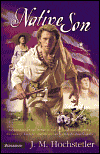
Hochstetler's, Native Son~ reviewed

J. M. Hochstetler
Zondervan
ISBN 0-310-25257-1
293 Pages


Reviewed by Erin Valentine

Elizabeth Howard and Jonathan Carleton defied overwhelming odds against their love, struggling to hold on to each other against the backdrop of a revolution. Before they can rest and enjoy their time together, however, General Washington has requests of them. Jonathan is sent into Indian Territory to secure the loyalty of the Natives for the American forces, a task he is uniquely suited for based on childhood ties to the Shawnee. Elizabeth is asked to stay behind and continue her work as a spy, gaining the intelligence from British loyalists that the General needs. Both of the lovers confront great dangers, yet hold on to the faith and hope that they will be together once more.

As with Daughter of Liberty, I am once again struck by the ability of Hochstetler to paint honest, even-handed portraits of people at war. She uses the keen eye of a historian to develop truthful relationships and concerns. This novel goes beyond the fighting in the colonies and travels into the lands of the Iroquois, Seneca, and Shawnee Indians, illustrating the author's obvious comprehension of a community both noble and brutal.

Soon after the novel begins, Jonathan and Elizabeth find themselves wrenched apart by the continuing needs of their countrymen. Deft moves between these two characters and their respective adventures build a suspenseful and portentous mood.

Native Son spends more time on Jonathan and his plight than in the previous novel, exploring his inner turmoil after being captured by Mohawk Indians, who plan to collect the substantial reward on his head from the British. As Jonathan lives and interacts with the different Indian tribes, his previous ties to the natives are strengthened. In addition to being torn between his love for Elizabeth and his loyalty to the American cause, his capture creates another quandary for Jonathan as he tries to balance his allegiances for the newly forming nation and the embattled Indians. His faith in God's plan for his life is what keeps him alive, trusting that He will guide him in the best way possible.

Elizabeth once again faces great danger, and although she doesn't participate in battle as she did in Daughter of Liberty, there are some very tense moments as she travels between her home in Boston and General Washington's headquarters. Her espionage duties are made more difficult by the suspicions of the British officers that Elizabeth might have participated in the daring escape of a captured American officer. She has to work doubly hard in this novel to win their trust.

A word of warning to those of you who read the last few pages of a novel before you finish...don't do it! And if you must (I should know, because I did), don't give up on this book. Despite my concern that Native Son was not going to do end as I would prefer, I still read it and found it to be an engaging, gripping novel.

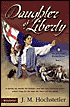
Hochstetler's, Daughter of Liberty~reviewed

Joan Hochstetler
Zondervan
ISBN 0-310-25256-3
368 Pages


Reviewed by Erin Valentine


Elizabeth Howard is a beautiful, strong-willed, and devoted patriot. Thanks to family ties with the British, she is uniquely able to spy for the Sons of Liberty. As a courier known only as Oriole, Elizabeth places her life in danger time and time again as she seeks information on munitions and troop movements. It is her heart, however, that is endangered when she meets Jonathan Carleton, a captain in the Seventeenth Light Dragoons and a respected member of the British Regulars. Will Carleton discover that the spy he seeks is, in fact, the woman he loves? Will Elizabeth be able to guard her heart as well as her secrets?

J.M. Hochstetler reminds me of my best history teachers; she delivers detailed, impressive information about the Revolutionary War in such an entertaining package that only when I finished the novel did I realize how much information I had absorbed.

Like Mel Gibson's film The Patriot, Hochstetler's presentation of the tensions and events leading to the war are gritty and realistic - no sanitized, textbook version here, folks. Characters on all sides of the issues are presented as complex human beings, torn amongst ties to their families, their land, and their king.

The novel's protagonist, Elizabeth, uses her charm and intelligence to spy on British officers, and despite the obvious acknowledgement that she is proud of her efforts and committed to the cause for freedom, she is deeply aware that the people on whom she spies are friends, many of them former neighbors who have known Elizabeth her entire life.

When Jonathan Carleton is billeted in her family's Boston town home, Elizabeth finds it increasingly difficult to deny her attraction for the man. They are equally matched in wit, character, and good looks, and she must finally acknowledge that he is the one man she could love. Of course, there is a little matter of his being the one who is assigned to discover and capture Oriole, the role Elizabeth created and assumes as she spies.

God's plan for our lives and how we follow it is an important theme in this book. Elizabeth is impetuous, taking chances that could leave herself and others in peril, but she loves the thrill of the chase. When one particular decision nearly ends with her capture and places Jonathan's life in jeopardy, she must finally accept the need to seek God's will in her life.

Daughter of Liberty is an exciting, well-crafted read. I thoroughly enjoyed the dance between Jonathan and Elizabeth as they fall in love, and I was fascinated by the historical information. The action moves quickly most of the time, slowing down a little during battle scenes, but never enough to lose my attention. I can recommend this particular effort to anyone, especially fans of Revolutionary history, who will find it remarkable.

Friday, January 27, 2006

Interview with Publicist Rebeca Seitz


www.glassroadpr.com


First off, thanks for taking the time out of your busy schedule to talk with us.

No problem! I can talk about publicity all day long. Thanks for the opportunity!

You’re a writer as well as publicist, is that right? What do you write?

I began my career in the CBA world as a writer. I wrote for newspapers, magazines, and anthologies while working on a southern novel in my spare time.

The phenomenal author Eva Marie Everson took me under her wing and showed me the ropes in the industry. With her guidance, I got my first real bite from a publisher for my novel. Trouble was – Eva seemed way more excited about the possibility of my novel being published than I was.

That was my big clue that perhaps I was supposed to do something else in the publishing industry. I put writing to the side and started learning about the other job paths I could take in publishing.

How did you get started in publicity?


It seems the people around me were much smarter about my future than I. My high school journalism teacher, Mrs. Pam Harris, told me I had the gift of writing. She encouraged me to major in communications when I went off to college, so I declared that major alongside my true love at the time – political science. (I wanted to be a U.S. Senator.)

When I began attending college, Drs. Jerald Ogg and Robert Nanney opened my eyes to the possibilities of a career in communications and encouraged me to concentrate my studies in the area of publicity. Years later, the guidance provided by these people would prove helpful when I went to work at WestBow Press, the fiction division of Thomas Nelson Publishers. I applied for the publicist position at WestBow not long after having the epiphany that writing a novel wasn’t my particular calling at the time. My background in publicity, coupled with my absolute love of fiction, provided the perfect preparation to be WestBow’s publicist.

Would you like to tell us a little about your company, Glass Road?


Again, God placed people in my life to steer me down the path He had for me. I was very happily serving as the publicist of WestBow Press, loving the team I was working with and the authors I represented. Four months into my marriage, my husband and I discovered we were expecting. I knew I couldn’t keep up the pace I had set for myself in the office and still be a mom.

Some women are remarkably adept at handling the workplace and motherhood. I’m not one of them. I knew I would need to change my schedule so that I could be at home with the baby and continue to be a publicist. After months of searching and praying, Jennifer Willingham – then VP of Marketing and Publicity at Thomas Nelson and my boss – asked me if I had considered forming my own firm.

I scoffed at the idea. Leaving my beloved authors and team at WestBow hadn’t occurred to me.

After a few more weeks with no solution for being able to spend time at home with my new son, Jennifer again brought up the idea. I took it to my father-in-law, an amazing man who proved his acumen in the business world as a Vice President for Northern Trust Bank and someone who has always been very honest with me regarding his opinions.

I asked if he thought I would be suited to running my own business and he didn’t hesitate. He cheered me on from the sidelines and still calls me every couple of weeks to find out what exciting new things we have going on at the firm. He loves it when we get clients on Good Morning America or we have Oprah taking a look at our books.

I opened the doors of Glass Road on May 1, 2005. By that Fall, we had clients from nearly all the major publishing houses. It just exploded. I had no idea there was such a demand for a firm that specializes solely in publicity for novelists. Once again, God knew my future and put people in place to point me in the right direction.

What’s the difference between marketing and publicity?


There is an easy way to tell if an initiative is marketing or publicity-driven. If you have to pay for the placement, it’s marketing. If you don’t, it’s publicity. For example, purchasing advertisements in a magazine is the responsibility of marketing directors. Getting reporters to write features about authors and trends in the marketplace is the responsibility of publicists. When the two areas work together, huge effects can occur.

Do you find publishing companies are doing most of the publicity work or are authors taking on the bulk of their own campaigns these days?


It’s different at different publishing houses. I think authors are becoming more savvy regarding the opportunities open to them. They’re learning the importance of publicity and marketing and are asking their publishers how they can partner with them to achieve greater results. We’ve contracted directly with authors, with publishing houses, and a combination thereof.

What can an author do to make your job easier?


Route all ideas through us. I love it when authors have ideas for publicity or relationships with media that they’d like to use to garner publicity. However, it reflects poorly on everyone involved when the primary publicist isn’t aware of contacts the author has made and goes to the same location.

Also, we truly appreciate it when authors are clear about their expectations on the front end. If you’re expecting to get your book considered by Oprah, then say that in the beginning so that we can talk about the realistic expectations of that happening.

What would be a dream campaign for you?


A blank check and twelve months lead time with an unknown author who wants to be a bestseller and has a well-written book.

How difficult is it to get good publicity?


More difficult than one would think, I’d bet. As with any profession, there are good and bad publicists out there. Just as authors research their agents and publishing houses, they should research publicity firms. Ask where the firm has achieved hits, what authors it has represented, and what it would do if given your campaign. A good firm will be able to point to its relationships and results to bolster its claim of credibility. Also, be certain to ask what books the firm has represented that are like yours. If you write novels and the firm only represents nonfiction or just dabbles in fiction, then recognize that you might need to look elsewhere.

Is it true that there is no such thing as bad publicity?


That depends on what result you would like your publicity to produce. If your goal is to achieve name-recognition, then there is no such thing as bad publicity. If your goal is to create a specific persona and achieve book sales, then bad publicity is anything that counteracts that persona or negatively affects book sales.

What seems to be the most effective media for novelists to get word about their books out to the public?


Print and internet. Broadcast outlets – radio and television – still remain rather closed to novelists, though we are making inroads.

I've heard of authors spending their advance on publicity. Is this something more first-time authors should consider?


If the author’s choice is to buy food or publicity, by all means head to the grocery store. If, however, the author is in a financial position to invest in his/her writing career, then I would encourage the author to invest that money in a publicity firm.

Our firm can even work with authors on a retainer basis. For a monthly fee, we cover all of the author’s publicity needs so long as the contract is in place. This is a good scenario for authors who plan to release multiple books in a year since the retainer fee is less than the cost of two campaigns and having the same firm handle all of the authors’ interests ensures continuity from book to book. I would also suggest that the author approach his/her publishing house to discuss a possible sharing of the publicity firm’s fee.

How much marketing/publicity should an author with an upcoming novel be prepared to do for herself?


Be prepared to do it all – and be pleasantly surprised when a bit of the burden is lifted by your publishing house.

How can an author gauge if what they’re doing publicity wise is working?


If the author is achieving regional hits, then the author can ask his or her publisher if sales are increasing in that particular area. Higher sales numbers would indicate that the publicity hits are driving customers into stores to purchase the book.

What is a typical day like for you?


Warning – this could scare some people. I get up sometime between 6 and 8 depending on how often my child was awake through the night. After a quick shower, I’m at my desk with South Beach Bar and caffeine in hand, checking email, calling media, and developing press materials.

If it’s Friday, I’m also reading all the publications that came in the mail through the week and preparing activity reports for clients. I take a break about three hours into it to walk around, hug my kiddo, and check in with my husband. Then it’s back to the office to communicate with publishers and authors, return phone calls, and research media outlets. I usually finish up sometime around 7 or 8pm.

I spend an hour or so with the hubby, help bathe the kiddo and put him to bed, then read novels for a couple of hours. I read every book our firm represents and many that are getting publicity hits, so there’s always a book on my bedside table. This routine is typical for every day but Sunday – we have a strict No Work Policy on Sunday.

How expensive is it for an author to hire a publicist?


Depends on the firm you hire. Expect to pay a few thousand, at least, for a comprehensive campaign. Some firms also require the client to pay expenses to a point. We don’t – the one fee covers it all – but it’s important to know that some do and that doesn’t mean they’re not legitimate firms. It’s a standard practice in the business. Also keep in mind you can ask your publisher to partner with you in hiring a firm.

What are some basic things a novelist can do to help publicize their own work?


If you do not have a publicist working your book then do the following – if you do have a publicist, he/she will probably handle these things for you. Make a list of all the media within a 50 mile radius of your home. Also list any alumni publications from schools you have attended, organization newsletters of which you’ve been a member, and church contact information for your current church and previous churches.

Ask your publisher for advance copies or actual copies of your book to send to this list. Work with your publisher to create a press release for your book and, perhaps, a canned interview with you. Include both of these, along with an introductory letter, to each of the entities on your list. Also consider doing a debut event in your hometown to highlight your book’s release.

How soon after an author hands in their manuscript to their publisher should they be planning their publicity campaign?


The day you hand it in, start thinking about publicity. Ideal publicity campaigns begin 6-8 months prior to the book’s publication.

Do you see any hot trends that novelists should be tapping to help get their work noticed?


Novelists writing from a Christian worldview are the trend right now. The Christian fiction industry topped $2 billion in sales last year – a statistic that media reps do not take lightly. I highly recommend that Christian novelists recognize their growing status in the market and capitalize on it by making their local media aware.

What’s something you wish more authors knew about your business?


I wish novelists understood that getting publicity for their books isn’t the same as getting publicity for nonfiction books. The two require completely different mindsets. Fiction publicity revolves around entertainment – which creates a much different media database than nonfiction publicity, which centers around breaking news.

Parting words?


Thanks for the opportunity to chat about publicity. When I discovered this passion of mine, an entirely new world opened up to me. I’m like a kid in a candy store most days. Finding new ways to get the word out about great novels and making new people aware of the great fiction being written by God-driven hands gives me a high like no other. Anytime I get to talk about it is a thrill!


Thursday, January 26, 2006

Author Interview ~ Bill Myers Part II

Bill Myers (www.billmyers.com) is a bestselling author and an award-winning screenwriter and director. His numerous books include Soul Tracker, The Wager, The Face of God, Eli, Blood of Heaven, Threshold, Fire of Heaven, The Bloodstone Chronicles, and When the Last Leaf Falls. His books and videos have sold over 7.5 million copies.


Gina Holmes: How do you find balance with being a family man, teacher, director, writing children’s books and adult novels?

Bill Myers: I use it to my advantage. I think if I only wrote straight adult stuff, I’d get burned out. It also stops me from taking myself too seriously. My recreation is teaching scripture in sort of an interactive thing with teens and college kids. That keeps me on my toes thinking differently.

Just when I’m about dead tired writing a suspense story, I get to pick up and write kids comedy. That’s an entirely different part of my brain and it’s refreshing. I’m still tired but it becomes more of a goofy-silly tired.

I take breaks, but not really, because those breaks are simply changing what I’m working on.

Gina: How many books do you write a year?

Bill: One adult and probably three kid’s books. One of my more successful series is The Incredible Worlds of Wally Mcdoogle. He’s sort of a seventh grade Woody Allen. I time it to write those types of books during the holidays. Because it’s play to write kids comedy. It’s hard work too but fun.

Gina: I’ve read as you were growing up you didn’t like to read. Do you like to read now?

Bill: Mmm. Next question please. I’m not a big fan of reading. I will read because I’m trying to grow in the craft. I don’t understand why I’d want to read about something when I can go out and do it. I’m sure there’s also some ADHD floating around in there.

Gina: What are you working on right now?

Bill: The book that I’m finishing up now is probably not a good idea to talk about. It’s high-concept, which is easy to get “borrowed”. I remember I had this really great idea called Blood of Heaven, and I went all over town pitching it. Then six months later, I discovered Michael Crichton was working on this thing called, Jurassic Park. I hold the high-concept stuff closer to my vest now.

I’m actually finishing that up today. Yey! I’m still doing the Wally Mcdoogle books and doing a comedy picture series. I’m just starting that.

Gina: There’s a lot of talk lately about branding. Publishers are wanting writers to brand themselves--stick to writing the same type of book. But you write across the board, children’s stories to suspense.

Bill: I’ve had adult fans write me and say, my gracious, are you the same Bill Myers my kids are reading? I think they think there are two Bill Myers. If I had the time, I’d write domestic comedy. That would have to happen under a penname.

Gina: You do feel the branding is a legitimate practice?

Bill: Yeah. I wish it wasn’t, but I think it’s necessary. There are ways to get around it. There will be somebody in a couple of years who will write domestic comedies. It won’t be with my name, but everyone who knows me will know I’m doing it.

Gina: Do you have a dream for your writing, other than writing the domestic comedy?

Bill: I don’t have dreams for my writing future. My passion is to draw people closer to Christ. I don’t care how that’s done. It could be writing, directing or operating the drill press, (thought I’d prefer the other two).

I have a business plan, but my great hopes are to bring people to Jesus. It doesn’t matter to me. It doesn’t mean I’m lazy or coasting. All my writer friends are so passionate about writing but it doesn’t interest me much. What interests me is the effect the writing has upon the people. I’m grateful that I’m doing it, but it’s not my passion.

Gina: Any advice for aspiring novelists.

Bill: The usual--read as much as you can. Write everyday. You only get better. Thank God you only get better. Really seek the Lord, make sure that’s what you’re wired to do. When you’re doing what you’re wired to do, that’s where the greatest satisfaction comes in.

You know I thought I was wired to be a dentist, but apparently I missed that one. I really encourage everyone to keep their ear cocked toward Heaven. It could be that the Lord has something for them that they’re not even aware of.


The Presence
Bill Myers
Zondervan

Supernatural Suspense
ISBN: 0310242363


From the Back Cover:


The first subjects exposed to The Presence went insane. Now, a far more terrifying experiment is about to begin. . . A diverse group of unusual characters are airlifted to a remote mountain lodge. Here they hope to participate in a séance connecting them to the spirit world.

David Kauffman and his teenage son have joined them to debunk a world-class psychic and expose her as a hoax. But not even David is prepared for what greets them. Still shaken by his daughter’s death and his visits to heaven and hell, he’s swept into a fantastic journey where the supernatural souls of people are exposed, and unseen thoughts become unimaginable reality.

As the power of The Presence increases, the group must overcome their innermost passions or be destroyed by them. All this as they struggle to break free of their captor—the head of the experiment and murderer of David’s daughter. Bestselling novelist Bill Myers weaves a supernatural thriller that will keep you turning pages late into the night—and thinking about it days after you’ve finished.

Wednesday, January 25, 2006

Author Interview ~ Bill Myers

Bill Myers (www.billmyers.com) is a bestselling author and an award-winning screenwriter and director. His numerous books include Soul Tracker, The Wager, The Face of God, Eli, Blood of Heaven, Threshold, Fire of Heaven, The Bloodstone Chronicles, and When the Last Leaf Falls. His books and videos have sold over 7.5 million copies.


Interview via telephone 2006:

Gina Holmes: Tell me about your road to publication.

Bill Myers: I’m afraid my story isn’t very inspirational. I got my first movie script assignment by a TV producer who came up to me and asked if I’d write for his series. That’s not real encouraging for those who are trying to break in.

What’s even more discouraging, some people got some misinformation. They’d heard there was a famous Christian TV writer in Hollywood and if they could just convince me to take time from my busy schedule and write a book for them, they’d really be excited about that.

Gina: Did you think, hey, how different can script writing be from novel writing? I can do that.

Bill: No, to this day I’m still not sure I know how to write. It was just another act of obedience. That and needing to eat. Back then we were pretty much living off macaroni and cheese. In both cases it was a series of accidents.

The TV shows I was writing were terrible. The worst writing I’d ever seen on TV. Apparently the book publishers didn’t bother to check that part out.

I started off writing Bible studies. Which for me was just a natural extension of loving to teach. I wrote a couple of those and discovered nobody was particularly interested in reading those and somebody came to me and asked if they could turn one of my scripts into a book. That involved going to Russia to research when the iron curtain was up. I thought that’ll be interesting. Why don’t I give that a shot?


And it just goes on and on like that. A series of accidents. McGee and Me was probably the big footprint for me. It was the same thing there. They said, you wrote the scripts, do you know anybody who could write the books.

I said, "Hey, I’m hungry."They let me do it.

Gina: How would you classify your adult novels?

Bill: I think the publishers are marketing me as supernatural suspense. I could have just as well write comedy, but they’ve got to have a place to put you. So there I am.

Gina: A lot of writers would love to have your ability to infuse serious fiction with humor like you do. Is there a secret to doing that?

Bill: I think so. It comes with loving the fallibility of humans. All of my humor comes out of character. When I’m designing a character I make sure I design them to have endearing quirks that we all have and pretend we don’t have. Then I have something to play with. It comes by designing the characters.

Gina: Why write supernatural suspense?

Bill: I don’t know. The publisher wants me write it.

Gina: So, if the publisher asked you to write a romance, you would?

Bill: Actually, my favorite book of mine is When the Last Leaf Falls, which is out of print. That’s sort of a love story about a father and his rebellious teenage daughter.

From a ministry point of view, what drives me is if I could reach more people by operating a drill press, then that’s what I’d do. I’d quit writing tomorrow.

It really is a passion to draw people to Christ. As far as writing supernatural, you can deal with God issues pretty quickly in that genre.

Why me? When I was a film maker, I did a lot of documentary work around the world. And a lot of mission films. I saw a ton of supernatural out there.

Tyndale House asked me to write a series called Forbidden Doors. She asked me if I would write a Christian horror series and I said, no, I’m too busy with my Christian pornography series. She says, okay Mr. Smart Alec, you go and look at what’s out there for kids to read and you come back and see if you can be so glib.

About eighty percent of the bookshelves were devoted to supernatural. I said, okay, I’ll write those but only if you let me turn them into a teaching series. So with those 12 books, one dealt with reincarnation, one with UFOs--sort of demystified all this stuff.

As a result of that, I did everything from researching at Duke paranormal psychology lab, to interviewing the Son of Sam serial killer, just to get the information right.

As a result of that, and a couple of supernatural situations of our own, we kind of became knowledgeable in the supernatural realm.

The Pat Robertson’s, Jerry Falwells and James Kennedy’s would have me on their shows to talk about the supernatural. It’s kind of a boring topic because our trump card is always the same, our authority in Jesus Christ. For better or worse,
I’ve become a reluctant authority on that.

Gina: You said you’ve experienced supernatural occurrences yourself?

Bill: We were involved in a deliverance with a top L.A. psychic when I was in my early twenties. I was volunteering for a lay pastor in a church and we got this call from this psychic who got my phone number in a dream. I knew nothing except what the Bible talked about. I went over there and tried to help him and soon found out we were involved in something that was right out of The Exorcist. The good news was that I’d never seen The Exorcist.

Gina: You performed an exorcist?

Bill: Myself and another man...Back to the research I was doing. Going to Duke paranormal psychology lab and have the experiments go flat-line when we’d come into the room would be exciting. At one point they’d tease me about having negative psychic energy.

Gina: Hmmm.

Bill: Exactly. That was due to a lot of prayer.

Gina: Do you find in the genre you write, that people are afraid to read it?

Bill: Not every genre is for everyone. As far as publishers go, I’ve only come up against one publisher who was reluctant to deal with this type of subject.

Gina: Why do you think that was?

Bill: Well, in the wrong hands, this subject manner can be twisted to glorify darkness. But, that’s true in every genre. You can write a romance that turns Christian values on its head and glorifies that which you stand against.

I try to go to scriptures and do the same thing with violence, language and everything else.

Scripture uses swearing, but it puts it like this, Peter said an oath. Hey, that works for me. Half a book took place on death row in one of my stories. The boys there did not say, “Well, golly!” But you don’t miss the swearing because you find ways of getting around it. Or the violence. You can talk about it, if you glorify it, there’s that fine line you risk crossing. You need to abhor it the way you write it.

Gina: What are you working on now?

Bill: The new series is Soul Tracker. It takes the brain twelve minutes to die. They record the brain waves of about 1300 volunteers who are dying and are able to recreate the first twelve minute of death in a virtual reality computer. So, you can experience the first twelve minutes of death. You can go to Heaven. You can go to Hell or anywhere in between.

And this guy’s daughter committed suicide--he’s desperate to know where she is. So he enters the chamber...

Gina: How much plotting do you do when you begin a book?

Bill: I think my training comes from TV and film. I pretty much know everything before I start. I spend about six months researching. A lot of times my stuff has science in it.

I just finished a book where they are subjected to the presence of God. Sort of a haunted house, but one that is haunted by God and the guys running the experiment want to know what would happen if these people are exposed to God. They’re able to record the presence and pump it in to the people.

I had to a lot of research on that on brains. Physiology and all that sort of junk.

Face of God I think I read seventy books to get the Islam correct.


Gina: Is the research fun for you?

Bill: Oh, the research is the best part. Fire of Heaven I got to go to each of the seven churches in Revelation at the publisher’s expense. So, I research first, which for me is the most fun, and I’m usually writing a kids book during that period. I’ll write during the day and research at night. Then I outline for about four weeks. By then I’m pretty happy with the structure. I work from that very detailed outline for the next several months.

In writing suspense it’s not that literary writing where you get to go down rabbit trails, because you cannot afford to in this genre.

If I was writing a different type of book, I’d probably write seat of the pants and have that type of fun, but not when you’re dealing with suspense.

Gina: What’s a typical day for you like?

Bill: Once I get the kids off to school and the wife off to work, I hang out for about an hour with the Lord. We live in Southern California and there’s an orchard out back and I’ll hang out there praying, reading, and jotting down notes. I teach a couple of Bible studies during the week. A lot of times that’s where my ideas come from.

I’ll rewrite what I thought was genius the day before but which is really garbage and I don’t know until I reread it. I rewrite for two hours. I take a break. I write two hours fresh. I then rewrite what I wrote. So, I write in three-two hour sessions.

That’ll usually come out to be about four pages a day.

Gina: How do you find balance with being a family man, teacher, director, writing children’s books and adult novels?

To Be Continued Tomorrow...


Tuesday, January 24, 2006

Tomorrow Bill Myers!

Stay tuned tomorrow for a special two part interview with best-selling author, Bill Myers.

Friday we'll chat with Glass Road publicist, Rebeca Seitz on the aspect of promoting our work!

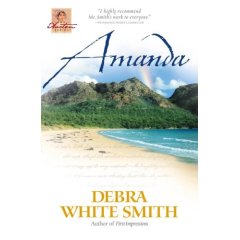
Debra White Smith's, Amanda ~ reviewed


Amanda
By Debra White Smith
ISBN: 978-0-7368-0875-7
320 Pages


Reviewed by Erin Valentine:


Description: Amanda Priebe, the title character, is still feeling the rush from a successful matchmaking effort when she decides to match Haley, her best friend and secretary, with someone “more appropriate” than Roger, the dairy farmer about whom her friend is apparently pretty serious. Nate Knighton, Amanda’s dear friend and brother-in-law, opposes her plans, but stays away from her efforts – primarily because he’s afraid he may be falling in love with Amanda. Complications arise when wealthy and handsome Franklyn West shows interest in Amanda, and Mason Eldridge, the man she intends for Haley, doesn’t follow the game plan. For her part, Amanda knows exactly what she wants, or does she? Will everyone end up with his or her one true love, or will Amanda’s best-laid plans go awry?

This is the fifth offering in Debra White Smith’s Austen Series. Fans of Austen will find that Ms. Smith does a masterful job of preserving Austen’s characters in contemporary settings. The re-telling of classic novels can be a dicey enterprise; people often feel protective of their favorite characters; social norms and conventions have changed, and conflicts that seemed fresh and innovative before feel dated and archaic now. Not so with the books in the Austen series. Smith retains the wit and charm of the Austen novels, but makes necessary revisions to intrigue a modern readership. Besides, Austen dealt with the vagaries of a human soul, creating keen psychological examinations of people both likeable and not. The human character is unchanging; therefore, our peculiarities are interesting in whatever time period they are revealed.

Amanda is a beautiful, intelligent young woman from a privileged background. As such, she has rarely been denied anything she wanted, and when the novel begins, she wants to match her friend Haley with Mason Eldridge, the music director of their church. There is something a bit disturbing in the character’s egotism, her certainty that she knows what is best for others whether they like it or not. The author, however, allows us to view Amanda’s better qualities, her generosity, fun spirit, keen wit, and empathy for others, and that is what makes her a multidimensional character, one we enjoy getting to know despite her flaws.

The miscommunication between Amanda and her intended victims is great fun, and so is the suspense that develops when the reader can’t be quite sure that Amanda will acknowledge what her heart has known all along. Readers who want romance will love this book, especially those who avoid books they fear might be “preachy” in the Christian market. Although the faith of Amanda, Nate and the others is present, it is inherent in who they are - the way they live their lives and the decisions they make. Their Christian worldview replaces any lengthy text on theology that might otherwise be present.

With Amanda, Smith aptly illustrates that “The course of true love never did run smooth,” but the twisted path these characters follow to romance is an intriguing one, and I feel certain that others will enjoy the trip as much as I did.

Monday, January 23, 2006

Author Interview~ Cindy Thomson


Cindy Thomson is a freelance writer living in the Columbus, Ohio, area with her husband and three sons. She is a former kindergarten and preschool teacher and writes on variety of subjects including family history, baseball, American history, and Irish history.

Her first novel, Brigid of Ireland, will be released in March 2006 by Monarch Books. Ms. Thomson has co-authored a full-length biography on baseball Hall of Fame member Mordecai "Three Finger" Brown, published in 2006 by the University of Nebraska Press. Her work has appeared in anthologies, and she has written several feature articles for Family History Magazine, Family Chronicle, History Magazine, Christian Networks Journal, War Cry Magazine, Everton's Genealogical Helper, and publications of the Society for American Baseball Research.

She can be found on the Web at
www.cindyswriting.com

Plug time. What book or project is coming out or has come out that you’d like to tell us about?

Brigid of Ireland, A Historical Novel, Monarch Books, March 2006. (distributed in the US by Kregel.)
This is my first published novel.

Tell us about your journey to publication. How long had you been writing before you got the call you had a contract, how you heard and what went through your head.

I wrote my first novel (still unpublished) based on my family history research. I started it in 2000 and that was my first serious plunge into writing for publication. During that process I attended several writers conferences and received many critiques from generous people.

In 2003 I signed with an agent and then went on to write another novel (also still unpublished.) I began publishing several articles, but still no fiction. Then one day while attending a local Irish festival, I picked up a book on saints and started reading about St. Brigid. She is a patron saint of Ireland. Of course St. Patrick is the best known Irish saint, but there are others with fascinating legends during a time when Christianity was in its infancy.

While pitching my novels at a conference, I pulled out a short story I had written on Brigid. The story received a lot of attention, and I wrote a proposal for a short story collection. It went to committee and was turned down. My agent thought it might be better received as a novel, so I worked on it and again it went to committee. Again it was turned down.

That's when I made the "mistake" that turned into a book contract. I asked my agent about a publisher in the UK. I told him they had published a similar book. He wrote a very strong letter in support of my project, and then I realized that publisher had not published the book I thought they had, and in fact, they published little if any fiction. I was so embarrassed. But, it was God's plan. The editor replied that they were interested. Two months later I had a contract.

Do you still experience self-doubts regarding your work?

Yes. I wonder if I can ever do this again. If my book bombs, no one will buy another one.

What’s the best advice you’ve heard on writing/publication?

Don't worry about what you can't control. Write the best book you can.

What’s the worst piece of writing advice you’ve heard?

Write what you know. It actually may be good advice for some, but if you take it too seriously, it can stifle your writing. I like research. For me a better rule would be: write what you have a passion for—what you want to know.

What’s something you wish you’d known earlier that might have saved you some time/frustration in the publishing business?

I queried agents way too early. I wish I had been more patient, but then it's hard to know what you don't know you're supposed to know—strange as it sounds!

Do you have a scripture or quote that has been speaking to you lately?

"You will be able to tell wonderful stories to your children and grandchildren about the marvelous things I am doing ..." Exodus 10:2 NIV

That verse speaks about passing on the stories of old so that people will see who God is and always has been.


Is there a particularly difficult set back that you’ve gone through in your writing career you are willing to share?
There have been some family problems that made it impossible for me to write for a time. I asked my prayer partners to pray for me, and that made such a difference. The struggles that I went through and those I watched others go through actually made my stories stronger and more realistic.

What are a few of your favorite books? (Not written by you.)

Such a hard question. My answer will likely be different every time I'm asked this.
I just finished Ann Tatlock's, All The Way Home. I was so impressed with both her research, and her technique: a Christian book that was not preachy.

I liked Sue Monk Kidd's, Secret Life of Bees for its beautiful descriptions of the characters' longings for acceptance and love.

A couple of other favorites: Francine Rivers', The Last Sin Eater, Lynn Austin's, Hidden Places, and Tricia Goyer's, From Dust and Ashes.

If your authorial self was a character from The Wizard of Oz, which one would you be and why?

I'd like to be Toto because that dog was so smart! But I identify with Dorothy, although I can't sing like her! I feel like I'm on a journey, a publishing journey. I have a few friends supporting me along the way, and some scary obstacles at times. But unlike Dorothy, I know I'll find my way home.

What piece of writing have you done that you’re particularly proud of and why?

Well, of course I'm delighted that my first book will be published, but this question made me immediately think of the Roaring Lambs award I received in 2003 from the Amy Foundation. The Amy Foundation encourages people to get pieces published in secular publications that promote Christian values and quote Scripture. I wrote a letter to the editor of the Columbus Dispatch concerning the question of whether or not God answers prayers.

Do you have a pet peeve having to do with this biz?

You bet. It's wait time. I tell people that God made me a writer simply because he wanted to teach me patience. I understand that editors are busy. I really appreciate those who acknowledge receiving a submission (one that has been assigned.) That keeps me happy for a while.

Can you give us a view into a typical day of your writing life?

I wish I had such a thing, but until my children (two of whom are over 18) move out, I probably won't have a typical day. But mostly I get up around 7:00, read and answer e-mail, eat breakfast, do devotions, ride my exercise bike while reading a novel, shower, then read more e-mail and work on one project or another.

At various times during the day I have to help my children with something. I am sometimes working when my husband comes home and he makes dinner. If we don't have a church activity in the evening, I sometimes write more after dinner. Unless, of course, it's baseball season. Then I'm in front of the TV with my laptop, and I work and read e-mail between innings.

If you could choose to have one strength of another writer, what would it be and from whom?

Another question that I could answer differently on any given day. Today I'll say Stephen Lawhead's superb research skills.

Do you have a dream for the future of your writing, something you would love to accomplish?

I would love to have a large readership of non Christians who were inspired by my stories in addition to Christians.

Was there ever a time in your writing career you thought of quitting?

Of course. But it didn't last long. Rejections tend to do that to you sometimes. You think, "Why even bother?" But then you wake up the next day and start all over again.

What is your favorite and least favorite part of being a writer?

I love making up stories. I suppose my favorite thing, besides working in slippers, is finding out someone enjoyed something I wrote.
Least favorite: low pay and finding out someone violated your copyright.

How much marketing do you do? Any advice in this area?

I am still learning. My advice is ask questions. My editor is very open to ideas. You never know unless you ask.


Parting words?

Thanks for the interview and for your blog, Gina. It's very interesting to read about other writers. Thanks for letting me share a little bit of my writing life.


Saturday, January 21, 2006

S'up Saturday

James Scott Bell's Fiction/Non-fiction book winners:

Glimpses of Paradise: Janet
Plot & Structure: Sandra

(Despite the heart rendering stories, these two ladies names were picked from a hat.)

~~~~~~~~~~~~~~~~~~~~~~~~~~~~~~~~~~~~~~~~~
Next Week on Novel Journey:
Interviews with Cindy Thompson and Publicist, Rebeca Seitz and a special two-part interview with Bill Myers!
~~~~~~~~~~~~~~~~~~~~~~~~~~~~~~~~~~~~~~~


Hurry to enter the Genesis contest. The deadline's approaching!

Eligibility – The 2006 ACFW Genesis contest is open to ACFW members unpublished in fiction in the last seven years (no published print or electronic works of 20,000 words or more). Authors of library bound fiction dissertations are eligible. Contracted authors are not eligible. Self-published authors *are* eligible, however they may not enter a manuscript previously in print. Previous Noble Theme category *winning* entries are not eligible. Manuscripts under consideration by a publishing house are not eligible. This only applies to full manuscripts requested and submitted, not proposals. Genesis entries may be submitted to other contests.

Entries must be postmarked by February 14, 2006.

Prizes – Highest scoring entry overall, GRAND PRIZE WINNER, receives $500. Top five (5) scoring entries overall, TOP FIVE FINALISTS, go to the Warner Faith editorial board for consideration. CATEGORY WINNERS, first place entries in each category, receive $50 off their 2007 ACFW National Conference registration fee and 1st choice for editor/agent appointments at the 2007 ACFW National Conference. CATEGORY WINNERS, TOP FIVE FINALISTS, and the GRAND PRIZE WINNER will be announced at the ACFW 2006 Conference.

To learn more about the Genesis contest or joining ACFW go to: www.americanchristianwriters.com

Ted Dekker's, Showdown~ reviewed


ShowdownTed Dekker
Hardcover 375 pages
WestBow Press
ISBN: 159554005


Reviewed by Cheryl Russell:


Paradise, Colorado, is an isolated mountain town where nothing much ever happens, until Marsuvees Black strolls into town. He claims to bear a message of grace and hope, straight from God. The townspeople are captivated by Black, his smooth words and apparent miracles. Only Johnny, who met Black when he first walked into town, questions Black's motives. But no one will listen to the boy with the limp.

In the mountains above Paradise, hidden from the world, is a monastery, built by former tenured Harvard professor David Abraham. He and a few other monks have spent years teaching a group of orphans the difference between good and evil, while keeping them isolated from the evils of society—Project Showdown. But now, the day David has expected and dreaded has come. Billy, one of the students, has challenged the monks' teachings. The path he takes threatens not only the future of the monastery, but the people in Paradise.

Samuel Abraham, David's son, and Johnny have a plan to save Paradise. But when that plan goes awry, there is only one way to stop the madness and that cost may be more than either boy can bear.

Showdown is a fast-paced novel with twists and turns that keep you a tad off kilter the entire book-typical Ted Dekker. Showdown is also a graphic novel about free will, choice, and the consequences of those choices. But the violence in the book is what powers Showdown's messages of grace and hope. Light isn't appreciated until it illuminates the darkness. This is a book I highly recommend.


Friday, January 20, 2006

James Scott Bell's Fiction/Non-Fiction 2 Book Givaway!

To enter to win an autographed copy of either Glimpses of Paradise or Plot & Structure, leave a comment, telling which book you want to win. Names will be drawn and announced on S'up Saturday morning. I wish this were someone else's blog so I could win Glimpses of Paradise. Boo hoo! I'm currently reading Plot & Structure and it's a wonderful how to book. Good luck!


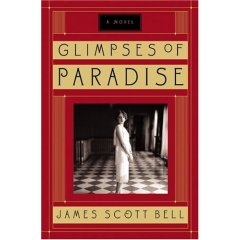
Glimpses of Paradise
Paperback: 400 pages
Publisher: Bethany House Publishers (April, 2005)
ISBN: 0764226487


Reviewed by Ane Mulligan

James Scott Bell has done it again. Glimpses of
Paradise brilliantly portrays the coming of age of two young people as they
struggle with parental expectancies and their own dreams. Doyle Lawrence finds
himself on the battlefields of France in WWI fighting evil, while his childhood
friend Zee Miller chases her dream to Hollywood to become a movie actress.

Ever the masterful story-teller, Mr. Bell brings the era of the early
twenties alive before your eyes and makes you care about his characters. With
unexpected twists in the plot and characters that aren't stereotyped, Bell has
given us a page-turner. One of the best reads of the year!


Write Great Fiction: Plot and Structure: Techniques and Exercises for Crafting Plot That Grips Readers from Start to Finish


FROM THE PUBLISHER
How does plot influence story structure? What's the difference between plotting for commercial and literary fiction? How do you revise a plot or structure that's gone off course? With Write Great Fiction: Plot & Structure, you'll discover the answers to these questions and more. Award-winning author James Scott Bell offers clear, concise information that will help you create a believable and memorable plot Filled with plot examples from popular novels, comprehensive checklists, and practical hands-on guidance, Write Great Fiction: Plot & Structure gives you the skills you need to approach plot and structure like an experienced pro.

Thursday, January 19, 2006

Author Interview~ Robert Whitlow Part II


Robert Whitlow is the best-selling author of legal thrillers set in the South and winner of the prestigious Christy Award for Contemporary Fiction. A Furman University graduate, Whitlow received his J.D. with honors from the University of Georgia School of Law where he served on the staff of the Georgia Law Review. A practicing attorney, Whitlow and his wife, Kathy, have four children. They make their home in North Carolina.


Interview 2006 via telephone.

Gina: When we talked about your journey to publication, we didn’t get very far.

Robert: Okay. So I picked the book back up in ’98, and sent it off. I found a guy in Nashville that had sold one book, he was really in the music business, and he agreed to submit it to Word Publishing, Ami McConnell. He didn’t read it, but he dropped it off.

Gina: Brave soul.

Robert: And three months later, Ami called him and said she couldn’t find the last page of the book. She found the last page and that was it. I’ve never been turned down by a publisher.

Gina: How about if I just smack you?

Robert:[laughs] My wife told me after I finished writing The List that I need to write another book. So, I started The Trial. The List was contracted as a two book deal with an option for a third. I’m on my third contract now.

Gina: That’s such an incredible story. I know there are a few people like you, Deborah Raney comes to mind, whose first book is bought and never have to plow through rejection, but most of the stories are like Ted Dekker’s and Randy Ingermanson’s where they’ve written a pile of books before one sells. That’s amazing to me. Usually first books are pretty bad.

Robert: [Laughs] Well...I still like that book, but I can’t read it now because I just want to correct it. You know we’re doing a movie on that one.

Gina: On The List? I didn’t know that. Have you started filming?

Robert: Yes, in Wilmington North Carolina.

Gina: How did this come about?

Robert: The producer is a guy named Gary Wheeler and co-producer Kevin Downes. Their site is
www.christiancinema.com I’m also co-producing it because we raised a lot of the money. We had screenwriters, but I was involved in editing the script.

Gina: Whose idea was this?

Robert: My wife.

Gina: [Laughs] If she isn’t your agent, she ought to be.

Robert: She’s amazing.

Gina: Sounds like it.

Robert: When I first wrote it she told me, “This is going to be a movie”. So, we’ve waited and prayed on it.

What happens on these things is people will contact you to option it. You make a little money, not much, but usually the movie doesn’t get made. But, I never did that because I was always afraid someone might really make it a movie. I waited until I met someone who really understood what the story was about.

I’ve been very pleased with it so far. Everyday I work on it. Something’s either going on the business side or the creative side. Every day.

Gina: Did the producer contact you or did you contact him?

Robert: I contacted him based on something my friend said. I contacted him and he got a copy of the book and then he contacted me.

Gina: Where will this film show?

Robert: At least a limited theater release. Select markets depending on how it does, we’ll move it around, provided it doesn’t sell.

Gina: Are you hoping it gets picked up by a major motion picture company after it sees its release?

Robert: No, beforehand. We have some interest now because people know we have a real product here.

The main character is going to be played by a guy named Chuck Carrington who plays on JAG. The main female character is played by a lady named Hilarie Burton an actress who played on One Tree Hill. We were looking for clean actors, you know? Will Patten is going to be in it. He was in Remember the Titans and Armageddon. He’s a well known character actor.

Gina: This is exciting for you.

Robert: Oh, this is cool. I’ve really enjoyed it. It is a Christian film, but it’s subtle.

Gina: So you see this appealing to the general market?

Robert: Yes, that’s our intention. Hopefully the people who read the book will want to see it. It will appeal to the CBA audience too I think.

Gina: Speaking of CBA, [Christian Book Assoc.] Why did you choose to write for CBA? Why not ABA [Secular/other]?

Robert: You write what you know and you write your passion. I could write a book that didn’t mention anything spiritual in it, but I don’t want to.

Gina: What about being classified as an author of Christian fiction?

Robert: You know, I’m not on some big crusade, but I don’t like the ghettoization that’s taken place within the Christian community of our work. That’s what happens to CBA stuff.


Moby Dick talks about God. The Scarlet Letter has a lot of things about God, so does Ben Hur. That’s about as Christian a novel as you’re going to get. But those things are just out there as works of literature. We write something and mention the name of Jesus and we’re labeled. If you mention the name of Jesus, but cuss then we’re out of the CBA.

Gina: Aha, the secret to cross-over success.

Robert: There you go. I understand the label makes sense. People want to buy a book that they know is going to be something they can read. My sister the librarian has to categorize books, I understand that.

I just like to write and let the spirituality of the characters come forward as it would in real life. If it’s not imposed then a reader can accept it. You create a credible world with believable characters then things like this happen. When you write what you know, if you’re a Christian and have a real relationship with God, then you can write about things that you know and avoid stereotypes that someone who didn’t have a real relationship with God couldn’t.

Gina: Any advice for aspiring writers?

Robert: Read a grammar book. Read Self-Editing for Fiction Writers...and finish a manuscript. Get something in your hands. A lot of people never do that.

Gina: Parting words?

Robert: Not really. You can come up with something.

Gina: How about Gina, you’re incredibly talented, a publisher better snap you up fast.

Robert: [Laughs] You know what, I’ll say this, you really can’t take yourself or success too seriously.

Gina: Those are good words.

Robert: You really can’t. I’ve been a successful lawyer before I wrote a word. I’ve learned you have to hold that success with an open hand. You can’t grasp it too tight. You have to be willing to let it go. You’ve got to have a genuine humility and focus on others.


Jimmy Mitchell knows he's different from the other teenagers in the little town of Piney Grove, Georgia. He's what people call "slow," which means he doesn't always understand what he sees and hears. But Jimmy sees and hears a lot, even the occasional "Watcher" (his mama calls them angels). And Jimmy remembers what he sees and hears with uncanny accuracy - which is why his lawyer father asks him to testify as a defense witness in a criminal trial.

Wednesday, January 18, 2006

An Interview with Robert Whitlow by Gina Holmes


Robert Whitlow is the best-selling author of legal thrillers set in the South and winner of the prestigious Christy Award for Contemporary Fiction. A Furman University graduate, Whitlow received his J.D. with honors from the University of Georgia School of Law where he served on the staff of the Georgia Law Review. A practicing attorney, Whitlow and his wife, Kathy, have four children. They make their home in North Carolina.


Interview 2006 via telephone.

Gina Holmes: I think most people know you’re an attorney as well as author. I’ve seen your law office’s web-site and noticed there is a link there to your novels. Your partner is supportive of your writing?

Robert Whitlow: Yes, they get a kick out of it. I use some of my co-worker’s names for characters in my books. In one book several of them appear as deputy sheriffs.

Gina: They like that I’m guessing.

Robert: Yeah.

Gina: You don’t kill them off?

Robert: [Laughs.] No.

Gina: That reminds me of Frank Peretti’s Monster. He has a character named Allen Arnold (WestBow publisher) who gets killed off. I laughed when I read that and wondered if Mr. Arnold did.

Robert: Yeah. I think he got a kick out of it.

Gina: Do you work full-time as an attorney?

Robert: Full-time. From ’97-2000, I had cut back when I was working in Georgia. I’m from Georgia and was a Georgia attorney for twenty years. I’m still a Georgia lawyer, but now practice in Charlotte.

Gina: What brought you to Charlotte?

Robert: We moved here in ’96. The reason for that was that my wife, Kathy, had a dream in 94 that we were going to move to Charlotte, and I don’t even remember her telling me that. A year later in ’95, she had another dream. Neither one of us dream a lot, she told me that she believed she saw the house we’re going to live in, in Charlotte. So, I thought, what am I going to do with that?

Gina: Drive around Charlotte until she recognizes it?

Robert: Charlotte’s a big city. My wife was talking to a friend and told her about the house she dreamt about, and her friend said, that’s my brother’s house in Charlotte and it’s for sale.

Gina: Wow.

Robert: She even got the asking price in the dream. I bought it for less though and I’ve always wondered if that was a sin.

Gina: [Laughs]

Robert: But that’s just the honest, straight answer of what happened.

Gina: Do you think that was God saying you were to move there?

Robert: I do. Otherwise I would never have become a writer. I was at a law firm in Georgia and extremely busy. I would never have had the time to undertake a project like writing a novel. When we moved, I worked part-time for a few years. It was really within a month of the move that I got the idea for my first novel. I’d never had any ambitions to write a novel. I would look at a novel and wonder how someone could do that.

Gina: Were you an avid reader?

Robert: I had read growing up. I have an older sister who is a professional librarian. She seems to have that gene. She would give me books to read in the sixth or seventh grade.

As an adult, I read so much in my practice, plus I had four small children who were so close in age, I didn’t have time to read recreationally.

Gina: What do you like to read now?

Robert: Grammar books.

Gina: [Laughs.]

Robert: [Not laughing.] “Woe is I”, which is a grammar book. This year I’ve read three novels: Huckleberry Finn, To Kill a Mockingbird, & The March.

Gina: Is there an author you’re particularly impressed with?

Robert: Charles Martin who also writes for WestBow is a very, very, talented young writer. I respect his craft quite a bit.

Gina: I’d read besides being a husband and father to four, you like to hike, trout fish & garden besides being a full-time attorney and author. How do you find balance?

Robert: I don’t do as much trout fishing as I used to. We let the garden go—just grow grass now. I do still exercise. I think most lawyers can’t really say they work “full-time”. I work about thirty-five hours a week. I will write some in the morning before going in to work and then write more in the evening. I don’t watch a whole lot of TV.

Gina: How much time in the morning do you devote to writing?

Robert: Only about forty-five minutes.

Gina: Do you edit during that morning time or jdo just straight, unrestricted, creative writing?

Robert: Both. I tinker with what I’ve written the day before and then go on. But I do the bulk of my writing in the evenings and on the weekend.

I’m not putting out two or three books in a year either. I put out one book a year at best.

Gina: Is that by design, meaning if you tried to up your output do you think you might lose some of the deep characterization you’re known for?

Robert: Yes. My temperament wouldn’t tolerate cranking out too much. Everyone’s different, but for me, after two or three hours of writing, I’m finished. I might be able to drive the plot forward after that, but I’d lose nuance.

Gina: Do you do extensive plotting before you write?

Robert: No, I’m more organic.

Gina: Seat of the pants?

Robert: Yeah, that’s it. I’ll have broad direction in my mind and a few notes scribbled on a piece of paper and then I go on a voyage of discovery.

Gina: Interesting. I’m finding a pattern of writers that write seat of the pants often put out about one book a year. It takes longer to write this way I think.

Robert: I’m trying to keep writing fun, because I have a job I’m happy with. I’m very thankful I have a good law practice and the writing can be something that’s an enjoyable activity, not something I’m trying to support my family on.

My children are all in their twenties now, but I still have two in college. It’s hard to make a living as a writer when you're paying private school tuition.

Gina: It’s probably hard to make a living as a writer regardless.

Robert: Some people do okay. I think Ted [Dekker] does well. But he’s going at it full-force.

Gina: My impression is that he’s quite driven.

Robert: That’s one model and that works for him.

Gina: Most writers seem to have the goal that eventually they’d like to live off their writing, that doesn’t sound like your goal.

Robert: No. I like being a lawyer and if I believed writing wasn’t something I was supposed to continue with, I’d simply quit.

Gina: Wow. I don’t hear that...ever. You could just give up writing, really?

Robert: I might continue to do things just for myself. I guess once that well is tapped, the water flows, but the solitary life of the writer is not for me. I’m not cut out for that as a full-time vocation. Sitting alone in my room with my laptop, I’d drive my wife nuts. I need to be involved with people in a work environment.

Gina: Do you ever attend writer’s conferences?

Robert: I’m a member of ChiLibris. Which is a group of CBA writers who’ve had at least two published novels. We have an annual retreat a few days before the CBA convention. Are you familiar with them?

Gina: Yes.

Robert: It’s a great group of people.

Gina: Do you teach at writer’s conferences?

Robert: I do some local things, but I don’t do a lot of traveling. I don’t get a lot of invites either. Not that I’m looking for them, I’m not, but if say Mount Hermon invited me to speak, I probably would. I doubt they’ll ask though.

Gina: [Laughs] They might now that they know you’re interested. Why Mount Hermon?

Robert: I’ve just heard they’re one of the best.

Gina: Another great conference is the ACFW’s.

Robert: What’s that?

Gina: American Christian Fiction Writers. It’s a huge group of Christian writers, who have come together to help each other promote, learn, and fellowship. It’s an awesome group, you should really check it out.

Robert: I will. Are you a writer?

Gina: Yes, I write suspense. [boring conversation here about Gina and who is considering publishing her, etc. During this conversation we get on the subject of his publisher, Allen Arnold at WestBow.]

Robert: When I met Allen in ’99 he was a marketing guy with Nelson. He is really sharp. He comes up with excellent promotions. Selling a book is like selling cans of cola, you need shelf space, and he gets it. In the marketplace where everything is driven by promotions, sometimes the best literature doesn’t always get its rightful place in the sun. This is a business. But Allen really has a way of making that happen for a book.

Gina: Yes, I’ve heard over and over that WestBow does an excellent job of promoting their authors.

Robert: You know my latest book, Jimmy, is in hardcover, which I didn’t really care.


Gina: C’mon, that’s pretty cool, you have to admit it.


Robert: Well, what I really want is for people get a chance to read them. If my first book came out in hardcopy, my mom might have bought only one book. [Hardcover is much more expensive that a paperback.]

Gina: Speaking of your books getting read and shelf space, you’re a best-selling author and very well known. What do you think your success is due to? Do you think you simply wrote a good book and were lucky/blessed, or was it due to marketing or something else?

Robert: I don’t do a whole lot of marketing. What they do is with the first book they just throw it out there and see what happens. That’s what happened with

The List.

Back then Nelson was doing more speculative fiction which gave me a chance, plus they were looking to fill that Grisham niche. I’m from a small southern town. I’ve got a legal component in my books and some suspense.

The local bookstore by my house had two copies. I went into the store and offered to sign them. The owner told me he hates lawyers, then checked my face against the back of the book author photo to make sure it was really me. He told me the company wouldn’t take them back with the author’s signature on them, so he told me to sign just one.

Gina: [Laughing hysterically] Oh man, that’s rough. He didn’t think he could move two copies. That’s hilarious.

Robert: [laughing] That’s a true story.

Gina: How did The List do by the way?

Robert: In the first six months it sold twenty thousand copies.

Gina: Wow, nice.

Robert: I didn’t know that was good. I thought a million was good.

Gina: So you were bummed out, huh?

Robert: I found out you don’t have to sell a million copies to be a best-seller.
It sold twenty-thousand copies between word of mouth and being picked up in ABA stores like Barnes & Noble. The success of that book was a blessing and hopefully it had to do with the craft too.

So, it did well and then The Trial was picked up by Crossings as a primary selection. That helped get fifty thousand more copies out there, which didn't make me much money directly, but indirectly it helped a lot because it helped generate more word of mouth.

Gina: In ’96 you started writing The List. How did you get from drafting this idea to a contract?

Robert: I had the idea for the story and my wife told me I should write the book. I worked on it for about eight or nine months, had about twelve or thirteen chapters, then I spilled a drink on my laptop. I did have a hard copy, but after that I didn’t do anything with it for a year.


But, I just couldn’t get away from it, so I went back and read it. I even forgot some of the characters it had been so long. I will tell you, it was really b-a-d. Except for one chapter that was really good. That one chapter was my encouragement to pick it back up.

And then, I bought a book in January of ’97 that changed my life.

Gina: Let me guess, Self-Editing for Fiction Writers.

Robert: That’s the one! I went to a writer’s conference in Atlanta—Most discouraging thing I’d ever done in my life. Everyone talked about how impossible it is to get published and then once you are published you don’t make any money...and then I spilled the drink on my laptop and I said to heck with this.

Gina: [Laughs]

Robert: You know that book liberated me from writing legal briefs in fiction form--trying to explain, telling instead of showing. Didn’t know a thing about point of view or what a beat was. As an attorney, I knew how to write and some of my briefs were even entertaining, but I never wrote fiction before I wrote The List.

That book really changed everything.

Gina: Self-Editing is the best how to book out there, most definitely. There ought to be a mandate for any aspiring fiction writer to read it. It can save you years of frustration.

Robert: The thing I like best about that book is it just gives a few excellent lessons instead of trying to teach too much. If you can hold on to the lessons that books gives you, that will really improve your writing.

Gina: I’m hearing a lot about branding lately, authors needing to brand themselves. Looking back through what you’ve written, I don’t see that with you. At first you were compared to John Grisham, then to James Patterson, recently with Jimmy it’s Mark Twain.

Robert: [Laughs] That’s my maturation as a writer, you know? [Laughs harder] That cracked me up. I saw that on the back cover copy and I call Allen up and said, “Allen, you sure you want to say that?” But you know the crazy thing about that is they didn’t know at WestBow that while writing that novel I was actually reading Mark Twain, at that time. So when that popped up on the back cover I thought, whoa.

But, the branding thing is true, though Jimmy is a very different book then my others. Allen was very gracious to allow me to do something that was really in my heart to do—write about this mentally challenged young man. It does have a legal component, but it is not a ‘what’s going to happen next’ kind of book, unless you’re wrapped up in who this young man is as a person. The novel rises or falls on your connection with him.

Gina: What gave you the idea for that book?

Robert: I don’t know. It was just something I really wanted to do. After writing that, I’m not really sure where I’m going as a writer now. Though the book I’m working on now does go back to what I’ve been doing.

Gina: What are you working on now?

Robert: A novel about a lawyer turned minister. He gets called in for this odd older man that lives in his town to represent him on a smaller criminal charge that turns into something a whole lot more involved than he anticipated. The effects upon him are more significant than he would have ever guessed.

Gina: Is it okay that I mention the plot?

Robert: That’s fine.

Gina: You’re obviously an intelligent guy, you’re an author, an attorney, so how difficult was it to write from the pov of a mentally challenged boy?

Robert: I loved it because one of my heroes is Hemingway. I believe Hemingway and television are the two biggest influences on novels. Hemingway set us free from the heavy handed, flowery narrative to a more journalistic style. And the television of course influences dialogue and action.

I loved writing as Jimmy because I had to go back and cut back my vocabulary. I’m not trying to make a big deal about this, but hopefully it comes out as a pure, simpler, more powerful emotion.

Gina: That's great that your publisher supported you wanting to write something different.

Robert: Yes, there has been a lot of support all around. One of the things I love about the ChiLibris group I mentioned, is that everyone’s so supportive and not competetive. It’s really nuts for writers to be competetive. because you’re not running a race against each other. Basically you’re just jealous that another writer is doing well. I think we’re all in this thing together if we have a kingdom perspective on it. And I love that about ChiLibris.

Gina: Yeah, I think that’s one of the biggest things the CBA has going for it. We all answer to the same boss and that effects how we treat each other. We’re accountable to one another on a very high level. I think it’s probably an entirely different environment than you would find outside a group of Christians.

When we talked about your journey to publication, we didn’t get very far....

To be continued tomorrow.


Tuesday, January 17, 2006

Author Interview ~ Stephen Bly


Stephen Bly has authored over 95 books. THE LONG TRAIL HOME, won the prestigious Christy Award. Three other books, PICTURE ROCK, THE OUTLAW'S TWIN SISTER, & LAST OF THE TEXAS CAMP, were Christy Award finalists. He speaks at colleges, churches, camps and conferences across the U.S. and Canada. He is the pastor of Winchester Community Church, and serves as mayor of Winchester, Idaho


Plug time. What book or project is coming out or has come out that you’d like to tell us about?

Gina, The Mustang Breaker is the 2nd in a series called Horse Dreams. It's a contemporary fiction series about a middle-aged, Indiana schoolteacher, Develyn Worrel, who comes out west during the summer to escape some incredible personal pressures. She finds forgiveness, love, and purpose in a little dirt road town in central Wyoming. I love the story because it's so real. This isn't a 'what if' story . . . but there are many people in Develyn's same struggles.

Tell us about your journey to publication. How long had you been writing before you got the call you had a contract, how you heard and what went through your head.

I've got to tell you that this is about book number 100 for me. So, I suppose my excitement is different than a first time author. Not less excitement . . . just different.

I had been writing numerous articles and short stories since 1976 when my wife, Janet, took a nonfiction book proposal of mine, at her insistence, to Mt. Hermon writers conference in 1980. Two different editors expressed interest. One of them, from Moody Press, called me several months later to announce they'd accepted it. We had been warned so often about how difficult it was to get a book contract that we could hardly believe it.

That first book, Radical Discipleship, was released in 1981. After a half dozen other books for adults, kids and teens by Moody and Cook, my first western novel, The Land Tamers, was published by Tyndale in 1987. This came about from an editor contact at Mt. Hermon. But she told me later they wouldn't be doing any more fiction after this came out. I had lots more western fiction ideas, but tabled them.

But soon after, Frank Peretti's book, This Present Darkness, exploded on the Christian fiction scene. One day, I picked up the book and noticed that Crossway Books was his publisher, so I got the idea to send them two western series proposals, one for kids and one for adults. At first, they told me they'd try one book and see how it would go. Then, months later, we received the news that they accepted both series: I got eleven contracts at one time in the mail! Don't get any better than that.

Do you still experience self-doubts regarding your work?

Always. If a writer ever loses the push to excel . . . the need to be better . . . the drive to greatness . . . then, indeed, he is merely a hack writer. I think my books get better each year and with each series. I'm always pushing myself.


What’s the best advice you’ve heard on writing/publication?

First: Always make your reader laugh . . . and make them cry. Second: if your story drags . . . shoot someone. Of course, that's from the perspective of the western genre, but the principle works for others too.

What’s the worst piece of writing advice you’ve heard?

Everyone has a book in them. Some people are born plumbers. They are the ones with the big fancy houses on the hill. But not everyone can write.

What’s something you wish you’d known earlier that might have saved you some time/frustration in the publishing business?

Get a 'mutual consent' clause about covers and titles from day one.

Do you have a scripture or quote that has been speaking to you lately?

Matt 23:11-12 "The greatest among you will be your servant. For whoever exalts himself will be humbled, and whoever humbles himself will be exalted."

I want to continue to learn what it means to be a writer who is also a servant.

Is there a particularly difficult set back that you’ve gone through in your writing career you are willing to share?

I just finished six months of hard work on a collaboration with some extremely famous people. The publishers, editors, agents and one of the collaborators liked the book . . . the other famous collaborator turned it down. So, in a way it was 6 tough months for nothing. But I don't consider it a complete set back. I did what the Lord wanted me to do at that time. It was my next thing to do. He is in charge of results. I have no regrets, no complaints.

What are a few of your favorite books? (Not written by you.)

Cannery Row - John Steinbeck
The Daring Young Man on the Flying Trapeze - William Saroyan
Anna Karenina - Leo Tolstoy
Mosquitoes - William Faulkner

If your authorial self was a character from The Wizard of Oz, which one would you be and why?

Dorothy . . . I spend most of my life in a fictional world. It's sometimes difficult to separate from reality. I explain a lot of that in my novel,
Paperback Writer.

What piece of writing have you done that you’re particularly proud of and why?

All 100 books because I feel so privileged and grateful that each one found its way into a publishing house. However, I really love Paperback Writer because it's quirky and Publisher's Weekly loved it too.

Do you have a pet peeve having to do with this biz?

People who want to write a book, but have nothing to say.

Can you give us a view into a typical day of your writing life?

Up before 4 am . . . jog, answer email and write 8 to 12 hours, except when the washing machine overflows.

If you could choose to have one strength of another writer, what would it be and from whom?

I'd like to be as subtle . . . and yet powerful . . . with the Christian message as C.S. Lewis . . . but who doesn't?

Do you have a dream for the future of your writing, something you would love to accomplish?

I would enjoy seeing one of my novels made into a movie that the Lord would be proud of.

Was there ever a time in your writing career you thought of quitting?

I've only been writing 38 years . . . so I've never thought about it yet. Never.

What is your favorite and least favorite part of being a writer?

The favorite part are the letters and emails from readers who have allowed my stories to touch and change their lives.

Least favorite? Having to write back cover copy and publicity blurbs for people who don't take the time to read my work.

How much marketing do you do? Any advice in this area?

Nope, not really. We don't do anything fancy, just plug along the old fashioned way, one reader at a time, by selling books at speaking gigs, giving away freebies and more recently, through our website,
www.blybooks.com We also emphasize the personal touch--letters back to everyone who contacts us, usually handwritten. We've made a simple, but comfortable full-time income that way.

Parting words?

Write from your heart, as well as your mind.


Monday, January 16, 2006

"Everybody can be great...because anybody can serve. You don't have to have a college degree to serve. You don't have to make your subject and verb agree to serve. You only need a heart full of grace. A soul generated by love." Martin Luther King Jr.

Author Interview: Mike Yorkey


Mike Yorkey graduated from the University of Oregon School of Journalism in 1975.
He went on to become Editor-In-Chief of eight magazines at Focus on the Family. He has authored or co-authored fifty books with nearly 1.5 million copies in print.


Plug time. What book or project is coming out or has come out that you’d like to tell us about?

By the Sword releases January 15, 2006, and although I am the author or co-author or more than 55 books, this is my first novel. I wrote it with my church pastor, Rick Myatt, and it’s basically a Middle East techno-thriller with the following premise: What would the world look like if jihad-minded Islamic leaders sought to extend The Prophet’s influence through conversion by the sword? After all, that is how Islam took root more than 1,000 years ago.

We are confident there is an audience for a suspense thriller told through the eyes of Amber Robbins, an American reporter stationed in Jerusalem. Her dangerous search leads her on a path that pits her faith and her investigative reporting skills against Islamic fundamentalists intent on converting all people to Allah and his messenger, Mohammad.

Broadman & Holman is publishing By the Sword, which pleases me to no end. They’ve been doing the Ollie North fiction, and I’ve long felt that By the Sword is cut from the same cloth and would be a good fit for B&H.

Tell us about your journey to publication. How long had you been writing before you got the call you had a contract, how you heard and what went through your head.

Rick and I started writing By the Sword in the spring of 2000 when the World Trade Center stood sentry in Lower Manhattan, welcoming tens of thousands of workers and tourists each day. We thought we had a fairly outlandish plot until a pair of passenger jets toppled the Twin Towers on September 1, 2001. On that fateful day, we were 75 percent finished with By the Sword—and just as stunned as the rest of the world.

We quickly finished the manuscript, but we soon learned that publishers were skittish about releasing a novel that touched so close to current events. Every publishing house our agent contacted turned us down.

We greatly believed in By the Sword’s message, so we persevered for several years, rewriting and revising our novel.

Do you still experience self-doubts regarding your work?

No, because I labored several years on this book . . . working on it when I had holes in my schedule with my deadlines for my non-fiction books. For some reason, I’ve believed in this story, even with all the rejections. Rick suggested at one time that we give up the ghost and go on to something else, but I believed that Amber’s story was right for the times we’re living in.

What’s the best advice you’ve heard on writing/publication?

Have other people read your work and be bold enough to let your friends or acquaintances know that they can tell you what didn’t work, or where they lost interest, or what you could do to improve the manuscript. We probably had 20 people read By the Sword in various mutations, and we learned something from each round.

What’s the worst piece of writing advice you’ve heard?

To change the title of our novel . . . an agent and close friend of mine suggested we change the name of By the Sword to Cloaked Intent . . . he thought the latter title would appeal more to the female demographic, but I thought it was too nebulous. We switched back to By the Sword, and that’s when it finally sold to Broadman & Holman.

What’s something you wish you’d known earlier that might have saved you some time/frustration in the publishing business?

I always felt if I could just get someone at a publishing house to read the novel . . . to compare it against what they published or what they received over the transom . . . then we would have a good shot at winning a publishing offer.

But acquisitions editors are so swamped with manuscripts that it was very difficult and time-consuming to get someone to sit down and stay with the novel. Again, I know how important the first 50 pages are, and our novel starts out with a bang and keeps up the heat . . . but even getting people to read those first 50 pages was a chore.

Is there a particularly difficult setback that you’ve gone through in your writing career you are willing to share?

Sure. Although I’ve written 55 books or so, I’ve been fired four times along the way. Well, maybe fired is too strong a word, but I was asked to stop working on the project, which I guess is the same as being fired. I’ve found out that one person can come along and say, “We’re going in a different direction,” and that’s all she wrote. I’m a people pleaser by nature, but sometimes these things are out of your hands.

What are a few of your favorite books? (Not written by you.)

Rick and I always enjoyed Tom Clancy, but his last few works have not been as good as his first half-dozen books. I’ve enjoyed Ken Follett and David Baldacci . . . but lately I’ve been reading more biographies . . . I even read a couple about those Sixties icons, Jim Morrison of the Doors and Joe Namath of the New York Jets.

If your authorial self was a character from The Wizard of Oz, which one would you be and why?

I think I would be the Scarecrow . . . he runs around without thinking a whole lot, and I tend to do that as well . . . chase after something without giving it some thought first.

What piece of writing have you done that you’re particularly proud of and why?

I’ve always had a soft spot in my heart for Touched by the Savior, a book I wrote about how James Dobson, Chuck Colson, Luis Palau, and people you never heard came to salvation in Jesus Christ. Everyone loves a story, and this book was filled with great come-to-Christ stories, but Touched by the Savior didn’t touch off great sales numbers.

Do you have a pet peeve having to do with this biz?

Not really . . . but I do know that I hate how long it takes for book publishing companies to move or make a decision. It takes so long to get things done . . .

Can you give us a view into a typical day of your writing life?

I wake up, read my Bible some, check my e-mail. Then I eat breakfast and read the Los Angeles Times and San Diego Union-Tribune. By then, it’s 9 a.m. I work on my various book projects: I’m usually juggled two or three different ones at the same time. Sometimes I go play tennis at noontime for an hour, or I eat lunch. Then I type away in the afternoon, stopping around 5:30 to exercise at the gym if I didn’t play tennis. Eat dinner, and then I may do a little work after dinner. No all-nighters for me. By 7 p.m., I’m pretty wiped.

If you could choose to have one strength of another writer, what would it be and from whom?

Bob Welch, a columnist with the Eugene Register-Guard, is an old college buddy, and his ability to make words sit up and beg amazes me. I’m weak on similes, and he is so good at them, like a . . . see, I can’t come up with one.

Do you have a dream for the future of your writing, something you would love to accomplish?

Well, if By the Sword ever got made into a movie . . . but seriously, I’m part of the Every Man’s Battle series with Fred Stoeker, and that’s been a career highlight for me.

Was there ever a time in your writing career you thought of quitting?

No, but there have been my share of low moments, like after the times I was fired, that I’ve had to mentally regroup and keep on plugging away.

What is your favorite and least favorite part of being a writer?

I love being able to create. I love what I do. I get to play with words all day. Bring characters to life. Create.

I’ve been writing for a living for nearly twenty-five years and met some fascinating and interesting people along the way. I worked for and interacted with Dr. James Dobson for eleven years as editor of Focus on the Family magazine. I’ve walked into the White House to interview a presidential aide, been escorted into the Pentagon, where I interviewed General John A. Wickam, the Army Chief of Staff (the guy before Colin Powell took the job), and strolled onto an on-location movie set where I yelled a question at actor and funnyman Eddie Murphy.

I’ve interviewed Christian artists like Rebecca St. James, Steven Curtis Chapman, and Sheila Walsh, and sports personalities like ABC football announcer Dan Fouts, Coach John Wooden, NBA star A.C. Green, San Diego Charger placekicker Rolf Benirschke, pro tennis player Mary Joe Fernandez, PGA golfer Paul Stankowski, pro tennis player MalVai Washington, and sports agent Mark McCormack.

My job has allowed me to meet Billy Graham, Andre Agassi, Bjorn Borg, Jimmy Connors, Michael W. Smith, Margaret Becker, Point of Grace, and Zig Ziglar. Best of all, I’ve gotten to collaborate with some amazing people by writing their books for them: folks like Tim and Beverly LaHaye, evangelist Luis Palau, pop singers Marilyn McCoo and Billy Davis, Jr., tennis stars Michael Chang, Roscoe Tanner, and Betsy McCormack, baseball pitcher Dave Dravecky, and Jordan Rubin of The Maker’s Diet fame.

Least favorite part?

Waiting for decisions from publishers!

How much marketing do you do? Any advice in this area?

I haven’t done much, but I got a website going in the last month called
http://www.mikeyorkey.com/

Come by and visit . . .

Parting words?

If
you want to be a good writer, you have to read.


Saturday, January 14, 2006

S'up Saturday

Winner of B.J.Hoff's, A Distant Music...
Kelly Klepfer!

lNext week, interviews with: Mike Yorkey, Stephen Bly and a special two-part telephone interview with Robert Whitlow!


Interviewing Robert has definitely been a highlight for me. He's incredibly fun to chat with. Luckily, we managed to get the questions asked and answered through all the laughing.

UACFW~ American Christian Fiction Writers Launches Book Club U

From airport news stands to Newsweek, Christian fiction continues to grow in popularity, resonating with readers looking for both faith and fiction. The growth of the genre has birthed many new writers, as evidenced by American Christian Fiction Writers (ACFW), an organization started in 2000. Now boasting almost 1000 members.

ACFW reaches out to readers as well as writers with their new ACFW Book Club. Beginning January 2006,the Book Club will offer fans of Christian fiction the opportunity to chat with ACFW authors and discuss monthly reading selections.

Readers will also be eligible for monthly free book drawings.

The titles chosen to kick off the club include:

a Black Sands by Colleen Coble. Trouble in paradise. A Hawaiian romantic
suspense.
a Leave it to Claire by Tracey Bateman. Single mom tries to fix her family. Chick lit fun!
a Outriders by Kathryn Mackel. A new ark. An ancient enemy. Fantasy adventure.
a Pink by Marilynn Griffith. Four fashion designers collaborate on a million dollar wedding dress. Will they find God in the seams? Multicultural tale.


Click on the image to learn more about the ACFW Book Club

McCourtney's, On the Run ~ reviewed

On the Run - An Ivy Malone Mystery

Lorena McCourtney
Publisher: Revell Books
ISBN: 0-8007-5956-7
Genre: Suspense


Reviewed by Karri Compton:

She may be just an LOL (Little Old Lady), but Ivy Malone’s mutant curiosity gene can plunge her into a mess of trouble. The gray-headed widow from Missouri continues to hit the road in her motor home, running from criminals who are out to get her. During her travels, she comes across a tattered lady in Oklahoma who needs help. When Ivy and young Abilene team up and go job hunting, they find more than they bargained for.

The emu-farming/survivalist Northcutts won’t be giving the duo jobs. They’re dead. And Ivy must find out why, even though the evidence points to suicide. Could the Northcutts have secret enemies such as Ute, a previous employee? Or did Frank, their son, have a bone to pick with them? And what is Abilene’s story? Can she successfully flee from her own demons?

Join Ivy in her zaniest mystery yet and get a glimpse of the joys of paintball, the delicate intricacies of emu sitting, and best of all – a reminder of God’s loving plan for each of us.

Lorena McCourtney has outdone herself with this little gem. What a hoot! I often forget that Ivy Malone is a fictional character. She is one LOL I would love to meet. Her perspective on life is quite refreshing, even if she does suffer from chronic inquisitiveness.

You’ll want to check out the first two books in this series, Invisible and In Plain Sight.


Friday, January 13, 2006

Author Interview ~ James Scott Bell


James Scott Bell studied philosophy, creative writing, and film in college, acted in Off Broadway theater in New York, and received his law degree with honors from the University of Southern California. A former trial lawyer, Bell is the Christy-award winning author of Deadlock, a thriller about the Supreme Court, and coauthor of the bestselling Shannon Saga series. Bell makes his home in Southern California with his wife, Cindy, and their two children.


Plug time. What book or project is coming out or has come out that you’d like to tell us about?

I’d like to plug Glimpses of Paradise, my historical novel from Bethany House. I worked really hard on this one, tried to give it epic sweep. I’m really happy with how it came out. I hope more people read it!

Next April, Presumed Guilty comes out. It’s a legal thriller from Zondervan.


Tell us about your journey to publication. How long had you been writing before you got the call you had a contract, how you heard and what went through your head.

I started as a screenwriter, and got fairly high up the food chain, but my optioned scripts, for one reason or another, weren’t getting to the screen. I was also “taking meetings” where people wanted me to write this or that for them. I was starting to get a little frustrated, and also felt myself compromising.

What do you mean by compromising?

That I was starting to justify doing material I otherwise wouldn’t do, just to get the work. So one day I sat down to write something totally for myself. It turned out to be this wacky, satirical novel of ideas called
The Darwin Conspiracy. I was going to publish it myself, because I knew it was too far out of the mainstream for a legit publisher! But through an odd set of circumstances it came to the attention of a publisher who offered me a contract. So I took it.

Do you still experience self-doubts regarding your work?

All the time. I find this is common with writers who continue to publish. I think it’s because our standards get higher the more we go along. We raise our own bar. The trick, I think, is to make writing the antidote—every hour spent writing is one less hour spent fretting about your writing.

What’s the best advice you’ve heard on writing/publication?

Set a word quota. Whatever it is, daily, weekly. Whatever you can reasonably do, just set it and stick to it. The writing piles up, and sooner than you think you have a book.

What’s the worst piece of writing advice you’ve heard?

Try to imitate what another writer does.

What’s something you wish you’d known earlier that might have saved you some time/frustration in the publishing business?

I’ve been pretty blessed in my writing career. Maybe one reason is that I only started seriously writing when I was 34, and this after law school and running a small business. So I brought a certain sense amount of professionalism and planning to it. That’s a piece of advice I’d give to new writers.

Treat this as a profession.

Treat those in the know—agents, editors—as fellow professionals. Don’t waste their time. Don’t be desperate with them. Offer them your best, and if they say No, offer it to someone else while, at the same time, you’re writing new stuff.

The is a business that wants to nurture professional writers, those who can produce a good novel again and again, not one shot wonders.

Do you have a scripture or quote that has been speaking to you lately?

Exodus 15:11:

“Who among the gods is like you, O LORD?
Who is like you—
majestic in holiness,
awesome in glory,
working wonders?

I’m preparing to preach a sermon on God, and this verse contains the outline. One can just scratch the surface here, but what depths underneath that scratch.

Is there a particularly difficult set back that you’ve gone through in your writing career you are willing to share?

Not really, other than the usual “Hollywood agent from hell” story that is quite common. As the old radio comedian Fred Allen said, “You can take all the sincerity in Hollywood and put it into a gnat’s navel, and still have room for two caraway seeds and an agent’s heart.”

Ouch. Does that mean you’re against agents?

No. Even though I do my own agenting, I think there are some fine ones out there.

Any advice on someone trying to get an agent?

First, work on being the best writer you can be. Get your proposals in tip top shape. Then, don’t jump at the first agent who shows interest. Find out a bit about their background. This is a big move, and having a bad agent is worse than having no agent. You can still get your proposals straight to editors.

What are a few of your favorite books? (Not written by you.)

I really like the 50’s novels of John D. MacDonald. He wrote paperback crime novels, but truly elevated the form. One of my current favorites is Michael Connelly. I’m reading The Lincoln Lawyer right now.

It seems quite a few authors these days are or were attorneys, You, John Grisham, Robert Whitlow, Don Brown, Aaron Thiel, and others. Why do you think that is?

We need a legitimate way to make money. But there’s also natural drama in courtrooms and legal controversies. Just look at all the TV shows!

If your authorial self was a character from The Wizard of Oz, which one would you be and why?

On days when the writing is going poorly, I’m one of the grumpy apple trees. My wife can attest to that. When I’ve finished a draft, or sent off my edited galleys, I’m like the “bust my buttons” guy, a little hyper and sing-songy.

What is the LOCK system?

I came up with the LOCK system as a way to teach the basics of story structure. When you understand the elements, you can’t help but have a solid structure for your novel. That takes care of a big part of the task. Then you’re free to add your creativity to it.

I wrote about it extensively in my book, Write Great Fiction: Plot & Structure (Writers Digest Books), but an article on it can be found at my Writer’s Tips page on my website:

http://jamesscottbell.com/tips.html

Your book on Plot & Structure is getting such wonderful word of mouth play. Was it unnerving to write a book that would only be read by other writers? (Would you share a tip?)


I wasn’t really unnerved, because I just see it as a way to sit down with other people who are trying to write, just as I am, and share some of the helpful techniques I’ve found.

Let me say one thing about structure. Early on in your book, the Lead should pass through what I call a “Doorway of No Return.” It’s sort of like the mythic journey idea, but the key is to create a situation that virtually forces the Lead into the main conflict of the book. Then you have a feeling of inevitability about it.

In The Wizard of Oz, of course, it’s a physical happening: Dorothy is literally transported to another world. But this is the feeling you want, that your Lead has to face a major problem, has to. Otherwise, he’d do what we all prefer to do, stay in the house.

What piece of writing have you done that you’re particularly proud of and why?

My short story, “I See Things Deeply,” for The Storytellers’ Collection II (Multnomah). I love the short story form, and am sorry it’s in such short supply. It’s also the hardest fictional form to master, but when it comes off, it can be even more powerful than a novel. I thought this story turned out pretty well.

Do you have a pet peeve having to do with this biz?

I wish the lag time between contracting a book and seeing it published weren’t so long. It’s now 18 months to 2 years before you see it on the shelf. It’s the way books have to go from publisher to retailer, though, so there’s not much I can do about it. I’d like the window to be no more than a year, but that’s not going to happen.

Can you give us a view into a typical day of your writing life?

Wake up, start the coffee, do my Bible reading before anyone else gets up. Later, I’ll I go to my favorite local Starbucks, with just the right table and atmosphere, get there around 7 a.m. and do a couple of hours of writing. Then I go to my “real” office where I’ll do some more writing before attending to other matters. Late afternoon, I may get some more writing in. If I haven’t met my quota, I’ll keep writing until I do.

If you could choose to have one strength of another writer, what would it be and from whom?

The “unobtrusive poetry” of some of Stephen King’s best writing. He is, at times, a fantastic stylist, but it never gets in the way of the story. It always serves the big picture. (I only wish he’d get over the high school habit of splashing so many swear words on the page. That’s so 70’s.)

Do you have a dream for the future of your writing, something you would love to accomplish?

I only want to make each book the best I can, and keep on doing it until I drop, which I hope will happen right after I type “The End.”

Was there ever a time in your writing career you thought of quitting?

Never. It was one of those things where I knew I had to do it, and would do it even if it meant making copies at Kinko’s and selling the things door to door.

What is your favorite and least favorite part of being a writer?

Favorite: Finishing.

Least Favorite: About 30,000 words in. That’s when I hit “the wall.” I think this whole thing is terrible, and who am I fooling? But I plug on through. Many writers experience this, so if it happens to you, take a day off, then get back to it. It’s never as bad as you thought, and sometimes it’s quite splendid.

How much marketing do you do? Any advice in this area?

I will do some things, like send out e-mails to reader lists and such. But I firmly believe the best marketing, the only marketing that works in the long run, is to write great books. Word of mouth takes it from there. So I need to spend the majority of my time writing.

Parting words?

Keep writing. When Isaac Asimov (500 books or so) was asked what he’d do if he knew he only had a week to live, he said, “Type faster.”

Thursday, January 12, 2006

Win an autographed copy of B.J. Hoff's, A Distant Music!!

To enter to win:

aRead Vennessa's review of A Distant Music.
&
aLeave a comment under the review, naming one person you know that this book would be perfect for.

Winner announced Saturday.

B.J. Hoff's, A Distant Music~reviewed


A DISTANT MUSIC
By B.J. Hoff
Harvest House Publishers
ISBN: 978-0-7369-1404-8
300 pages


Reviewed by Vennessa Ng:

Picking up a B.J. Hoff novel guarantees that you will be transported into another time filled with captivating characters. Book #1 of the new Mountain Song Legacy series, A DISTANT MUSIC, is no exception.

Ever since the publication of her novella, THE PENNY WHISTLE, readers have asked B.J. for more of the story. With A DISTANT MUSIC, B.J. delivers the first installment, and it’s a novel that will tug at your heart and fill you with hope.

Skingle Creek in the late 1800’s is a small coal mining community whose inhabitants have little of the ‘extras’ in life. But it is also a community where people genuinely care for one another and are willing to sacrifice what little they have to help those in need.

It comes as little surprise then when Maggie MacAuley turns to those around her in a desperate attempt to save their schoolteacher, Jonathan Stuart. Ever since Mr. Stuart’s flute has gone missing, he has grown sicker and weaker by the day. With the help of her classmates, Maggie hatches a plan to bring music back into their teacher’s life, and hopefully renew his strength. But will the desperate plight of Widow Hunnicutt and the Crawford family put an end to Maggie’s plan?

It seems to Maggie that God has lost interest in the good people around her. Not only is her teacher fading away, but her best friend, the ailing Summer Rankin, is also waning by the day, spending more time in bed than at school. Then there is the matter of Kenny Tallman and the class bullies. In Kenny’s attempt to save Maggie from a beating, Kenny puts up with the abuse from the bullies and swears Maggie to secrecy. But just how long will his heroism continue to protect her?

Maggie struggles to understand how God can know about everything and care about it all when those around her struggle with ill health, hunger, and bullies. How can a loving God let bad things happen to good people?

B.J. Hoff’s gift of bringing characters to life shines in A DISTANT MUSIC. I found myself drawn into Maggie MacAuley’s troubles and shed more than a tear or two with her.

A DISTANT MUSIC is an enchanting read that touches the heart. Once more B.J. proves that when it comes to the historical voice, she is the master. B.J. tells us that this is the just the beginning, with more to come. I, for one, am eagerly awaiting the rest of the Mountain Song Legacy.

Wednesday, January 11, 2006

Author Interview: Randy Ingermanson, Part II

Can you give us a view into a typical day of your writing life?

That depends whether I’m on deadline or not. When I’m on deadline, I’m very focused. I’ll get up and do the early morning chores and then crank out a chapter. Then I’ll go to work at my day job. (Except I don’t have a day job anymore, I got laid off recently and I’m HAPPY about it.) Then I’ll come home and write another chapter. Then I’ll collapse. I do about 3000 words per day when I’m in deadline mode. I tend to be cranky. I tend to make rude remarks to the cat.

When I’m not in deadline mode, I don’t do much at all. I’ll answer email. Browse the web. Do some research (I love research!) Anything but writing. I’m bad at discipline. I need a deadline to make me write. Preferably a horrible, impossible deadline that gives me palpitations. That’s just the way I am. I’m a horrible example to our youth.

If you could choose to have one strength of another writer, what would it be and from whom?

Well, Steven King’s got some nice biceps, and I could really use those, because I don’t have any . . .

Do you have a dream for the future of your writing, something you would love to accomplish?

Not really. I just try to keep writing a better book with each project. My goals are fairly modest—achieving Total World Domination, being named Supreme Dictator For Life, and possibly, if I’m good, someday becoming First Tiger.

Was there ever a time in your writing career you thought of quitting?

Yes, a year ago I was ready to bag it all. This, after yet another incredibly bad royalty statement showing that yet another book had lost a sum roughly equally to the Gross Domestic Product of Albania. And I thought, “Why am I doing this again? My publisher is losing its shirt again. Nobody reads my crappy books. I’m never going to get out of my Day Job From Hell. I might as well quit and then we’ll all be ahead.”

I actually told my wife essentially that in one of our midnight walks together. She said whatever I wanted to do was fine, especially if it meant I could do more vacuuming.

Then later that week, my agent called and asked me if I wanted to coauthor a novel with Luis Palau. In this business, some days you’re up, some days you’re down. Best to remember to take those midnight walks. And you get extra credit if you remember to vacuum.

What is your favorite and least favorite part of being a writer?

Favorite: Writing the first draft. Love it! It’s like a drug, only it’s legal and cheap.

Least favorite: Getting critiqued. Hate it! How dare mere mortals tell me that my writing sucks???? I, who will one day be Supreme Dictator For Life and First Tiger! I don’t like being critiqued, I have never liked it, I will never like it. Of course, getting critiqued is the only thing that keeps my writing from being a steaming pile of crap, but that’s a minor point.

How much marketing do you do? Any advice in this area?

Too much. Not enough. I’m still trying to learn how to do marketing right. The best marketing is the kind you can’t buy—word of mouth. And how does that happen? Nobody knows! Nobody! Successful writers will tell you what they did. You try it. It doesn’t work for you, because you’re not them.

I’m developing some ideas that I think will work for me. I call them “Tiger Marketing,” because I like tigers. Tigers have a nice powerful image, unless their name is Hobbes. The essence of Tiger Marketing is to create an electronic presence that will let your natural market find you. Then you don’t have to waste time and money trying to sell your stuff to people who couldn’t care less about you.


You spend your time selling to people who know and love you and already want your stuff. If that turns out to be three people, that’s not the fault of Tiger Marketing. It’s just a statement about who you are and what sort of ungrateful weasels populate this cruel earth. But if it turns out to be millions of people, that’s also a statement about who you are and the extraordinary geniuses on this planet who recognize your true worth.

If you want to learn more about Tiger Marketing (or the craft of writing fiction) check out my free Advanced Fiction Writing E-zine, which now has over 3600 subscribers:
http://www.advancedfictionwriting.com/html/afwezine.html

Your snowflake method of novel writing really gets a lot of buzz on the internet. I hear reference to it again and again. Have you been approached to put it into book form?

I talked to my agent awhile back about writing a book on the Snowflake. I’d love to do it, but have been too . . . um, snowed under with other projects to do it so far. Now that I’m unemployed/self-employed/retired, I have time to do it. So I plan to write it this coming year.

An overview: The “Snowflake method” is my ten-step process for analyzing and organizing your novel before you write it (and again after you write it when it’s time to do major revisions for your pesky editor). The basic idea is that you start with the high-level ideas and break them down into manageable pieces until they’re small enough to tackle. This is not rocket surgery. This is obvious stuff that I stole from the world of software development. I use it to write my novels. My last four novels have all gotten written in under 7 weeks. The Snowflake makes me massively productive, which is good because I am massively lazy.

I have a page on my web site about the Snowflake at:
http://www.rsingermanson.com/html/the_snowflake.html
This page gets lots of hits. So far, it’s been viewed about 130,000 times. I hear from people all over the world who tell me that the Snowflake has gotten them out of a rut they’d been in for years. No kidding, years. So it helps a lot of people. Not too long ago, I put together an audio CD of me giving a lecture on the Snowflake. It’s available on my web site. For people who are auditory learners or who just want to listen to it over and over while they’re stuck in the commute to work, this is a cheap way to pound it into their heads.

Parting words?

A few: Writing is hard work. It’s also very rewarding work, as long as you don’t need to be rewarded with money, sex, power, or fame. If you need those, go be a rock star. I hear that’s easy.

If writing is not in your blood, then don’t bother with it. Go find some safer career, such as lion-taming or firewalking or insulting angry terrorists.

But if writing is in your blood, you won’t let pesky matters like money or rejections or cruel critiques or vicious reviews or the cat peeing on your keyboard stop you. You’ll just roll right on over those problems, because you’re a writer and that’s what writers do. Carry on.


Tuesday, January 10, 2006

Author Interview~ Randy Ingermanson, Part I


Randy & Gina at the ACFW conference, 2005. Enraged, possessed or disgusted by the photgrapher's flatulence? You decide.


Randy was both class nerd and class clown. He's now an award winning novelist, a physicist, and a fiction teacher. He wants to be Supreme Dictator For Life and First Tiger.
He's getting closer every day!
www.rsingermanson.com

Plug time. What book or project is coming out or has come out that you’d like to tell us about?

My most recent book is a novel, Double Vision, published by Bethany House. It’s a technothriller about a high-tech startup company in San Diego, and I deny, deny, deny that it resembles in any way the company I used to work for. The book deals with a huge “what if” question which could happen any day now—“What if the standard method of encrypting electronic financial transactions could be broken?” (This is based on a very real branch of physics called “quantum computing.” Most experts believe that it won’t be many years before quantum computers come along that can break our current encryption method.)


You don’t have to know anything about physics to enjoy the novel. In fact, hundreds of my romance writer friends loved the book because of the lead male character, a quirky, brilliant guy named Dillon who has never had a girlfriend. As the story opens, there are two attractive and intelligent ladies who are determined to change that situation.

Double Vision was recently named one of the ten best Christian novels of the last year by BookList Magazine, the review journal for the American Library Association.


Tell us about your journey to publication. How long had you been writing before you got the call you had a contract, how you heard and what went through your head.

I started writing in 1988, after telling myself for the previous four years that I was going to write a novel. I spent a good solid ten years learning to write. This is normal. I met editors, got an agent, wrote manuscript after manuscript, and . . . nothing happened. Then disaster—my agent died! I decided to start going to the largest Christian writing conference in the country, Mount Hermon, and I wasn’t going to quit till I got published!

It didn’t take long after that. The market was finally ready for a whackball physicist/novelist like me. During my third trip to Mount Hermon, I drummed up some interest in a nonfiction book idea—analyzing the alleged “Bible code” that was so popular back in 1998. I sold that book almost immediately, and then only a few months later (in the spring of 1999,) I sold my first novel. My editor called me at work on the day I was packing up to switch to a different employer. I was so excited, I could barely get all my boxes packed.

Do you still experience self-doubts regarding your work?

Well . . . rarely. Not much more often than once every minute or so. I’ve learned to ignore that stuff. Maybe once a year, I’ll get really depressed and think that maybe it’s time to give up. Routinely, that is just a few days before some new breakthrough happens in my writing career. So I’ve realized that it doesn’t help to spend too much time listening to those thoughts.


If you write fiction, you will have a few great days and a few horrible days. The great days come when you win some big award. It’s best not to dwell on those awards too much, because two hours later, everybody will have forgotten your name anyway. The low days usually come when you look at your royalty statements. It’s best not to dwell on that too much either. From what I hear, most books either lose money or just about break even. Books that earn a lot of money are rare.

What’s the best advice you’ve heard on writing/publication?

Don’t give up. Ever. If writing is in your blood, you can’t give up anyway, because you are a hopeless addict who will be writing all your life, even if you write the worst crap ever. So there’s no sense in even thinking about giving up. You might as well plug on.


There are any number of great writers who got rejected dozens or hundreds or thousands of times. (Yes, thousands!) They were told they wrote the worst crap ever. And they probably did. The thing is, they didn’t quit writing, and they didn’t quit learning their craft.

What’s the worst piece of writing advice you’ve heard?

“Why are you writing that kind of fiction, when you should be writing this kind?”
The reason that’s bad is because it’s nobody’s business what kind of fiction you write. If you want to write romances, don’t let anyone convince you that you should really be writing subtle and deep women’s fiction instead of “shlocky romance.”


Who are these people anyway, to call a whole genre shlock? If you’re not subtle and deep, you’re going to look like an idiot trying to write subtle and deep. And vice versa. If you are subtle and deep, there’s no sense in trying to write “shlocky stuff that sells”. Just write what you were made to write. There’s bound to be somebody who wants to read it. Maybe not a lot of people, but there are some.

Not everybody writes bestsellers. Let’s face it, bestsellers don’t usually win awards. Conversely, not everybody wins awards. But let’s face it, award-winning novels don’t usually sell very well. That’s just life. You can’t win at everything, so you might as well try to win at what you like.

What’s something you wish you’d known earlier that might have saved you some time/frustration in the publishing business?

Learning to write fiction is a process, just like learning to do brain surgery or quantum physics or chess. Admittedly, writing fiction is a bit harder than any of those, but it’s not too much harder. You can learn it, if you give yourself time. If you expect that you’ll break in after a weekend of delightful writing beside the pool, or after skimming through one how-to book on writing, you’re in for a lifetime of misery. You’ll always be going for the quick kill, that instant shortcut to fame and glory.

IT WON’T HAPPEN! Trust me on this, it won’t. If you try to get published without making some real effort over a period of at least a couple of years, you won’t make it. And you’ll be frustrated and angry and will alienate all your friends with your muttering about “those stupid publishers who don’t recognize great writing when it bites them in the butt.”


There are tens of thousands of writers who imagine that this thought is original to them, when in reality it’s been said by every single wannabe who ever lived since the time of Gutenberg. I even said it a couple of thousand times.

Whereas if you make yourself a plan that lets you spend a year or two learning the craft and another year or two making connections and another year or two waiting for your book to sell, you just might make it. Thousands of writers break in every year. Almost without exception, they are people who have spent a LARGE amount of time learning to write. I heard once that it takes 2000 hours of work to learn the craft of fiction. That’s a whole year of effort, full time! So accept that. Work with that. Plan for that.

There just aren’t any shortcuts in writing, but there are longcuts. The best way to get published is to avoid the longcuts, which easily recognized because they look exactly like shortcuts. If you just remember that there aren’t any freaking shortcuts, you’ll spot them every time. Just say no to shortcuts. Say no again. Keep saying no.

Do you have a scripture or quote that has been speaking to you lately?

There’s a Bible verse that’s stuck with me for a long time: “My grace is sufficient for you, for my power is made perfect in weakness.” (2 Cor. 12:9). It’s easy to get overwhelmed by the whole writing thing and to feel like it’s an impossible task. I usually start feeling this way when I’m on deadline. And then I remember that God’s strength only shows up when humans recognize their own weakness and start relying on God. Funny how that works, isn’t it?


I’ll tell you, with every book I’ve ever written, I’ve had a period of several weeks where I was convinced that this book was gonna be a train wreck that would destroy my career. So I’ve learned that that’s a good time to ask for help. Admit your weakness. Ask for God’s strength.

Is there a particularly difficult set back that you’ve gone through in your writing career you are willing to share?

Only a few billion. Here’s one that a lot of people can relate to:

I didn’t finish the first novel I started, because midway through I realized it was awful. I didn’t finish the second one either, for the same reason. I did finish the third one, and I knew right away it was a Heartbreaking Work Of Staggering Genius. It was just obvious. So I got me an agent and we set out to sell this thing. It made the rounds and finally I heard from my agent that it had gone to the publishing committee at Thomas Nelson, a major publisher.

Every writer knows that when a book goes to committee, that’s do-or-die. If they accept it, then the book gets published. If they reject it, then the book doesn’t happen. I knew in my heart that they’d accept it, because committees don’t reject Heartbreaking Works Of Staggering Genius. They just don’t.

But the committee at Thomas Nelson rejected it. Luckily, I had an editor who believed in the project, so he took it back to committee again.

And they rejected it again. This editor was stubborn. He knew it was a Heartbreaking Work Of Staggering Genius and he took it back to the committee again.

Well, it was just a bad year for Heartbreaking Works Of Staggering Genius, because they rejected that sucker again. So I asked my agent to submit it to one last publisher, Bethany House. He did. We waited. Months passed. Lots of months.

Finally we heard! Bethany House really liked the book. They could see it was truly a Heartbreaking Work Of Staggering Genius.

But they rejected it anyway. The editor gave us three reasons why it wouldn’t work. And I realized right away that I had an idea in my files for another book that would work for Bethany House. It would satisfy all their objections. I was pretty sure I could write this book pretty quickly and it would get sold. After all, once you’ve written your first Heartbreaking Work Of Staggering Genius, it’s easy to pump out more.

So I started writing and I wrote that book pretty fast. It was good. I sent it around to various publishers. And I sold that book! Not to Bethany House, but to Harvest House. That was my first novel, Transgression. It was a pretty decent book. I’m not entirely sure now that it was a Heartbreaking Work Of Staggering Genius. I’ve kind of got past writing those. But the book got me some nice praise. And it won me my first Christy award, in a category where the two other finalists happened to be incredibly successful writers and personal heroes of mine.

There’s about six or twelve morals to this story, so I’ll pick one at random: Sometimes a rejection is a good thing. Because the truth is that the book that got rejected so many times wasn’t all that great a book. It was OK, but I’m much happier to have my first novel be Transgression. It’s just a better book.

What are a few of your favorite books? (Not written by you.)

Lord of the Rings, Pillars of the Earth (by Ken Follett), River God (by Wilbur Smith), Outlander (by Diana Gabaldon), My Name is Asher Lev (by Chaim Potok), along with the sequel, The Gift of Asher Lev.


If your authorial self was a character from The Wizard of Oz, which one would you be and why?

Hmm, the tornado? Or maybe the lion. I’m not really good on the courage thing. Matter of fact, until recently, public speaking was an absolute nightmare for me. Most people would rather die than speak in public. I had it a lot worse than most people. Major anxiety attacks. Worse than Johnny Carson, who used to throw up every night before he went his show. Bad anxiety. I finally decided that if I was going to be teaching at writing conferences and giving 30 or 40 talks per year, I’d better get over it. So I talked to a counselor and found out I have General Anxiety Disorder (hey, it’s not my fault—I’m sick, so I have an excuse!). Or maybe it’s Panic Disorder. We’re not sure. We treated it aggressively, and I’m much, much better. Which is good, because speaking was a nightmare for me before. Now it’s fun. Yes, really. Fun. So put me down as the Cowardly Lion who now has a bit of Courage, thanks to that pesky wizard.

What piece of writing have you done that you’re particularly proud of and why?

I just finished writing a novel about Jesus. It’s turned in to my publisher and I’m waiting to hear what revisions they’ll want on it. But I think this is my best work so far. And I mean that. I’ve got piles of awards and honors for my half-dozen novels. A whole shelf full. And none of those novels are anywhere near as good as this book, The Lamb. I’m coauthoring this book with Luis Palau, who has the same agent as I do. Time Warner is publishing it. The one thing we all agreed up front that I would never do was to get inside the head of Jesus. We were all sure that was impossible. Way too risky. Maybe even sacrilegious.

But the further I got into the novel, the more I realized that the other characters in the story were stealing the show. Some of my fellow authors at Zondervan told me this when we were reading our works-in-progress at a Zondervan fiction retreat. Then my literary assistant, Meredith Efken, started hammering on me that Jesus was fading into the background of the story because Mary and John and Peter were too strong.

I had to do something, so in desperation, I tried writing some scenes from inside Jesus’ head. I was scared to death. Afraid of treading on holy ground. And rightly so. It’s risky business. But I did it and . . . I think it worked. The folks who’ve read the manuscript so far tell me it did.

So I think this book will be my magnum opus as a writer. I really do. It’s certainly the piece of writing that’s moved me the most as a writer. I hope it’ll move a few readers.

Do you have a pet peeve having to do with this biz?

Yeah: Why don’t I make more money? Enough money to make a living? I’ve just finished books #8 and #9. I don’t think I’m a bad writer. But I’m not making a living at it. Waaaaaahhhhh! Poor little me.

OK, end of rant. Let’s be honest. This is a tough business. It’s HARD to earn a living writing. I know some people who do it. But it takes a lot of time and effort and personal sacrifice. Tragically, a lot of deserving writers never earn beans. That’s too bad. I don’t like it. Nobody likes it. It’s the way things are

Can you give us a view into a typical day of your writing life?

To be continued tomorrow...

Monday, January 09, 2006

Author Interview ~ Susan Meissner


Plug time. What book or project is coming out or has come out that you’d like to tell us about?

My newest book, In All Deep Places, published by Harvest House, is my first novel written from the male point of view. And even though it was written in third person, it was still a delicious challenge. I found myself studying my husband and my sons often as I wrote.

Obviously one of the main characters is a man, but this book is still laced with themes that women will easily relate to because this man’s story is really the story of the girl who lived in the house next door to him while he was growing up.

When people ask me what the story is about, I usually say it’s about our universal longing for heaven. The writer of Ecclesiastes tells us that God has set eternity in our hearts; we are wired to want it. The story takes this man back to his hometown following his father’s stroke. As he spends night after night in the where house he grew up, he begins to retrace his past and the part the girl played in it. It is part love story, part redemption story and part second chances story.

Tell us about your journey to publication. How long had you been writing before you got the call you had a contract, how you heard and what went through your head.

I quit my job as managing editor of a weekly newspaper in 2002 to write my first novel, Why the Sky is Blue (Harvest House, 2004). It was a tough decision because at the newspaper I was getting paid to write — a wonderful thing — but I wasn’t writing what I wanted to write. I wanted to write novels for more than a decade.

So I was very motivated to get at that first book since I had been dreaming of doing it for years and had actually quit a very busy fulltime job to see it done. I wrote it in 10 weeks. It kind of just flew out of me.

In retrospect, writing the book was easy compared to getting published. I didn’t know anyone in the industry and no one knew me. I pored over Sally Stuart’s market guide and marked it to death. Then I began sending queries, proposals — whatever a publishing house or agent would allow me to send. And I was picky. I only sent out queries and such to houses and agencies I knew and trusted, and unfortunately many of the larger, more respected houses don’t accept unsolicited manuscripts or even proposals. That was very frustrating.

If I had known better I would have attended writers conferences where the houses I liked best were in attendance. For the unpublished, that is simply the best way to get your foot in the door.

I placed my proposal on Writers Edge and First Edition, too, (two online resources for proposal posting) and got not a nibble for months. When my six months’ subscription to First Edition ended, I almost didn’t renew it. I will be forever grateful to God for nudging me to renew because two months after that, Harvest House contacted me. An assistant editor had seen my proposal on First Edition and asked to see the entire manuscript.

With shaking fingers, I emailed it and then waited as it went from one editor to the other at Harvest House. When the editorial team unanimously gave it a thumbs-up, my book was pitched to the publishing committee. To my joy and amazement they went for it, as well as a second book that I had begun to plot in my head but did not even have a title for yet. The contract came just about a year to the day I began writing.

In All Deep Places is my fourth book for Harvest House and number five will release in July 2006. It’s been the ride of my life. And I feel like it’s still only the beginning.

Do you still experience self-doubts regarding your work?

All the time. And I don’t think that is necessarily a bad thing. The last thing I want is to be is over-confident. Sometimes my doubts are debilitating, though, and that can squelch creativity like water on a flame. When I am feeling unsure of myself as a writer, I usually run to God — the Great Enabler — for assurance. I also keep every email or letter I get from readers so that I can remind myself that there are people in this world who’ve been moved or touched by what I have written.

When I get back on track mentally, I try to remember that it is good to know that there is always room to improve my craft. Knowing this keeps me striving for excellence and not being content with mediocrity.

What’s the best advice you’ve heard on writing/publication?

There are things you can control about your writing career and things you can’t. You can control how hard you work, how diligent you are and how much time you devote to honing your writing skills.

But you cannot control that elusive thing called Perfect Timing. And that’s what you have to have to get published:
1. A great story (you control that)
2. Perfect timing (you can’t control that).

Don’t stress over what you cannot control. Do your best; commit the rest to a sovereign God who loves you.

What’s the worst piece of writing advice you’ve heard?

Write to the market.
But I don’t agree. Don’t just write what will sell, which is what “writing to the market” means. Write what you love; write what you are passionate about. Make your words pierce the reader (and the editor) with its loveliness such that it begs to be sold.


What’s something you wish you’d known earlier that might have saved you some time/frustration in the publishing business?

I should have gone to a writers’ conference as soon as my first book was finished. Editors and agents go to those events looking for new writers. They want to find that next page-turner manuscript. And you get to meet them face-to-face. There is no other arena for that to happen. Go to conferences. Think of the money spent as an investment in your writing career.

Do you have a scripture or quote that has been speaking to you lately?

I do not know the author of this quote but it has meant a lot to me these last two years as I have watched my dreams come true: “Do the thing you fear and the death of fear is certain.” For a long time I was afraid to write “the book.” I was afraid if I wrote it, I would finish it. And I was afraid that if I finished it I would have to try and get it published. And I was afraid that if I tried to get it published that no one would want it. I was stressing out over the part I couldn’t control. Not good. I think I can safely say that we are to cheerfully employ our gifts and abilities and leave the results to God.

Is there a particularly difficult set back that you’ve gone through in your writing career you are willing to share?


I’ve been blessedly un-set back so far, praise Jesus.

What are a few of your favorite books? (Not written by you.)

I read a lot of fiction by ABA authors and many of my favorite titles, though beautifully written, are not books I can endorse without a caveat: Some of these contain material that may offend, so be mindful of that. They are models to me because the prose is achingly beautiful, not because the content is without fault. I enjoyed Sue Monk Kidd’s, The Secret Life of Bees, Life of Pi by Yann Martel, The Kite Runner by Khaled Hosseini and Stones from the River by Ursula Hegy.

If your authorial self was a character from The Wizard of Oz, which one would you be and why?

Oh, probably Auntie Em. Awhile back I would say I was most like the Cowardly Lion but since I have worked hard to tame my fears, I prefer to think of myself as someone who is able to share her krullers and who places a cool rag on the forehead of a hurting soul when that is what is needed.

What piece of writing have you done that you’re particularly proud of and why?

In All Deep Places was probably the book in which I invested the most emotion. I imagine it is because the storyline is pretty painful at times. We live in a terribly broken world. Heaven awaits, hallelujah, but while we wait, we are here. And often times, life is simply very difficult.

Do you have a pet peeve having to do with this biz?

It ain’t fair. Wonderful writers often never get published. And writers whose material is nice but not stellar, sometimes do.

Can you give us a view into a typical day of your writing life?

When I am in writing mode; that is, when I am not on a break from having just completed a novel or researching the next one or plotting or outlining (yes, I outline), my workday starts at 9 a.m. and ends at 3 p.m. I try not to be at the computer when my kids come home from school. And really, six hours of intense writing is really all my brain can manage. It’s good to stop at that point and just let the ideas for what will happen next in my story percolate until the following day.

If you could choose to have one strength of another writer, what would it be and from whom?

I would like to have the power to create memorable characters like Lisa Samson does. She always casts her novels with wonderfully flawed people who are deeply layered and perfectly imperfect.

Do you have a dream for the future of your writing, something you would love to accomplish?

Well, if we are being honest here I would like to see my books gain the respect of ABA reviewers and sell like hotcakes at WalMart and Barnes & Noble. I’d like to see more Christian worldview fiction — not just my own — on the shelves at mainline bookstores and in the hands of the non-churched.

Was there ever a time in your writing career you thought of quitting?

Not yet. Not ever, I hope.

What is your favorite and least favorite part of being a writer?

I love putting words and sentences together in yummy ways that make for a memorable story. I don’t like having to worry about sales and numbers. Yuck.

How much marketing do you do? Any advice in this area?

I send free copies to local bookstores and speak whenever and wherever I am invited. Truth be told, I really do not like “marketing” my books; I love writing and talking about writing. I had dismal cookie sales when I was a Girl Scout. But I digress. I have a website — a must if you are published — and I send out newsletters 4 or 5 times a year. I am a member of the Christian Authors Network (CAN) — a cooperative of 40 authors who work together to support local retailers and cross-promote each other. The best thing you can do to market your book, especially if you are marketing-deficient like me, is to get it into the hands of readers who will talk it up. Word of mouth is as good or better than a 30-second TV spot, I am convinced of that.

Parting words?

Writing is an art, just like painting and sculpting. It is also a form of communication, but so are painting and sculpting. Writers are people who see the world and make sense of it with words arranged just so, like Beethoven arranged music. A published writer is no different than the writer who waits to be published in this respect; they are both artists of the written word. It is easy to think yourself not a writer if you don’t have a byline in print anywhere, but that is like saying you’re only alive if your eyes are open.

If you are waiting for your manuscript to be noticed, read, haggled over, considered or accepted, remember that you are a writer even while you wait. Don’t give up. Heed the advise of wise critics, politely ignore the counsel of the misinformed. Go to conferences. Write every day. Read good books that are akin to the kind you want to write. Break up your fallow ground, sow good seed, weed and water, then wait patiently for the fruit to show up.

I am right there in the garden beside you. . .

Sunday, January 08, 2006

Another lucky winner...

The winner of R.K. Mortenson's, Landon Snow and the Auctor's Riddle is...

Vennessa!

Congratulations.

Saturday, January 07, 2006

S'up Saturday...and another contest!

Next week we have Susan Meissner, Randy Ingermanson and James Scott Bell.

These folks give great interviews. You'll learn lots! The week after is just as good, but I won't overwhelm you with names just yet.

Today, enter to win a copy of Landon Snow and the Auctor's Riddle, by R.K. Mortenson by leaving a comment under Cindy's review of the book.

Winner will be announced Monday.

R.K. Mortenson's, Landon Snow and the Auctor's Riddle, Reviewed

Landon Snow and the Auctor’s Riddle
R. K. Mortenson
Barbour Publishing
ISBN 1-59310-881-8
223 pages


  • Reviewed by Cindy Sproles


  • Book Description:

    “Just ask Landon Snow. He could tell you all about being swallowed by a book, or falling from the sky on horseback, or fleeing a hail of arrows through an enchanted forest, or watching a gigantic gold coin flipping into the sky and wondering…could it be chance, mere circumstance?”

    When Landon Snow and his family head to Button Up, Minnesota to visit his Grandpa Karl and Grandma Alice, he had no idea what would lie ahead. After Grandpa Karl suffers a slight injury in an accident while working on his old jalopy, Landon begins to wonder if life is an accident.

    Grandpa Karl gives Landon a collectable Bible once owned by Bartholomew G. Benneford founder of the local library, and a “dream stone.” He begins an adventure which teaches him the word of God can be depended upon. When the adventure is over, you, like Landon Snow, will wonder if the adventure was real or a dream. Chance or circumstance?

    This “tween” book is filled with extraordinary vocabulary and scripture cleverly tucked into its plot. The book is a great mixture of Alice and Wonderland type characters, books that are alive, and chess pieces which jump the board and become live characters. It’s sure to be a fun read for youth with a Christian content as the guiding force though not overbearing.

    I was impressed with the author’s choice of vocabulary, using words such as “auctor”, “furtively”, and “precipice” to challenge young readers to read further and discover their meaning.

    Landon Snow will intrigue readers from age 10 to 110. A fun way to see how scripture is given and fulfilled – imaginative and even silly at times, Landon Snow and The Auctor’s Riddle is sure to be a hit with both boys and girls in their tweens.


    Friday, January 06, 2006

    And the winner is...

    The name drawn to win a copy of Athol Dickson's, River Rising is...

    Ane Mulligan!

    Congrats, Ane.

    Next week we have some awesome interviews! In fact this month is packed with many of your favorite authors.


    Stop by tomorrow for a sneak peek of the exciting line up.

    Brandilyn Collins' Web of Lies, Reviewed

    Paperback: 368 pages
    Publisher: Zondervan

    February 1, 2006
    Language: English
    ISBN: 0310251060


    Reviewed by Gina Holmes

    Ms. Collins' first two novels, Eyes of Elisha & Dread Champion, featured Chelsea Adams, a Christian whom God speaks to through visions.

    Brandilyn's Hidden Faces Series' heroin is a forensic artist named Annie. Collins brings these two ladies together in her suspense novel, Web of Lies.


    Chelsea gets a vision from God, a frightening scene~someone locked in a dark room filled with spiders.

    She feels a burden to contact forensic artist Annie to draw the face she saw in this vision. The women's lives interweave and the roller-coaster ride begins.

    This story is told in an unusal manner, third person from Chelsea's point of view, first person from Annie's.
    A strong and believable faith message is ever present as both heroins seek God for His guidance and help.

    I had recently read Collins', Dead of Night, so I fully expected the ending of Web of Lies to have a twist I didn't see coming, and Brandilyn did not disappoint. Her writing is tight, and the story is full of twists, turns and surprises.

    I recommend Web of Lies to mystery, suspense and thriller lovers.


    Thursday, January 05, 2006

    Author Interview~ Aaron Thiel

    Aaron S. Thiel graduated from the University of Florida with a finance degree and received his law degree, cum laude, from the University of Miami School of Law. He is currently a member of the Florida Bar.

    Apart from the pursuits of a successful estate planning practice and career in the trust department of a large banking institution, he holds a private pilot's license and is an avid Space Law enthusiast. This "hobby," coupled with his experiences as a young attorney who came to rely on God's direction for his life and practice, serves as the backdrop for his writing.

    www.aaronsthiel.com


    Plug time. What book or project is coming out or has come out that you’d like to tell us about?

    The second novel in the Dutch Bennett Series is set to release January 2006. In The Foreigner, Dutch Bennett fights for justice after discovering the U.S. government’s attempt to cover-up the crash of a nuclear powered satellite into an elite group of Russian soldiers on the Israeli border.

    Tell us about your journey to publication. How long had you been writing before you got the call you had a contract, how you heard and what went through your head.

    My first novel, The Payload, took me six years from the first word on the first draft to publication. The idea for the novel came to me when I was in law school. I was taking an aviation and space law class which sparked my creative engine and gave me enough material for an entire legal thriller series.

    Do you still experience self-doubts regarding your work?

    At times. I was told from the beginning that a legal thriller series dealing with space law would not work in the CBA marketplace where the readership is mainly women. But I have learned not to listen to everyone. Many women have enjoyed my first novel and can’t wait to get their hands on the second one. I’m convinced that God has bigger plans for the series and that it would indeed transcend the ranks of CBA into the secular world. But don’t ever think that your book doesn’t have a space on the bookseller’s shelf.

    What’s the best advice you’ve heard on writing/publication?

    Never take the reader where the reader wants to go.

    What’s the worst piece of writing advice you’ve heard?

    Make sure your genre and theme are something that the publishing houses believe will sell in the marketplace.

    What’s something you wish you’d known earlier that might have saved you some time/frustration in the publishing business?

    I spent too much time trying to get an agent. During the time I spent trying to get an agent, I could’ve been published and on my way to developing a readership.

    Do you have a scripture or quote that has been speaking to you lately?

    God can do exceedingly abundantly more than we can ask or think.

    Eph 3:20

    Is there a particularly difficult set back that you’ve gone through in your writing career you are willing to share?

    The death of my father caused me to stop writing for a number of months. But what I’ve come to realize is that my writing is now stronger and more relationship orientated than ever. I no longer want to write just a great story. I want to write a great story that really moves people emotionally.

    What are a few of your favorite books? (Not written by you.)

    The Firm, by John Grisham. The Trial, by Robert Whitlow. Directed Verdict, by Randy Singer. The Great Divide, by T. Davis Bunn.

    If your authorial self was a character from The Wizard of Oz, which one would you be and why?

    The lion. Things aren’t always as they seem on the outside. We all have battles within just like the lion.

    What piece of writing have you done that you’re particularly proud of and why?

    Not to plug, but I am most proud of The Foreigner. I started writing it around 9/11 in an attempt to address why bad things sometimes happen to good people. Drawing out those types of questions, feelings, and emotions through the characters in this story was very fulfilling.

    Do you have a pet peeve having to do with this biz?

    In general, traditional publishing house contracts pay royalties twice a year. Enough said.

    Can you give us a view into a typical day of your writing life?

    My writing life often begins in the evening after my day job, playing ball with my son, and enjoying dinner with the family. I try to get about two to three hours of writing or marketing completed each night. On the weekends is where I can get in a bit more writing depending on whether I have a book signing or family event.

    If you could choose to have one strength of another writer, what would it be and from whom?

    I admire authors who write character driven novels. Since my novels are so plot driven, I have started to concentrate on character driven novels to help with my character development.

    Do you have a dream for the future of your writing, something you would love to accomplish?

    I would like to set my standard of writing at the Christy Award level. I take my craft very seriously and dedicate many hours to perfect it. The Christy Award would be one of the highest marks of recognition. But then again, if just one person came to Christ because of my writing, that would be the highest honor.

    Was there ever a time in your writing career you thought of quitting?

    Once. But it was for all the wrong reasons. Writing is like eating. You can stop but eventually you’ll get hungry again.

    What is your favorite and least favorite part of being a writer?

    My favorite part of being a writer is creating. The least favorite part is the amount of time it takes to create.

    How much marketing do you do? Any advice in this area?

    I spend about 10-15 hours a week on developing a readership. Get a website, write a blog, schedule book signing events, speak at libraries and community groups, publish articles, go to writers conferences and book fairs, join author newsgroups on yahoo, schedule radio/newspaper/blog interviews in conjunction with all your events, and last but not least, donate your books to public libraries, retirement communities, hospitals, and vacation resorts.

    Parting words?

    Christian fiction was not meant to replace the gospel but to express it through the experiences of its modern day characters. These experiences become a part of us. That is the true life changing power of fiction.


    Ane Mulligan ~ Southern-fried ... fiction that is

    While a large, floppy straw hat is Ane's favorite, she's worn a lot of them: hair dresser, legislative affairs director (that's a fancy name for a lobbyist), business manager, drama director and writer—her lifetime experience provides a plethora of fodder for fiction (try saying that three times fast). She's co-owner of the popular literary blogs Novel Journey & Novel Reviews and a member of ACFW's Operating Board. She's published dozens of plays and several articles and won numerous awards in contests for unpublished novels. A mom and grandmother, she resides in Suwanee, GA, with her husband, where they are owned by one very large dog.

    Ane writes Southern-fried fiction served with a tall, sweet iced tea.

    Come visit her website and blog.

    Wednesday, January 04, 2006

    And the winners are...

    Here are those lucky people whose names were drawn to win a copy of Chris Well's,
    Forgiving Solomon Long. If you didn't win, you have another chance today. Leave a comment under the review of Athol Dickson's, River Rising below to enter to win a copy of that novel.

    The winner of today's contest will be announced Friday.

    . Chris
    . Linda
    . Ron Estrada
    . Bonnie Calhoun
    . Robin Miller

    If the lucky winners will kindly e-mail Gina (email info on profile), we will get the prize packs out to you. Congrats!!

    Athol Dickson's~River Rising, reviewed


    Athol Dickson
    Hardcover: 304 pages
    Publisher: Bethany House Publishers (January, 2006)
    ISBN: 076420162X

    http://www.bethanyhouse.com/riverrisingatholdickson/index.htm


  • Reviewed by Mike Duran


  • The first indication to me that Athol Dickson’s newest book,
    River Rising, would be something special, was his last book.

    The Gospel According to Moses is based on Dickson’s five year study of the Torah at a Reformed Jewish temple. It examines what he discovered about the Bible, Christianity, Judaism, faith, and friendship. It’s not often that authors – not even Christian ones – devote so much time to an in-depth exploration of their theological and historical roots. Let me confess up front, this piqued my interest in his new novel from the get-go.

    River Rising is not a theological piece, per se. It is a historical thriller set in the Louisiana swamplands, in an isolated stilt town named Pilotville. But it is Dickson’s grasp of human nature, its longings and distortions, and his devotion to spiritual matters that impregnates the narrative.

    The year is 1927 when the Reverend Hale Poser, raised in New Orleans, arrives in the mysterious backwater town in search of his past. Although the locals are suspicious of the newcomer, he eventually gets a job working as a janitor at the Negro Infirmary and begins attending the African Assembly of God church. After several seemingly mystical acts, rumors begin surfacing that Poser is no ordinary man, but a miracle worker.

    At first glance, Pilotville appears to be a “sanctuary from racism” where blacks and whites live together in harmony. However, after a baby is kidnapped and the Reverend joins the search, the facade collapses. Not only does the city have a long history of unsolved baby-abductions, Poser’s investigations lead him deeper into the swamplands and the startling discovery of a more sinister cover-up.

    The bayou backwaters serve as vivid backdrop to the unfolding mystery. I was reminded of Marlow, the introspective sailor and his journeys up the Congo in Conrad’s, Heart of Darkness. As Hale Poser drifts further back into the belly of the swampland, it is clear his search is for more than just a missing child. It is a journey upriver, into America’s dark past and the depths of human pain—a search for grace and redemption.

    Along the way, Dickson’s protagonist struggles with himself and his beliefs, bringing us into contact with hypocrites and haters on both sides of t he aisle. The author uses these to explore a variety of complex issues such as religious faith and racial equality. I found this book timely in its characterization of racial tension and injustice, and appreciated the absence of PC-induced guilt and simplistic answers, as well as the practical outworking of grace as the primary path of reconciliation.

    Clearly, Dickson’s interests in theological reflection lace the tale and provide a redemptive scaffold for the dramatic unfolding. But throughout, it is Hale Poser, a simple, gracious man, that leads us through the swamps of injustice and unbelief, bridging the world that is, with the world as it should be.

    River Rising is a memorable story, very well-written and deftly-paced. The culture, language and customs of the old south create a haunting atmosphere and imagery sure to stay with the reader. In an age of shallow, mediocre fiction, I found this a refreshing read—a book that will be in many top ten lists at years’ end and referenced for years to come. Highly recommended.

    Tuesday, January 03, 2006

    Win an autographed copy of Forgiving Solomon Long, and a bonus!

    5 winners get an autographed copy of Forgiving Solomon Long, plus a bonus short story preview of Deliver Us From Evelyn (March 2006).

    TO ENTER:

    Under today's interview or tomorrow's interview/book review leave a comment for Chris. And/or post a link and mention the contest/interview on your site or blog and email Gina (email info on blog profile). If you do both, you'll be entered twice!

    Winners to be announced tomorrow!

    Author Interview ~ Chris Well Part II


    Bio: Chris Well is a novelist and magazine editor. His first novel, the crime thriller Forgiving Solomon Long, was published January 2005. His next novel, the quirky crime drama Deliver Us From Evelyn, will be published March 2006. By day, he is the editor for Homecoming Magazine and a contributing editor for CCM Magazine. Chris is a member of International Thriller Writers, Inc. He and his wife make their home in Nashville, Tennessee. Find him online at www.StudioWell.com, or at his blog www.chriswellnovelist.blogspot.com.


    Amy Grant reading Forgiving Solomon Long


    Do you have a pet peeve having to do with this biz?

    I am finding that time spent promoting the writing takes time away from doing the writing …

    ... but if I spend all my time doing the writing and not promoting the writing, then nobody will know that I’m doing the writing …

    ... but if I spend all my time promoting the writing and not doing the writing, then nobody will have anything of mine to read …

    It’s a vicious circle. (So I guess my “pet peeve” is that I’m not better at time management.)


    Can you give us a view into a typical day of your writing life?

    On a good day, I take my spiral notebook with me to lunch and I write out the core of the chapter for the day. That evening, after I get home from work, I type that “core” into the manuscript, and flesh it out so that it is at least 1,000 words. As long as I need my day job, that seems to be my limit for now. I also do other bits of writing here and there in short bursts.


    If you could choose to have one strength of another writer, what would it be and from whom?

    He’s not a novelist, but I think I would point to Joss Whedon, creator of Serenity, Firefly, Buffy the Vampire Slayer and Angel. He has such a knack for weaving together some of the funniest dialogue, some of the scariest moments and some of the best drama into one package, sometimes inside the same scene. He is able to do all that and also delve into spiritual questions.

    Oh—and he gets to write X-Men comics.


    Do you have a dream for the future of your writing, something you would love to accomplish?

    Right now, I am just focused on building this second career up into being my first career. (And when I get to that place, then I can use my lunch hours and nights working on my real love—writing comic books.)


    Was there ever a time in your writing career you thought of quitting?

    In the first 10 years or so as a freelance magazine writer writing about Christian rock, I tried to “retire” several times—and the Lord wouldn’t let me. Every time I would announce “I’m finished, this just doesn’t seem to be getting me anywhere,” some new opportunity would open up to keep me hooked.

    Then, about 12 years ago, I was offered the chance to be a professional magazine editor. And that has been my day job ever since.


    What is your favorite and least favorite part of being a writer?

    My favorite part is the thrill of discovery … of pushing through to find that great story element, that great plot twist, that great scene. My least favorite part would be how some people dismiss the sweat it takes to write. They’re proud of you when it's convenient, after the book is finished—but impatient when you’re actually doing the hard part.


    How much marketing do you do? Any advice in this area?

    My publisher can only do so much—after all, I am just one writer, and they have dozens to worry about any given moment—so I have done what I could with the resources I have. I don’t have money for advertising or marketing, so I have spent my energy on press releases (any excuse for a press release is usually a good excuse for a press release), updating the website(s) at least twice a week, and trying to make a name for myself in the blogosphere.

    My advice to other writers—and this is me speaking as an editor—is to give your gatekeepers all the tools they need so if they do want to spread the word, they can do it as easily and painlessly as possible.

    But remember, nobody owes you anything—so be polite, and be low maintenance. If you antagonize people, the odds of them helping you diminish rapidly. RAPIDLY.
    (It’s a shame to have to tell this to people, but there you go.)


    Parting words?

    There is no great "writing," there is only great "rewriting." The first draft is never good enough.
    And stop looking for shortcuts. If you work hard, if you shine, you will be noticed. You will be found.


    Review of Forgiving Solomon Long
    By Chris Well
    Harvest House Publishers
    ISBN 0-7369-1405-6
    280 Pages


    Description:

    A page-turning crime thriller that sizzles with action! Crime boss Frank "Fat Cat" Catalano has his fingers in nearly every business sector of Kansas City. But a coalition of local storeowners and clergy have had enough---and enlist the help of Detective Tom Griggs. Can they catch "the Cat" before they become the mice?

    Reviewed by Dawn Burns

    I really had no idea what to expect with this book. I didn’t expect the thrill and fast pace that this story delivers. I was surprised at the intensity, actually feeling my own heart beating fast on numerous occasions.

    Chris Well’s writing is edgy and engrossing. Great characters and witty dialogue wrapped in a plot that will keep you guessing until the end - I was unprepared for the twists and turns and never figured it all out until it unfolded on the last few pages.

    I read the last page several days ago and have yet to quit thinking of Solomon Long. Yes, it is a story of organized crime and all the evil that goes with that, but it’s ultimately a story of God’s power and His pursuit of us, no matter what we’ve done.


    Monday, January 02, 2006

    Author Interview: Chris Well

    <Bio: Chris Well is a novelist and magazine editor. His first novel, the crime thriller Forgiving Solomon Long, was published January 2005. His next novel, the quirky crime drama Deliver Us From Evelyn, will be published March 2006. By day, he is the editor for Homecoming Magazine and a contributing editor for CCM Magazine. Chris is a member of International Thriller Writers, Inc. He and his wife make their home in Nashville, Tennessee. Find him online at www.StudioWell.com, or at his blog www.chriswellnovelist.blogspot.com.


    Plug time. What book or project is coming out or has come out that you’d like to tell us about?

    My debut novel is Forgiving Solomon Long (Harvest House), a crime thriller that some have compared to the works of Ted Dekker, Elmore Leonard and Carl Hiassen. It was recently named one of the year’s 10 Best Christian Novels by Booklist (American Library Association).
    My second novel, Deliver Us From Evelyn, comes out March 2006. It is about a Martha Stewart-type media queen who is inconvenienced when her media baron husband disappears.
    And then, of course, under my pen name of “Max Lucado,” I have a new book every six weeks. (Of course, I’m kidding. My pen name is “Stephen King,” and it’s a book every eight weeks.)

    Tell us about your journey to publication. How long had you been writing before you got the call you had a contract, how you heard and what went through your head.

    I have been writing since I was a kid, at least as far back as the first grade. All through school, I wrote short stories and serials and comic books and plays. Somewhere around high school, I started writing for the local newspaper, which led to my spending the last 20 years working in newspapers and magazines as a writer and editor.

    A few years ago, through one of the magazines, I became acquainted with some of the fine folks at Harvest House. One of them remarked one time, “You should try writing a novel—I think it would be funny.”

    We talked about the possibility off and on for years, but I was always too busy to seriously work on anything extracurricular. Then, in April 2002, I was laid off from my job—as a newlywed, married only six weeks—and suddenly had some time to work on a novel. I submitted three or four different one-sentence ideas; he picked the one he liked best, and I began to work on a synopsis and sample chapters of what eventually became Forgiving Solomon Long.

    By that fall, I was employed again and also working on an assortment of freelance projects—in addition to the novel. It took another year, an updated synopsis and more sample chapters before my editor felt like he had something to present to the board. They liked what they saw and initially asked for two books.

    I turned in Forgiving Solomon Long June 2004, and it was published January 2005.

    I always feel a little self-conscious about the part of the equation where “I knew a guy,” because I remember being the wannabe on the outside looking in. (And, in some markets, I am still that guy.)

    So I want to make clear that my contacts were made as a result of 20 years of being faithful with the opportunities presented to me—writing everywhere I could, for the school paper, for the local newspaper, for the small magazines, working my way up. It was because of all that experience that I even met these people—and also the reason they believed I had something to offer.

    If you as a writer are not willing to pay your dues, not willing to earn that next rung on the ladder, you will probably never get anywhere. And I have not even hit the big time yet—so I still need to be faithful with what I have now if I ever expect to get any further.


    Do you still experience self-doubts regarding your work?

    That’s a good question. I don’t generally have time to have doubts. I am anxious to see how people respond to Deliver Us From Evelyn when it comes out in March, but I am already busy writing a bunch of other stuff, including Kansas City Blues Novel #3, which is due at the publisher next summer. I also keep a full schedule as a full-time employee of Salem Publishing, serving as editor of one magazine and contributing editor to another magazine.

    When the reviews and comments were coming in for Forgiving Solomon Long, there were only a couple that were frustrating. (Heck, even the lady who said it was “vomit inducing” said it was “well written.”)

    But there were some constructive things various people said that I thought were fair; I tried to apply those suggestions in the course of writing Deliver Us From Evelyn.

    Another thing is that, most of the time, I'm just writing for myself. Many have remarked how unusual my novels are for the Christian market—some say I invented a whole new genre—but these stories are just a product of me writing the kind of stuff I like to read.


    What’s the best advice you’ve heard on writing/publication?

    A college instructor at Lewis & Clark Community College, for one of my radio production classes: “Something is better than nothing.” If you put together something that is not quite right, you can always fix it. But if you don’t do anything, you have nothing to fix.

    A TV instructor at Southern Illinois University-Edwardsville gave me the best piece of editing advice I ever heard: “When you cut out the good stuff, it leaves you with the great stuff.” I have seen way too many writers over the years who do not understand that you have to push past your target word count, so that you can cut out all the fat and still have enough story left.


    What’s the worst piece of writing advice you’ve heard?

    I can’t really think of anything. You take all the advice with a grain of salt; what works for one person does not necessarily work for the next. So you use what works for you, and forget the rest.


    What’s something you wish you’d known earlier that might have saved you some time/frustration in the publishing business?

    All the “time/frustration” it took me to get to this place is part of who I am and part of how I got here. I don’t believe there is any wasted writing.


    Do you have a scripture or quote that has been speaking to you lately?

    I keep mentioning this all over the place, but it is such great, great wisdom:

    Do you see a man skilled in his work? He will serve before kings; he will not
    serve before obscure men
    . (Proverbs 22:29)

    Over the years, I have worked with a lot of different kinds of artists—in music, in radio, all over the place—who do not put much effort into their craft, claiming they will do better after their “big break.” But what I have always seen—and, as the Bible says—is that the big break comes after you learn your craft.

    Even after I had an “in” at Harvest House, I still needed to prove myself before they offered me a contract. I had been writing and editing for almost 20 years by that point.


    Is there a particularly difficult set back that you’ve gone through in your writing career you are willing to share?

    I am still heartbroken over Mammoth City Messengers. It was this awesome multimedia audio drama/comic book project—seven-and-a-half comic books, dramatized on three CDs—for which I co-plotted and wrote all the scripts. MCM was the brainchild of producer/songwriters Matt Bronleewe and Jeremy Bose, who wrote all the songs, co-plotted the main story and directed and produced the dramatization.

    Early response was great, but around the time the first CD came out, the project fell through the cracks when the record label was caught up in restructuring. I don’t think any of the same employees are even there any more.

    Ironically, a weekly serial prequel was syndicated on the radio (and, as of this writing, is still available online at www.MammothCityMessengers.com) and a multi-part sequel is available as Sunday school curriculum. But the actual story itself—which, in fact, explains how they actually become the “Mammoth City Messengers”—is this big, unfinished, unpublished project.

    So that still smarts. (It was a really cool story.)
    But I got some great friends out of the experience. So that’s something.


    What are a few of your favorite books? (Not written by you.)

    Full Tilt, Creston Mapes; The Hot Kid (well, just about anything by Elmore Leonard); Kafka On The Shore and Sputnik Sister, Haruki Murakami; The Great Divorce and the “Space Trilogy,” C.S. Lewis; Showcase Presents: Jonah Hex, various; The Thin Man, Dashiell Hammett; The Jesus I Never Knew, Phillip Yancey; L.A. Confidential and American Tabloid, James Ellroy; Showdown, Ted Dekker;The Frumious Bandersnatch and Fat Ollie’s Book, Ed McBain; Astonishing X-Men, Joss Whedon and John Cassady; How Then Shall We Live, Francis Schaeffer; Needful Things, Stephen King. And I am sure a bunch of other books I’ll remember later and kick myself for not mentioning.


    If your authorial self was a character from The Wizard of Oz, which one would you be and why?

    Probably the wizard. I just like to be left alone so I can write. (And watch DVDs.)


    What piece of writing have you done that you’re particularly proud of and why?

    I feel really good about Deliver Us From Evelyn. It touches on the style that people liked about Forgiving Solomon Long, yet gives readers a new experience. Of course, what I’m really excited about is the book that comes after that …


    Do you have a pet peeve having to do with this biz?


    To be continued...


    Sunday, January 01, 2006

    Techniques of the Selling Writer, reviewed


    Paperback: 330 pages
    Publisher: University of Oklahoma Press (May, 1982)
    Language: English
    ISBN: 0806111917


    You're probably wondering why I'm reviewing a book this old. Good question. One of the tips in this book is to not let your typewriter ribbon fade. My what? (Okay, I'm old enough to actually understand that, unfortunately).

    I'm reviewing it because it's one of the best how-to books out there today for fiction writers. It has helped me and I know it can help you too.

    The book isn't the easiest read. It's a bit dry and there is so much information packed in it, but if you can get through it, your writing is sure to benefit.

    Some of the topics this book deals with are: How to build conflict, write a beginning, middle and end, the trouble with rules, (my favorite) writing the climax, writing vividly, and the list goes on and on...and on.

    The only fiction how-to book that has helped me more is Browne and King's, Self-Editing for Fiction Writers.

    I'm not quite ready to dethrone that one, but Techniques of the Selling Writer is one that has earned a permanent place on my reference shelf.